
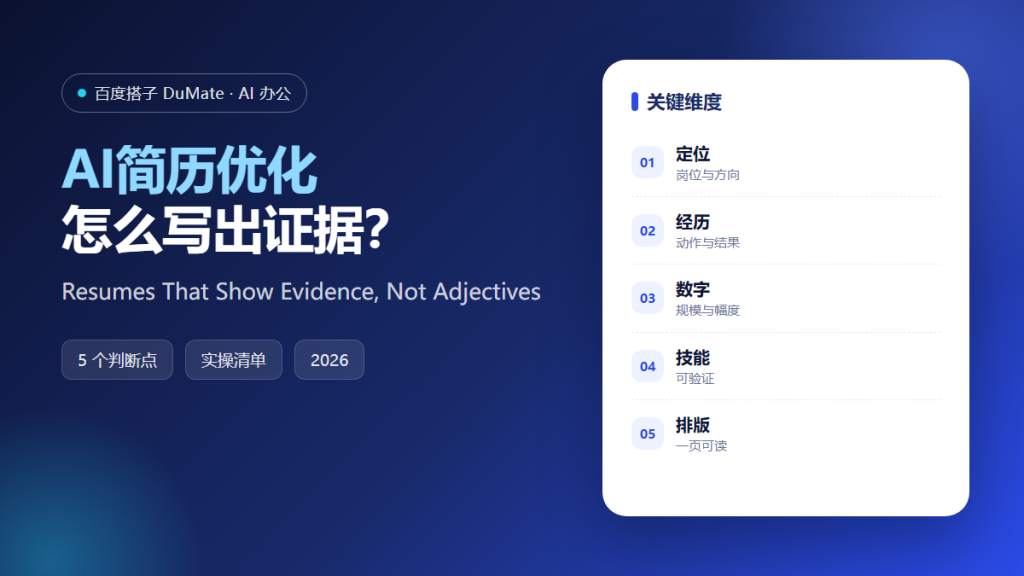
AI简历优化 usually begins with a request to make the wording stronger, and that is the wrong first move. Recruiters scan for evidence: a system, a scale, a result. AI简历优化 helps when it replaces adjectives with facts that a hiring manager can verify in an interview.
This guide describes a five-step method for AI简历优化, the checks that keep a resume honest, and the mistakes that make a polished document read like everyone else’s.
Key Takeaways
- Read the posting before touching the resume.
- Replace adjectives with numbers and systems.
- One bullet, one result.
- Keep the top third specific to the role.
- Verify every claim you cannot defend.
Why AI简历优化 Needs Evidence
Responsible for describes a job description, not a person. A reader wants to know what changed because you were there. AI简历优化 should convert duties into outcomes, with a scale attached: how many, how often, how much, and compared with what.
The second reason is filtering. Many applications are read by software first, and it matches terms from the posting. AI简历优化 can align vocabulary without inventing experience, which is the line that separates help from harm.
The third reason is the interview. Every line is a promise to answer questions for twenty minutes. AI简历优化 that inflates a claim creates a trap that opens in the room, in front of the person who decides.
How AI简历优化 Works in Five Steps
Step 1: Parse the posting
List the five requirements that repeat. Mark which ones you can prove with a project, a number, or a reference, and leave the rest out of the top third. A requirement you cannot support is a question you should prepare for, not a line to borrow. Write the list before you edit a single line. Keep the posting open beside the draft, so every edit answers something the employer asked for. Write the requirement in the employer’s words, then in yours. A requirement you cannot prove may still be worth addressing in the cover note.
Step 2: Rewrite bullets with evidence
Verb, action, scale, result. Cutting invoice errors from six percent to one percent by adding a two-step check is a claim someone can test. AI简历优化 should be given the numbers, not asked to invent them. One bullet should carry one result, because two results in a line usually means neither is measured. If a bullet has no number, write the number down and decide later whether it is impressive enough. Use the unit the business uses, because a percentage of an unknown base means nothing.
Step 3: Remove adjectives
Delete passionate, detail-oriented, and results-driven. They occupy space that a fact could use, and every reader has learned to skip them. Replace each one with the evidence you would offer if asked to prove it in the interview. A short resume with evidence reads as confidence; a long one with adjectives reads as hope. Keep one adjective if it is a job title, and delete the rest. Replace the adjective with the thing you did that made it true.
Step 4: Tailor the top third
The summary and the first two roles carry the decision. AI简历优化 should adjust emphasis and order, not rewrite history or move a job title to a friendlier year. Keep the dates identical across every version you send out, because a recruiter may compare two of them. Move the most relevant role to the top only when the chronology still makes sense. A tailored summary should name the role, not the industry.
Step 5: Check format and facts
One column, standard headings, consistent dates, no text inside images. AI简历优化 can flag a gap; only you can explain it, and a short honest line beats a creative timeline. Open the file on a phone and on a laptop before sending it. Ask someone else to read it aloud, because a typo survives silent reading. Spell the company name exactly as it appears in the posting. Check the file name too, since it is the first line a recruiter sees.
‘ alt=’AI简历优化 checklist: posting requirements, evidence bullets and fact check’ />
A Resume Checklist
- Five requirements from the posting are addressed.
- Every bullet contains a result.
- No adjective stands in for a fact.
- Dates and titles match the record.
- The file opens cleanly as a PDF.
Where AI简历优化 Fails
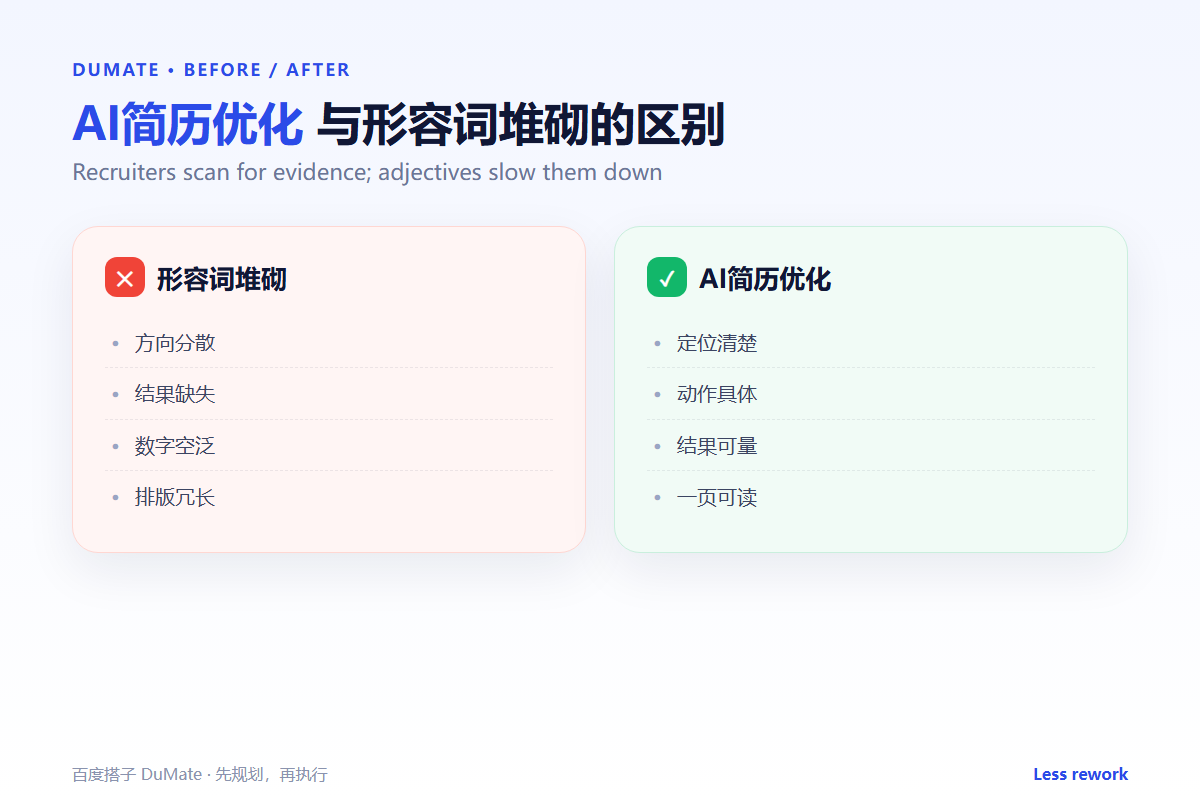
The usual failure is sameness. Generated bullets converge on the same verbs and the same rhythm, so ten resumes read like one. The second failure is a claim that cannot survive a follow-up question, which costs more than the interview it won. AI简历优化 will produce both if it is asked for polish instead of proof.
- Buzzwords copied from the posting.
- Metrics with no baseline.
- Two-column layouts that parse badly.
- Hiding a gap instead of addressing it.
Before and After
Before, an operations analyst listed eleven duties and received no replies. The resume described the role, not the person, and a reader could not tell whether anything had improved.
After, AI简历优化 kept four bullets, each with a number and a method, and moved the relevant project to the top. Two interviews followed in the first week, and both asked about the same project, which was the point.
FAQ
Should I use the same resume everywhere?
Keep one master file and tailor the top third. Rewriting everything for each application is unsustainable, and it usually lowers quality.
Is a two-page resume acceptable?
Yes, if the second page earns its place. A dense single page beats two pages of filler.
Will the tool invent experience?
It can, if asked to make the result stronger. AI简历优化 should be given facts and asked for structure, not for confidence.
延伸阅读
For formal wording, see official writing, and for a full proofread, document proofreading. Small slips are covered in typo check, academic phrasing in paper polish, and final layout in PDF editing. External references: NIST AI Risk Management Framework and ISO/IEC 42001.
评论
还没有评论,来说两句吧。