
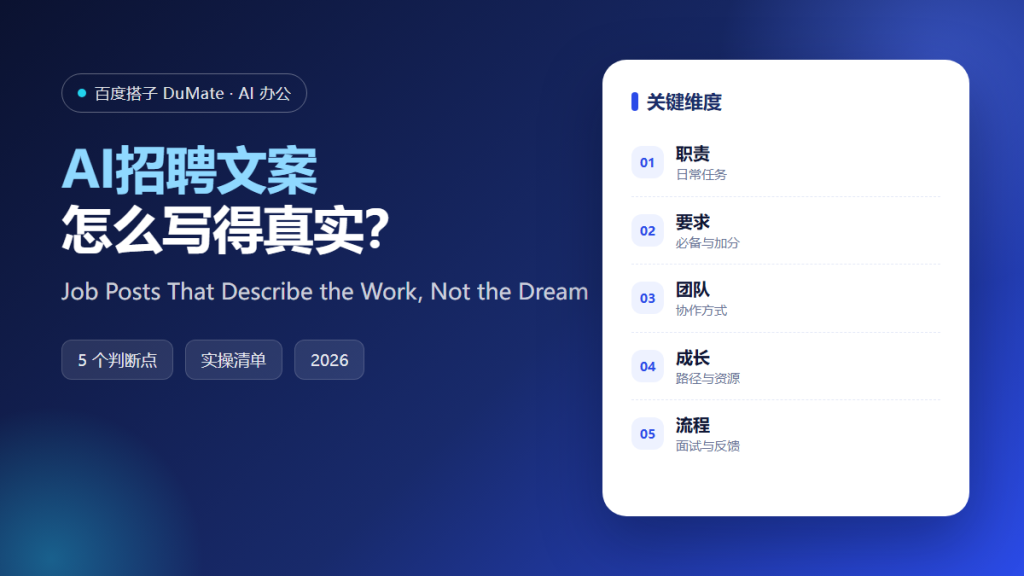
AI招聘文案 starts with a simple discipline: describe the work as it is actually done. A job posting is not a brand manifesto or a list of buzzwords. It is a working document that tells a candidate what the role requires, how success will be measured, and what the first ninety days will feel like.
Most postings fail because they sell a dream and hide the job. This guide shows how AI招聘文案 turns a hiring manager’s notes into a clear posting, a checklist for reviewing the draft, and the mistakes that make a well-written advertisement useless.
Key Takeaways
- Describe tasks, tools, and expected outcomes.
- Separate must-have requirements from nice-to-haves.
- State the salary range and work location.
- Use plain language and short paragraphs.
- Review the AI招聘文案 draft with the hiring manager.
Why AI招聘文案 Needs a Task-Based Draft
Candidates apply to a title and decide based on detail. If the text lists only qualities such as passionate or collaborative, the reader learns nothing about the daily work. AI招聘文案 should begin with the tasks that fill the calendar: the reports, calls, approvals, and handoffs that define the role.
The second problem is screening. A vague posting attracts a wide mix of applicants, and the team invents criteria after the fact. When the requirements are written before the advertisement goes live, every interviewer can use the same standard. AI招聘文案 makes that standard visible to candidates as well as to the team.
A task-based draft also protects the employer. If a new hire is surprised by shift work, travel, or weekend coverage, the misunderstanding starts in the posting. Clear language reduces the chance that a good candidate accepts a job they would hate.
How AI招聘文案 Works in Five Steps
Step 1: Collect the real work
Ask the hiring manager to list what the person will do in a normal week. Include meetings, tools, customers, and decisions. Keep notes messy; the goal is coverage, not polish.
Step 2: Let AI招聘文案 sort the requirements
Divide the list into skills that can be taught and skills that must already exist. Mark each item as required, preferred, or optional. AI招聘文案 can propose the split, but the manager must confirm which gaps are truly disqualifying.
Step 3: Write the outcomes
Describe what success looks like after three months, six months, and one year. Use measurable language: response times, close rates, error rates, or delivery milestones. AI招聘文案 turns these outcomes into short, concrete paragraphs.
Step 4: Add the practical details
AI招聘文案 should state the location, schedule, salary range, contract type, and interview process. Mention any physical or language requirement affecting eligibility. Candidates should not guess these facts from the title.
Step 5: Test the draft
Give the draft to someone outside the team and ask what the job involves. If they cannot explain it in one minute, revise. AI招聘文案 can flag jargon and long sentences, but a human reader is the final test.
‘ alt=’AI招聘文案 checklist: tasks, requirements, outcomes and practical details’ />
A Job Posting Review Checklist
- The first paragraph names the role.
- The AI招聘文案 splits requirements into must-have and optional.
- Salary and location are stated plainly.
- Success measures are specific and realistic.
- The application steps are easy to follow.
Where AI招聘文案 Fails
AI招聘文案 fails when the tool is asked to make an ordinary job sound exciting. Exaggeration attracts candidates who want the story, not the work. It also fails when the posting hides a difficult condition, such as on-call duty, until the interview.
- Copying a competitor’s posting without checking tasks.
- Listing ten required skills for an entry-level role.
- Using vague phrases such as fast-paced environment.
- Publishing without a salary range or location.
Before and After
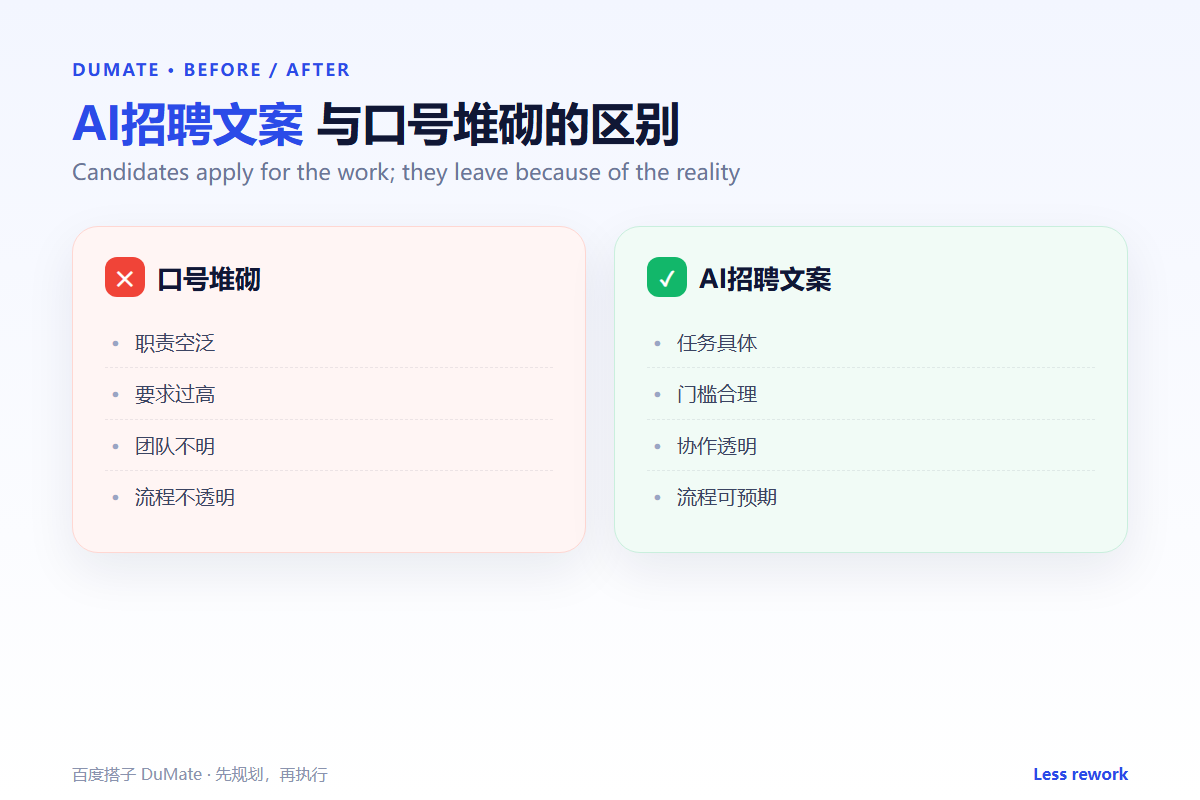
Before, a team reused an old posting that described a perfect candidate and never mentioned the weekly reporting load. Applications were plentiful, but half the shortlist withdrew after learning the schedule. After, AI招聘文案 produced a shorter draft with three core tasks, a clear shift pattern, and a salary band, so interviews started from the same facts.
A good posting does not attract the largest crowd. It attracts the people who understand the job and still want it.
Keep the first month simple. One task, one owner, and one weekly review are enough to prove the workflow before it spreads across the team.
Write down what changed after each run. A short note is easier to trust than a memory, and it makes the next improvement obvious.
Review the output before it leaves your desk. A two-minute check catches most of the errors that would otherwise come back as questions.
Keep one example of a good result. New team members learn faster from a concrete reference than from a long explanation.
The first version does not need to be perfect. It needs to be complete enough to review, so the team can see the gaps and fix them in the next round.
Write the review notes in the same place as the work. Notes stored somewhere else are rarely read when the next decision arrives.
FAQ
How long should a posting be?
Long enough to cover tasks, requirements, and practical details, and short enough to read in three minutes. Most roles need four to six sections.
Should we include a salary range?
Yes, where local rules allow it. A range saves time for both sides and signals that the employer is serious about a fair conversation.
Can a template replace the hiring manager?
No. A template provides structure, but only the manager knows which tasks matter and which conditions are non-negotiable.
延伸阅读
Improve the wording with official writing and document proofreading. For outreach messages, see ad copy. Role titles are covered in brand naming, and structured onboarding appears in lesson plan. External references: NIST AI Risk Management Framework and ISO/IEC 42001.
评论
还没有评论,来说两句吧。