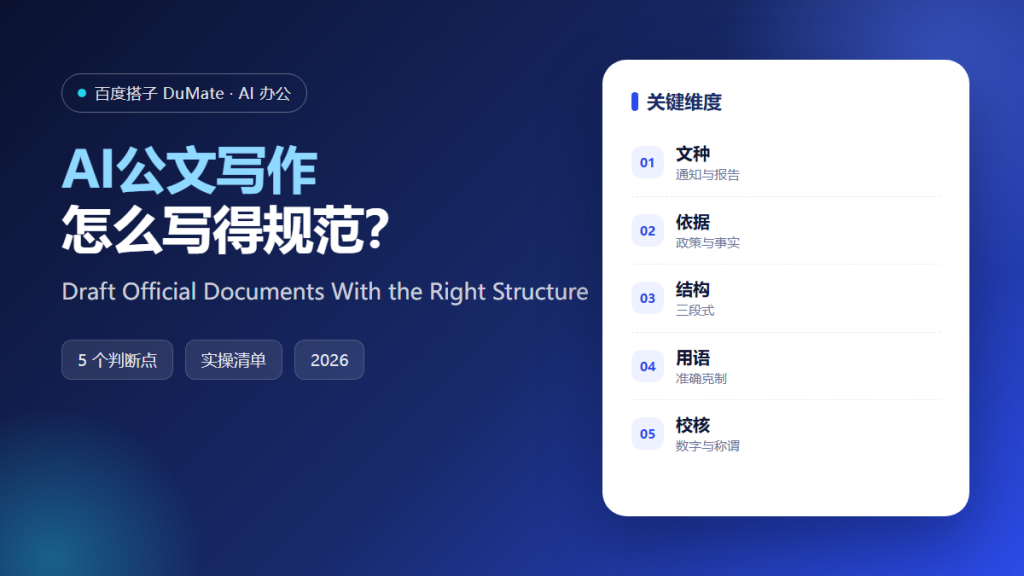
AI公文写作 is not about producing more text faster. It is about producing the right document, in the right form, with facts that can be checked. A notice, a report, and a request for instructions follow different rules, and a single wrong title can send the whole document back. AI公文写作 helps most when the writer already knows what the document must accomplish.
This guide covers a five-step method for drafting official documents, the review items that cause most returns, and the habits that keep language consistent across a team.
Key Takeaways
- Choose the document type before writing a sentence.
- Collect the policy basis and the facts first.
- Use a three-part structure: background, matter, requirement.
- Keep titles, names, and numbers consistent.
- Proofread the form as carefully as the content.
Why AI公文写作 Needs a Fixed Starting Point
Official writing fails in predictable ways. The document type is wrong, the basis is missing, the addressee is imprecise, or the numbers do not match the attachment. AI公文写作 can generate fluent paragraphs, but fluency is not the standard. The standard is that a reader can act on the document without asking a question.
A fixed starting point solves most of this. When the writer defines the document type and the required action first, the rest of the text has a job. AI公文写作 then becomes a drafting aid rather than a source of plausible filler.
Consistency is the second reason. A team that writes the same kind of notice every week should not reinvent the opening, the closing, or the numbering. AI公文写作 can reuse a checked pattern, which reduces both drafting time and review comments.
How AI公文写作 Works in Five Steps
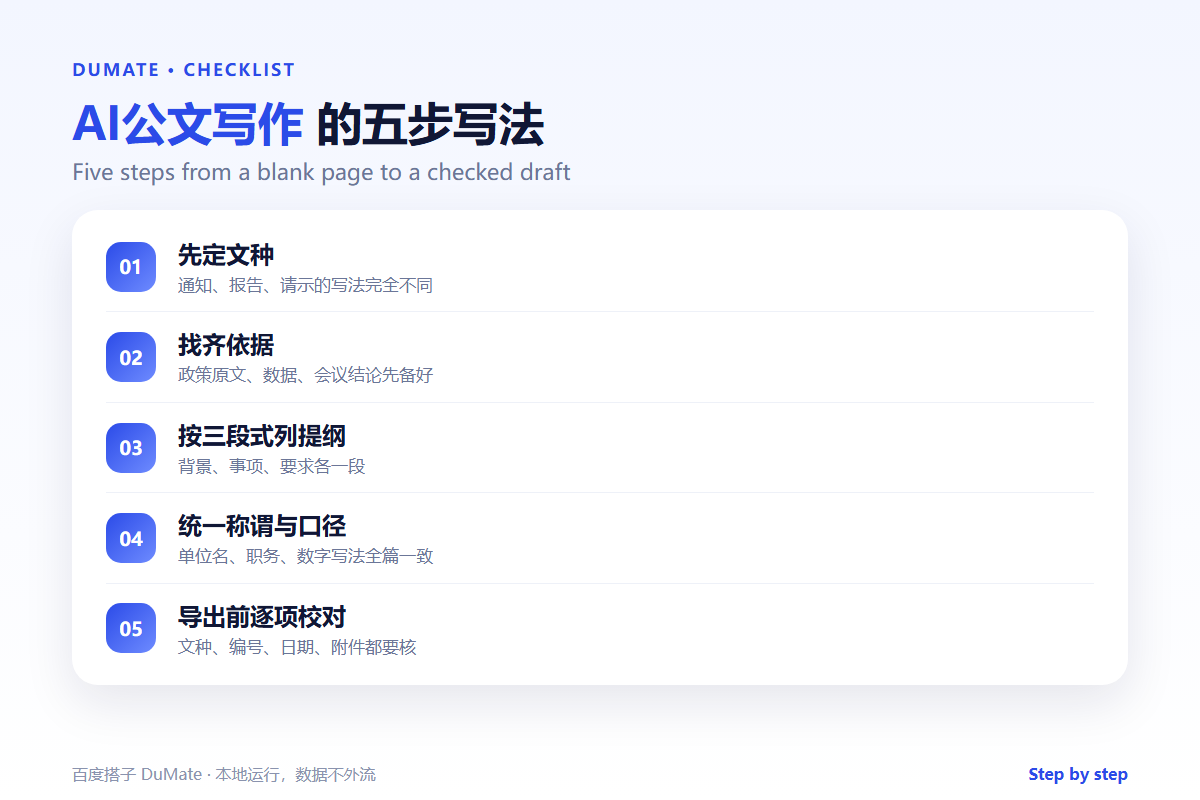
Step 1: Choose the document type
Decide whether this is a notice, a report, a request, or a reply. Each type has a different reader expectation. AI公文写作 should be instructed with the type explicitly, because the model will otherwise default to a generic memo.
Step 2: Collect the basis and the facts
Gather the policy reference, the meeting decision, the data, and the deadline. Put them in a short list before drafting. AI公文写作 can organize this material, but it cannot verify a number that was never supplied.
Step 3: Draft with a three-part structure
Use background, matter, and requirement. The background explains why the document exists. The matter states what happened or what is proposed. The requirement says who must do what by when. AI公文写作 handles this structure well when the three parts are named in the prompt.
Step 4: Unify titles, names, and numbers
Check the organization names, the job titles, the dates, and the amount format. Use one style throughout. AI公文写作 tends to mirror the input, so inconsistent inputs produce inconsistent outputs.
Step 5: Proofread the form
Check the document number, the addressee, the attachment list, the page numbers, and the signature block. These details decide whether the document is accepted. AI公文写作 can produce a checklist, but a person must confirm each item.
A One-Page AI公文写作 Checklist
- The document type matches the purpose.
- The policy and data sources are listed.
- The required action has an owner and a date.
- Names, titles, and amounts are consistent.
- The form and attachments are complete.
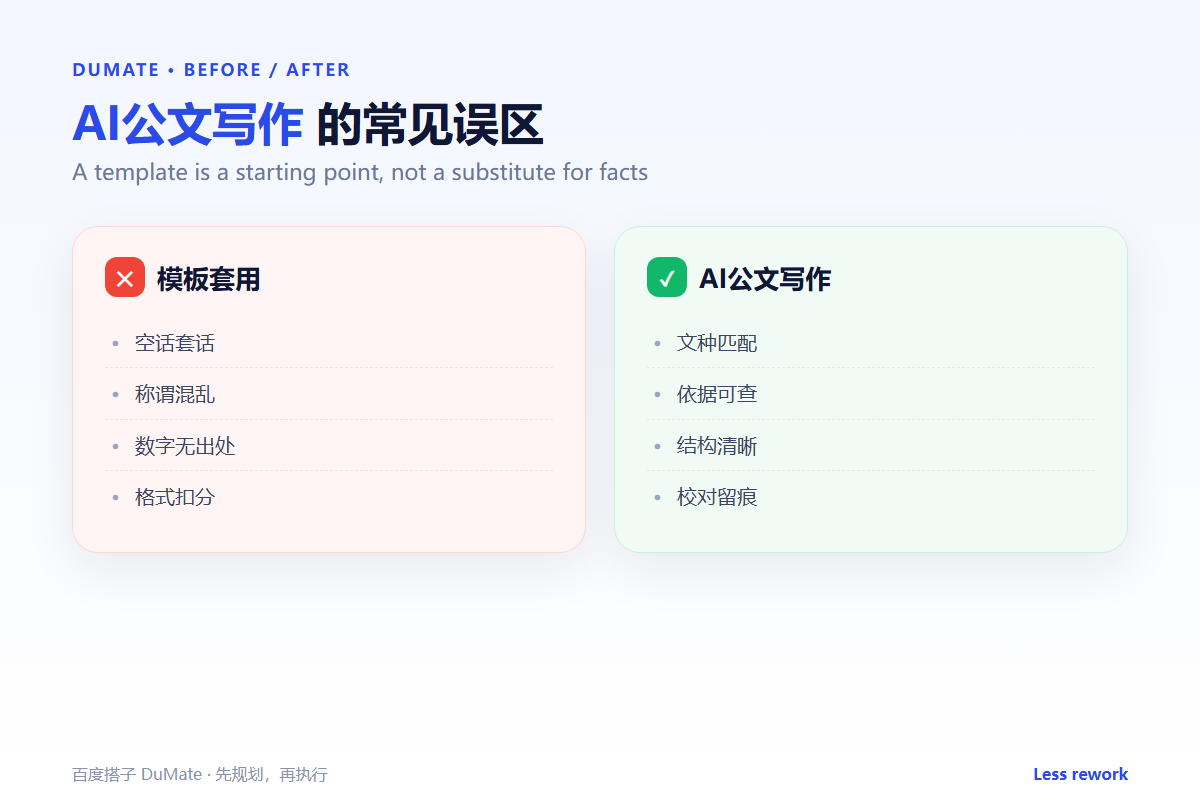
Where AI公文写作 Fails
It fails when the prompt contains no facts. The output will sound official and say nothing. AI公文写作 also fails when the writer asks for a shorter version but keeps every requirement, which produces dense paragraphs that readers skip.
- Template language without a real decision.
- Addressee and scope left vague.
- Numbers copied from an old document.
- Attachments referenced but not attached.
Before and After
Before, a team spent a morning drafting a notice, then spent another morning answering questions about who should act and by when. After, AI公文写作 produced a structured draft in twenty minutes, and the review focused on two unclear requirements instead of the wording.
The saving is not only time. A document with a clear action list reduces follow-up messages, which is where most of the hidden cost sits.
A Four-Week Rollout
The first week with AI公文写作 should be a small pilot, not a team-wide launch. Choose one recurring task with a clear output and run it end to end. Keep the sample small enough to check by hand. The point is to see where AI公文写作 saves time and where it creates review work.
During the pilot, keep a short log of inputs, outputs, and corrections. Record the time spent before and after. AI公文写作 feels faster even when it is not, so the log matters. At the end of the week, review the log with one colleague and decide whether to continue, change the input, or stop.
In week two, write a one-page standard for input and output. Include what must be checked and who approves the result. the workflow works better when the standard is visible to everyone. In week three, add permissions and a review step. In week four, compare the results and write a short guide. That guide is what makes the workflow survive after the first month.
Keep the pilot narrow. A broad rollout hides which step failed, and a narrow one shows exactly where the workflow needs help. Expand only after the narrow case is stable.
FAQ
Can AI公文写作 replace a trained writer?
No. It speeds up drafting and checking. Judgment about tone, authority, and political context stays with the writer.
How long should an official notice be?
Long enough to be unambiguous and short enough to be read once. One page is a good target for routine notices.
What should be checked last?
The names, the numbers, and the attachments. Errors there are the most visible and the most damaging.
延伸阅读
For general drafting technique, see AI写作助手. For office workflows, read AI办公助手. Meeting decisions often become official documents, so see AI会议纪要. Keep approved templates in an AI知识库. Access rules are covered in AI权限管理. External references: NIST AI Risk Management Framework and ISO/IEC 42001.
评论
还没有评论,来说两句吧。