
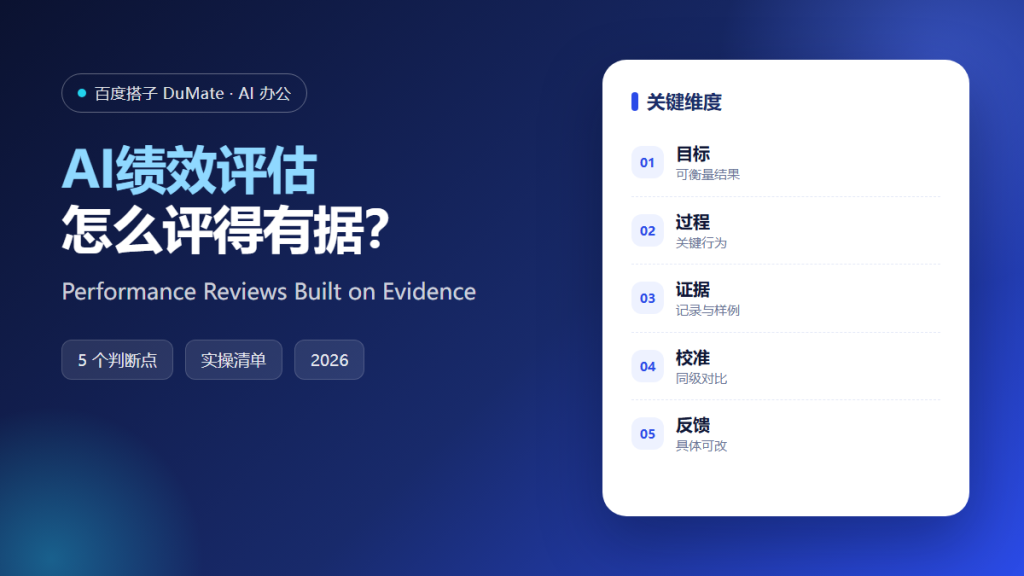
AI绩效评估 should make a review feel less like a surprise and more like a summary. The purpose is not to rank people by memory or likeability, but to compare agreed expectations with documented results. When evidence is thin, the conversation drifts toward personality, and the employee has no way to respond.
This article describes a five-step review cycle, the evidence that is worth collecting, and the failure modes that turn a fair process into an annual argument.
Key Takeaways
- Agree on expectations at the start of the period.
- Collect dated examples throughout the year.
- Separate results from behavior.
- Use the same rubric across similar roles.
- Let employees read the evidence before the meeting.
Why AI绩效评估 Needs Recorded Evidence
Memory favors the recent and the dramatic. A project finished in the last month looms larger than steady work delivered in spring. AI绩效评估 cannot fix a manager’s memory, but it can enforce a structure that asks for dates, outputs, and witnesses before a rating is written.
Evidence also makes calibration possible. When managers meet to compare ratings, phrases such as strong performer are useless. A record showing that one analyst closed forty tickets with two errors and another closed thirty with none gives the group something to discuss. AI绩效评估 can summarize these records without deciding who deserves the higher rating.
The third reason is legal and ethical. An employee may challenge a rating, and the employer must be able to show the basis. Notes written months earlier are more credible than a narrative composed the night before the review. AI绩效评估 should preserve the source, the date, and the person who observed the event.
How AI绩效评估 Works in Five Steps
Step 1: Set the expectations
AI绩效评估 begins with three to five outcomes for the period, each with a measure and a deadline. Add the behaviors that matter for the role, such as handover quality or customer follow-up. Both manager and employee should sign the same document.
Step 2: Collect examples
Ask for short notes after each meaningful event: what happened, what the employee did, and what changed. Store them in one place. AI绩效评估 can prompt the manager to record an example while the details are still fresh.
Step 3: Sort the evidence
Group notes by outcome and by behavior. Mark which items are direct observations and which are second-hand. AI绩效评估 can identify gaps, such as an outcome with no supporting example, and request more information.
Step 4: Draft the summary
Write one paragraph per outcome, then one paragraph on behavior. Use plain descriptions and avoid adjectives that cannot be verified. AI绩效评估 can turn the notes into a draft, but the manager must remove anything that sounds like a diagnosis of character.
Step 5: Discuss and adjust
Send the evidence and draft to the employee at least two days before the meeting. Invite corrections and missing context. AI绩效评估 can log the changes, which protects both sides if the rating is reviewed later.
‘ alt=’AI绩效评估 checklist: expectations, evidence, sorting, summary and discussion’ />
A Review Evidence Checklist
- Each outcome has at least two examples.
- Examples include dates and sources.
- Behavior is described separately from results.
- Ratings use the published rubric.
- The employee has seen the evidence.
Where AI绩效评估 Fails
AI绩效评估 fails when the tool is asked to produce a persuasive rating instead of a fair summary. Confident prose can make weak evidence look stronger than it is. It also fails when managers copy the same phrases across a whole team.
- Evidence collected only in the final week.
- Ratings based on one visible project.
- No distinction between effort and outcome.
- Feedback that the employee hears for the first time in the meeting.
Before and After
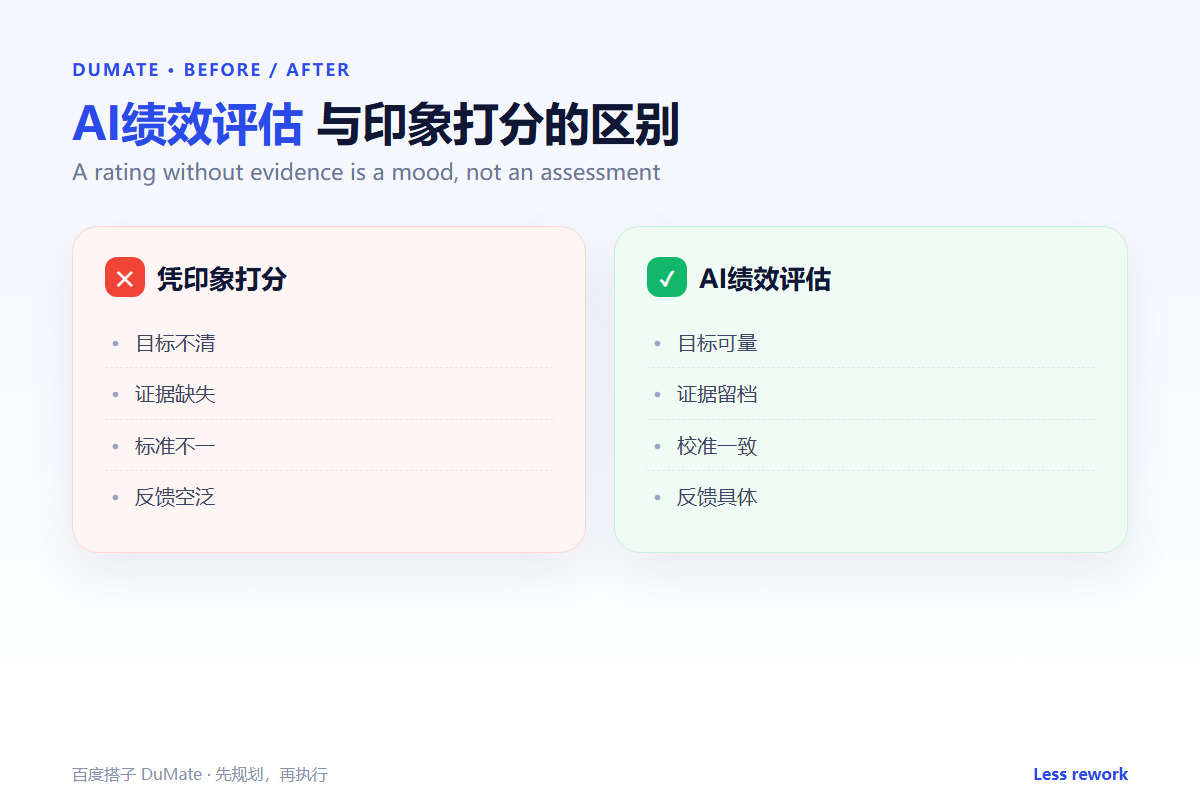
Before, a manager wrote reviews from memory and gave almost everyone a middle rating to avoid conflict. High performers could not tell what had earned recognition, and struggling employees received vague encouragement. After, AI绩效评估 organized dated examples under each agreed outcome, and the review meeting focused on two specific gaps and one clear strength.
A review is not a verdict on a person. It is a documented conversation about the work, and the best reviews leave both people with the same understanding of what happens next.
Keep the first month simple. One task, one owner, and one weekly review are enough to prove the workflow before it spreads across the team.
Write down what changed after each run. A short note is easier to trust than a memory, and it makes the next improvement obvious.
Review the output before it leaves your desk. A two-minute check catches most of the errors that would otherwise come back as questions.
Keep one example of a good result. New team members learn faster from a concrete reference than from a long explanation.
The first version does not need to be perfect. It needs to be complete enough to review, so the team can see the gaps and fix them in the next round.
Write the review notes in the same place as the work. Notes stored somewhere else are rarely read when the next decision arrives.
FAQ
How many examples are enough?
Two or three per outcome are usually sufficient. More examples help when the rating is contested or the role has high variability.
Should peer feedback be included?
Yes, when it is specific and attributed. Anonymous comments are hard to verify and easy to misuse.
Can AI绩效评估 decide the rating?
No. It can organize evidence and check consistency, but the rating remains a management decision with accountability.
延伸阅读
Write the summary with official writing and edit it with document proofreading. For feedback data, see sentiment monitoring and data labeling. Team grouping is covered in user segmentation. External references: NIST AI Risk Management Framework and ISO/IEC 42001.
评论
还没有评论,来说两句吧。