

AI仓储管理 is mostly a fight against small errors that compound. A pallet put in the wrong bay, a receipt accepted without a count, a reorder point copied from last year: each mistake is cheap alone and expensive in a stack. AI仓储管理 earns its cost by making location, count, and reorder the three numbers everyone can see.
This guide describes a five-step routine for AI仓储管理, the checks that keep inventory records honest, and the failures that turn a clean system into a set of conflicting spreadsheets.
Key Takeaways
- Every item has one location.
- Receipts are counted before they are booked.
- Cycle counts beat annual counts.
- Reorder points come from demand, not habit.
- Slow movers are reviewed on a schedule.
Why AI仓储管理 Needs Location Discipline
A warehouse without location discipline runs on memory. The person who knows where the seasonal stock lives becomes a bottleneck, and every absence costs an hour. AI仓储管理 should make the location a field, not a habit, so a new picker can find an item on the first attempt.
The second reason is counting. A record is only as good as its last verified count, and annual counts are too late to prevent a stockout. AI仓储管理 supports small, frequent counts that catch drift while it is still cheap to correct.
The third reason is reorder logic. Orders arrive with lead times that change, and a fixed minimum becomes wrong within a quarter. AI仓储管理 recalculates the trigger from recent demand and current lead time, then shows the assumption behind the number.
How AI仓储管理 Works in Five Steps
Step 1: Map the physical space
Name every bay, shelf, and bin, and print the label. Walk the floor with the map and correct it. A location that exists only in a drawing will be ignored within a week. Put the same code on the shelf edge and in the system, and photograph the aisle so a new starter can match the two. Photograph the aisle from both ends, because a label that cannot be seen from the door will be skipped. A map drawn at a desk will be wrong in at least three places.
Step 2: Receive against the order
Count, photograph damage, and book the difference the same day. AI仓储管理 can compare the packing list with the purchase order and open a discrepancy note before the truck leaves the yard. A receipt signed without a count is a promise that the next cycle count will have to break. A discrepancy note that nobody reads is a note, not a control. Photograph the pallet before it is broken down, so a damage claim has evidence.
Step 3: Count on a cycle
Count a rotating sample every day. Investigate variance above a threshold instead of recounting everything. The goal is a trend, not a perfect number once a year. Write down who counted and when, because a variance without an author cannot be corrected. Rotate the sample by location rather than by product, or the same shelf gets counted every week. Small samples taken often beat one large count taken late.
Step 4: Set triggers from demand
Use recent daily demand and the supplier’s actual lead time. AI仓储管理 should add a buffer for the variance in delivery, not for the mood of the buyer. Review the trigger when a lead time moves by a week, and record the calculation so the number can be defended. Set the buffer with the supplier in the room, so the number is a shared commitment rather than a guess.
Step 5: Review slow movers
List items with no movement in ninety days. Decide to discount, return, or keep with a reason. AI仓储管理 can produce the list; the decision needs a merchant. A slow mover that nobody will defend should leave the building, because shelf space is rent. Write the reason on the list, so the next review does not relitigate it. Return the cleared space to a fast mover and measure the change in pick time.
‘ alt=’AI仓储管理 checklist: location label, count cycle and reorder trigger’ />
A Warehouse Checklist
- Every bin has a printed label.
- Receipts are counted the day they arrive.
- Cycle counts run on a fixed rotation.
- Reorder points cite demand and lead time.
- Slow movers are reviewed quarterly.
Where AI仓储管理 Fails
Records fail when two systems disagree and nobody owns the reconciliation. They also fail when the model is fed clean data from a warehouse that never counted, which produces confident forecasts on top of a wrong base.
- Locations entered once and never audited.
- Receipts booked from paperwork only.
- Reorder points set by seniority rather than data.
- No owner for the gap between physical and recorded stock.
Before and After
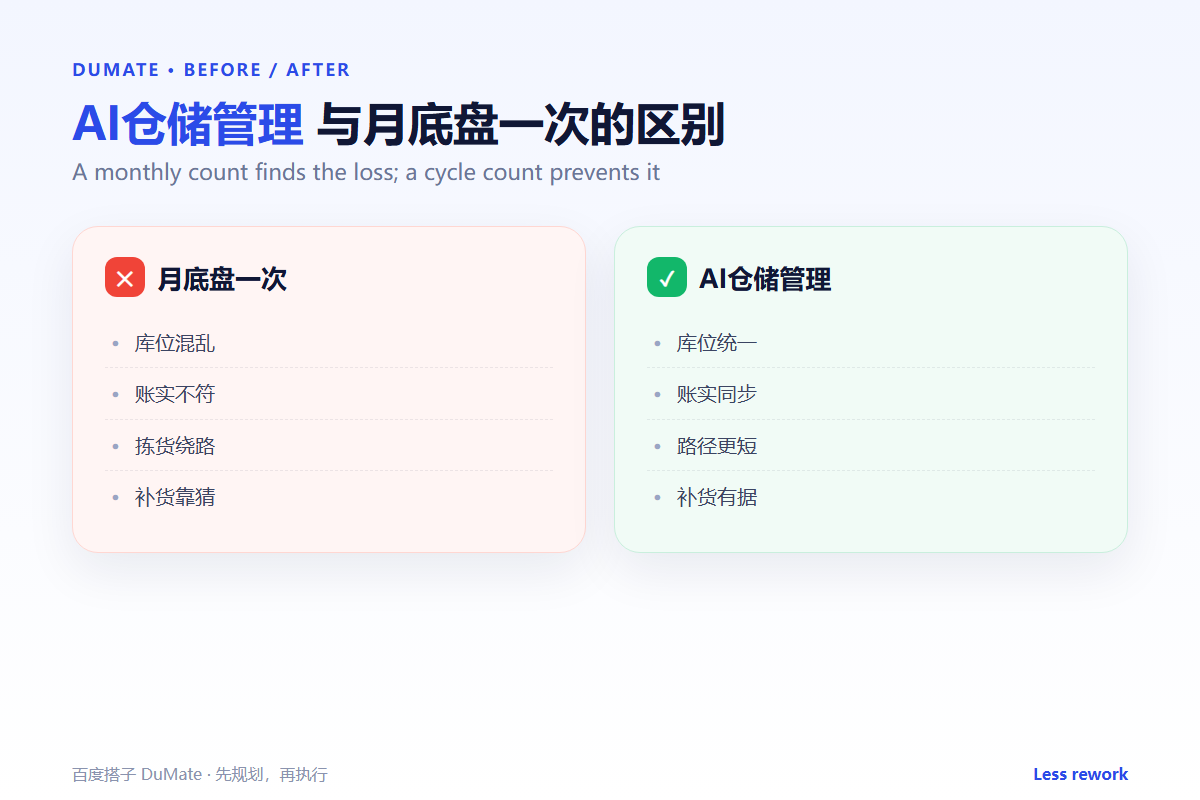
Before, a parts distributor kept stock in three rooms and a spreadsheet, and a picker spent twenty minutes on a part that sat in the wrong bay. Overnight orders were promised from stock that existed only on paper.
After, AI仓储管理 assigned a location to every item, counted a rotating sample each morning, and recalculated triggers from the last ninety days. The first month found four hundred units that had been invisible; the second month cut urgent purchases by a third.
FAQ
Do we need barcode scanners?
They help, but labels and a routine matter more. A tidy paper process beats a scanner used inconsistently.
How often should a full count run?
Once a year at most, for financial reporting. Daily cycle counts do the operational work.
Can the layout be planned automatically?
AI仓储管理 can suggest slotting from pick frequency. The final layout still depends on weight, safety, and the shape of the building.
延伸阅读
Demand planning is covered in inventory forecast, and buying terms in procurement comparison. Supplier quality is in supplier evaluation, while seasonal volume appears in sales forecast. For clean item records, see data labeling. External references: NIST AI Risk Management Framework and ISO/IEC 42001.
评论
还没有评论,来说两句吧。