
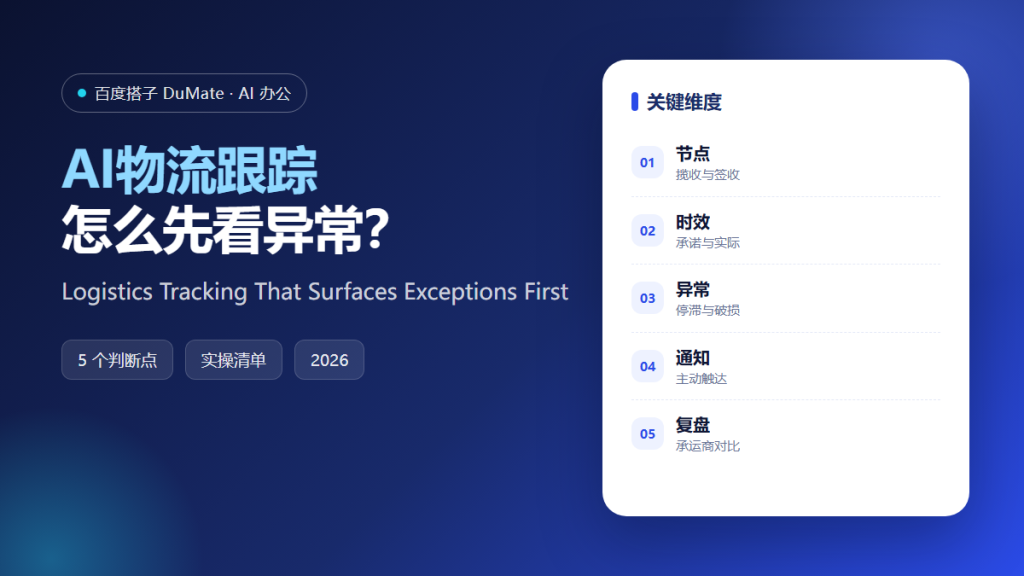
AI物流跟踪 earns its place when a parcel goes wrong, not when it goes right. A shipment that moves from pick-up to delivery on schedule needs no commentary. AI物流跟踪 matters in the gap between the last scan and the promised date, where a customer is deciding whether to write an angry message.
This guide explains how AI物流跟踪 should be built around exceptions, the five-step routine that keeps alerts useful, and the reasons most tracking dashboards are ignored by the people who could act on them.
Key Takeaways
- Track milestones, not every scan.
- Define exceptions before choosing a tool.
- Notify the customer before they ask.
- Give every open case an owner and a deadline.
- Score carriers on the rules you publish.
Why AI物流跟踪 Needs Exception Rules
A tracking feed produces dozens of events per parcel, most of them normal. A dashboard that shows all of them trains the team to ignore the screen. AI物流跟踪 should convert the feed into a handful of states and raise a case only when a parcel leaves the expected path.
The second reason is the customer’s clock. People forgive a delay they were told about and punish a silence. AI物流跟踪 that notices a missed milestone on the day it happens gives support time to send a useful message instead of an apology.
The third reason is carrier management. Without a shared definition of a late delivery, every review meeting becomes an argument about anecdotes. AI物流跟踪 produces the same measure for every carrier, which makes a quarterly conversation about rates possible.
How AI物流跟踪 Works in Five Steps
Step 1: Normalize the feed
Carriers describe the same event in different words, and some send the same event twice. Map them into one vocabulary: collected, in transit, customs, out for delivery, delivered, exception. The map is the foundation for everything that follows, so write it down and keep the carrier’s original code beside your own. A carrier that renames a service every quarter is the usual reason a report stops matching the warehouse’s view. Two people should agree on the map before it goes live, and the map should carry a date, because a carrier’s vocabulary changes with every contract renewal.
Step 2: Set the milestones
Choose four or five dates that matter to the customer, then compare each one against the promise made at checkout. Internal codes stay in the log, where support can find them. A milestone nobody promised is a milestone nobody needs to see, and every extra date dilutes the one that should trigger a case. That comparison is the only thing a customer actually experiences.
Step 3: Write exception rules
A missed milestone, a scan gap longer than forty-eight hours, two failed delivery attempts. These are the rules worth writing, and each one should carry a name. AI物流跟踪 should open a case with the rule name attached, so the reason is never a guess and two shifts handle the parcel the same way. Start with three rules and add a fourth only after the first three are quiet. A rule that fires every day is a rule that needs tightening, so review the thresholds monthly and retire the ones nobody acts on.
Step 4: Notify before the question
Send one message with the new date and one action the customer can take. Silence followed by an apology is the pattern people remember when they rate the order. Keep the message short, put the new date first, and avoid blaming a carrier by name in customer copy. A link to a reschedule page saves a reply, and AI物流跟踪 can draft the message, but a person approves the tone for high-value orders.
Step 5: Review carriers monthly
Count exceptions per thousand parcels, not total delays, because volume hides performance. AI物流跟踪 can rank carriers, but the contract conversation still needs a person with authority to change volume. Bring two examples to that meeting and the discussion moves from opinion to evidence. Review the same measure for six months before changing a contract.
‘ alt=’AI物流跟踪 checklist: milestones, exception rules and carrier review’ />
A Tracking Checklist
- Carrier events map to one vocabulary.
- Each parcel carries a promised date.
- Exception rules are written and named.
- Every open case has an owner.
- Carrier scores use the same rules.
Where AI物流跟踪 Fails
The common failure is volume. Every scan becomes an alert, the team mutes the channel, and the one parcel that mattered is lost in the noise. A second failure is a feed that stops updating without anyone noticing, which produces confident silence and a surprise call from the customer. AI物流跟踪 is not the problem in either case; the process around it is.
- Alerts without an action attached.
- Rules that ignore weekends and public holidays.
- No record of which message the customer received.
- Carrier scores calculated from incomplete data.
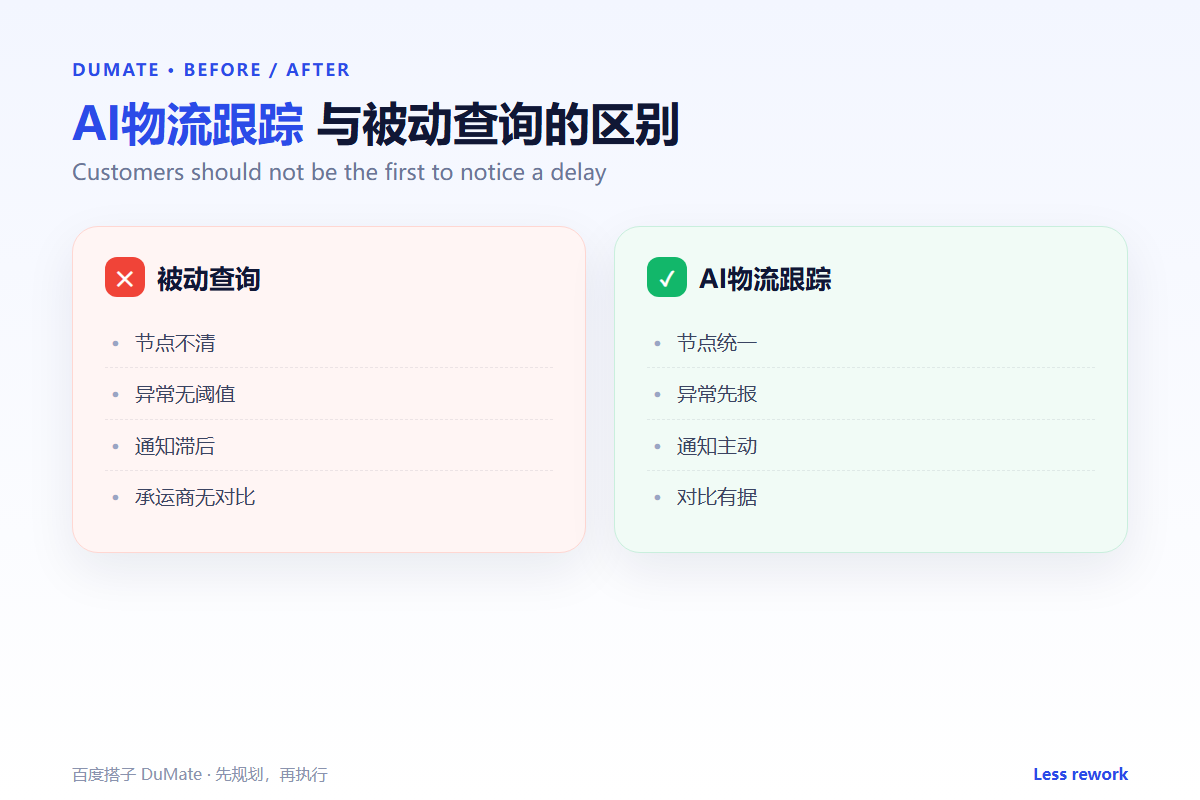
Before and After
Before, a furniture seller learned about a delayed container when the customer called. Support had no date to offer and promised a call back that never happened.
After, AI物流跟踪 raised a case at the missed port milestone, sent a revised date with a delivery window, and flagged the carrier’s second failure that month. Complaints about delivery fell, and the carrier agreed to a revised schedule.
FAQ
How many alerts should a customer receive?
Two or three per order. Confirmation, an exception notice if one occurs, and delivery. More messages train people to ignore them.
Should tracking be shown on the website?
Yes, but show the promise and the next milestone, not every internal code. The internal detail belongs to the support view.
Can delays be predicted?
Sometimes, from historical patterns on the same lane. Treat a prediction as a reason to check, not as a fact to publish.
延伸阅读
For stock implications, read inventory forecast. Carrier quality is covered in supplier evaluation, and contract terms in procurement comparison. For buyer history, see customer profile, and for early signs of frustration, sentiment monitoring. External references: NIST AI Risk Management Framework and ISO/IEC 42001.
评论
还没有评论,来说两句吧。