
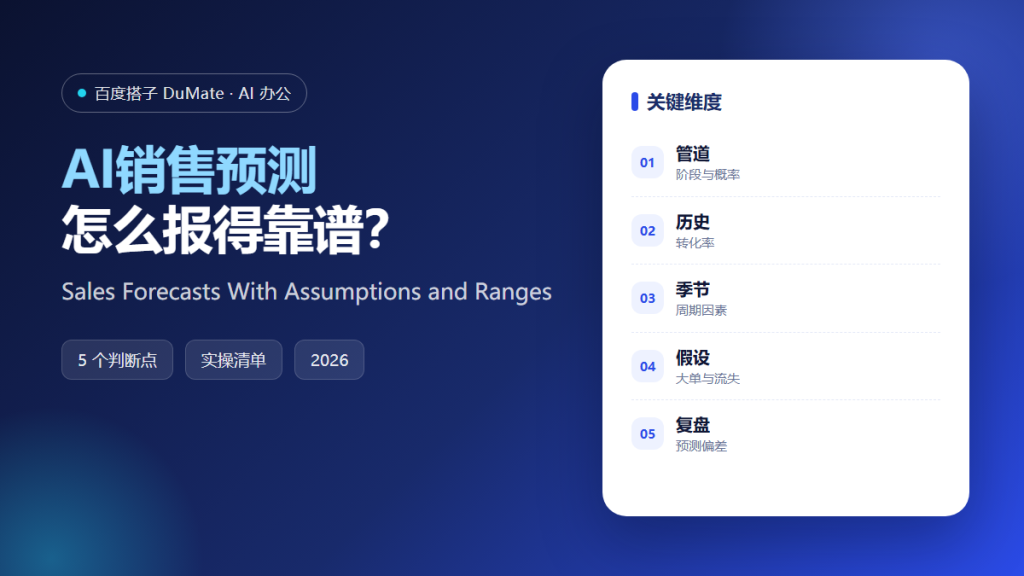
AI销售预测 is a communication tool as much as a calculation. Leadership needs a number it can plan around, and sales needs a number it can influence. A single figure hides both the risk and the assumptions. A range with named drivers is more useful and more honest.
This guide covers a five-step forecasting method, the pipeline hygiene that makes it possible, and the monthly review that improves the next forecast.
Key Takeaways
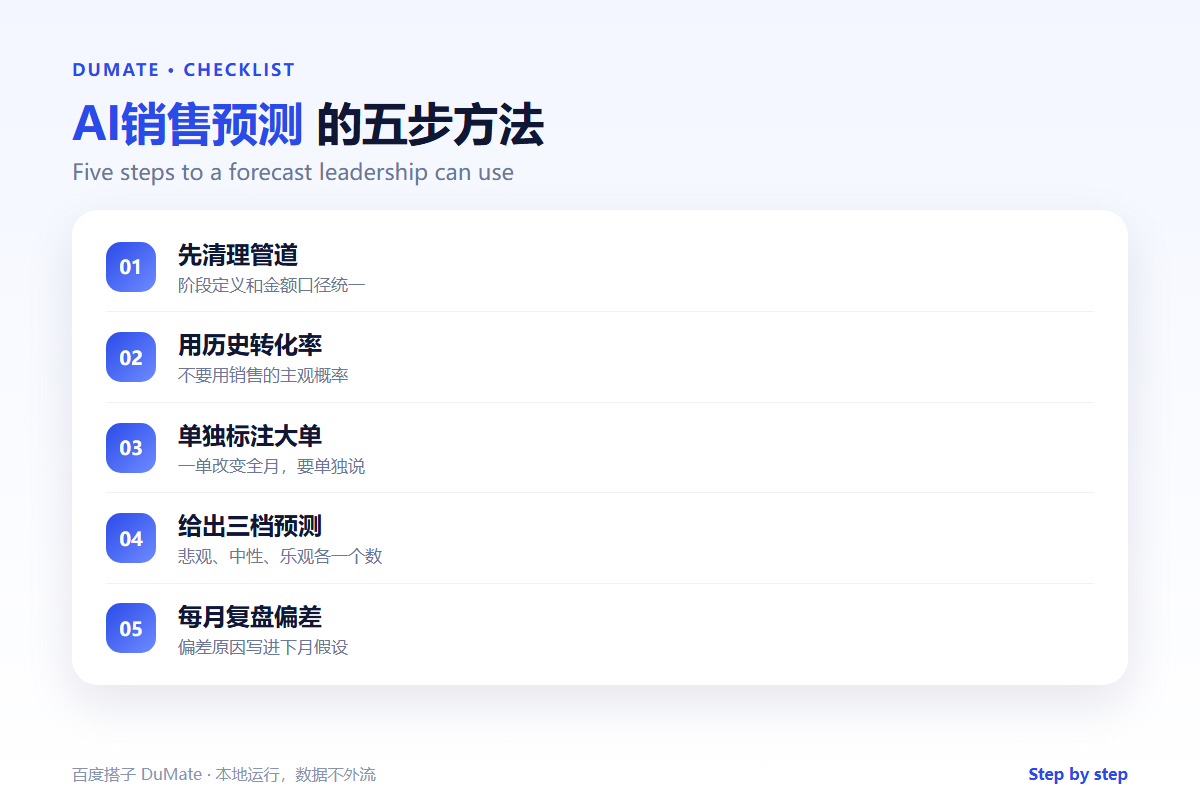
- Clean the pipeline before forecasting.
- Use historical conversion by stage.
- Separate large deals from the baseline.
- Give pessimistic, base, and optimistic cases.
- Review the error every month.
Why AI销售预测 Needs Pipeline Hygiene
Most forecast errors start in the pipeline. Deals sit in the wrong stage, amounts are inflated, and close dates are optimistic. AI销售预测 can apply conversion rates, but it cannot repair data that the team does not trust.
The second reason is concentration. One large deal can move the quarter by double digits. Treating it like every other opportunity hides the real risk.
How AI销售预测 Works in Five Steps
Step 1: Clean the pipeline
Define each stage, remove stale opportunities, and confirm the amount and close date. AI销售预测 should use the cleaned pipeline, not the raw CRM export.
Step 2: Apply historical conversion
Calculate win rates by stage and segment from the last four quarters. Use those rates instead of rep confidence. AI销售预测 can show the range implied by different periods.
Step 3: Isolate large deals
List deals above a threshold separately and assess each one. Add them back only with a probability. AI销售预测 should show the forecast with and without them.
Step 4: Produce three cases
Build pessimistic, base, and optimistic scenarios with explicit assumptions. State what would have to happen for each. AI销售预测 can generate the cases; the sales leader owns the assumptions.
Step 5: Review the error
Compare forecast with actual and classify the misses: timing, amount, or lost deal. AI销售预测 improves when the causes are recorded, not when the number is defended.
A Forecast Review Checklist
- Stage definitions are current.
- Conversion rates use four quarters.
- Large deals are listed separately.
- Each case has written assumptions.
- Miss causes are categorized.
Where AI销售预测 Fails
It fails when reps are rewarded for optimistic pipeline, because the data becomes a negotiation. It also fails when seasonality is ignored, which makes every quarter look like a surprise.
- Inflated deal amounts.
- Close dates that never move.
- Conversion rates from a single good quarter.
- No link to capacity or supply.
Before and After
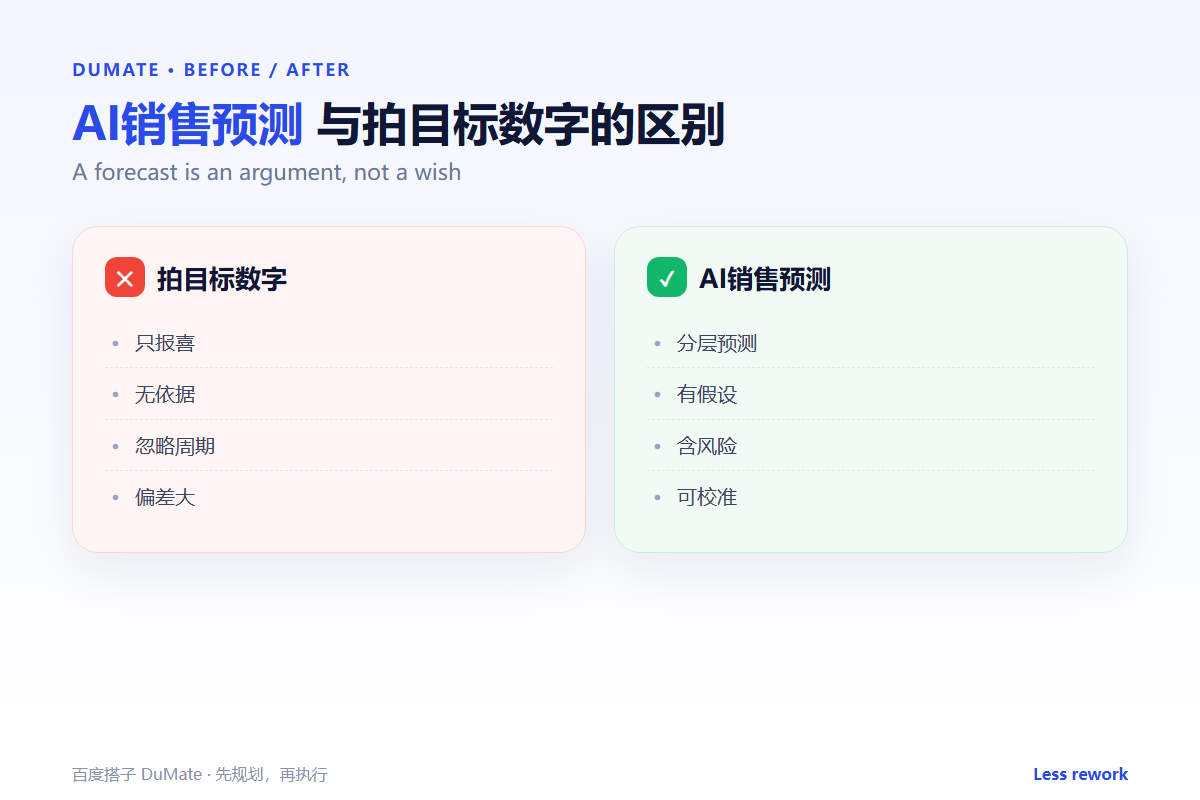
Before, the forecast was a single number that changed every week and satisfied nobody. After, AI销售预测 produced three cases with named drivers, and the weekly meeting discussed the two assumptions that had changed.
A forecast is a plan for decisions, not a test of optimism.
Used consistently, AI销售预测 becomes part of the normal review routine rather than a separate project.
A final check with AI销售预测 takes a minute and catches the errors that are easiest to miss.
The same AI销售预测 routine works for small tasks and large ones, which is why teams keep using it.
Measuring Whether It Works
Measure AI销售预测 with three numbers: time spent, rework required, and output accepted without changes. Track them for four weeks before drawing a conclusion. Set a baseline from the manual process, because without a baseline any result looks like progress.
Time alone is misleading. A task that finishes faster but needs a full rewrite is not an improvement. Pair time with rework, and pair both with the quality of the final output. AI销售预测 should be compared with how the work was done before, not with an ideal.
Review the numbers monthly with the people doing the work. They know why a week was slow or why rework increased. AI销售预测 improves when the review includes the operators, not only the managers. Keep the dashboard small: three numbers and one note are enough.
Also record the exceptions. A week with an unusual campaign or a system outage is not a fair test. Note the context next to the numbers so a later reader does not compare incomparable weeks. When the numbers are stable, expand the scope; when they move the wrong way, fix the input before adding more use cases. The goal is not to prove that AI销售预测 works, but to know when it works and when it does not.
Keep the first month simple. One task, one owner, and one weekly review are enough to prove the workflow before it spreads across the team.
Write down what changed after each run. A short note is easier to trust than a memory, and it makes the next improvement obvious.
Review the output before it leaves your desk. A two-minute check catches most of the errors that would otherwise come back as questions.
Keep one example of a good result. New team members learn faster from a concrete reference than from a long explanation.
The first version does not need to be perfect. It needs to be complete enough to review, so the team can see the gaps and fix them in the next round.
FAQ
Should the forecast be conservative?
It should be honest. A conservative forecast that ignores a real opportunity is as misleading as an optimistic one.
How often should it be updated?
Weekly for the current quarter, monthly for the year.
What is the biggest source of error?
Close-date slippage. Track it separately from lost deals.
延伸阅读
For analysis, see AI数据分析工具 and AI报告生成. Clean pipeline data with AI数据清洗. Prepare tables with AI表格处理. Batch updates are covered in AI批量处理. External references: NIST AI Risk Management Framework and ISO/IEC 42001.
评论
还没有评论,来说两句吧。以下为本文的引用通告: