

AI流程图 is a thinking tool before it is a drawing tool. A diagram that lists boxes without saying who acts, in what order, and what happens when a step fails is decoration. AI流程图 becomes useful when it forces those answers onto one page that a new colleague can follow without asking.
This guide explains a five-step method for AI流程图, the conventions that keep a diagram readable, and the reasons most process maps are abandoned within a month of being drawn.
Key Takeaways
- Name the process boundary first.
- Show one direction of flow.
- Write verbs on the arrows.
- Mark every decision with two exits.
- Validate the map with the people doing the work.
Why AI流程图 Needs a Boundary
A process without a start and an end becomes a map of the whole company. AI流程图 should begin with two sentences: the process starts when a specific event happens and ends when a stated condition is true. Everything outside those sentences is context, not scope. A boundary written down can be argued with; a boundary assumed cannot.
The second reason is ownership. Each box needs a role, not a department name. AI流程图 with roles exposes handoffs that a department diagram hides, and handoffs are where most delay accumulates.
The third reason is testability. A map with verbs on the arrows can be checked against a real case. AI流程图 that only names stages cannot be verified, so nobody notices when practice drifts away from the drawing.
How AI流程图 Works in Five Steps
Step 1: Write the boundary
One sentence for the trigger, one for the end state. If the two sentences disagree with the team, the process is not ready to be drawn. A boundary that moves while you draw produces a map that is correct for nobody and useful only as wall decoration. A boundary that cannot be stated in two sentences usually hides two processes. Write both sentences in the past tense, as if the event has already happened.
Step 2: List the actors
Put roles in columns before placing boxes. AI流程图 works best when a box belongs to exactly one column, because two owners usually means no owner. Write the column headings as jobs rather than as names, so the map survives a resignation. Three or four columns is the practical limit before the diagram stops fitting on a screen. Put the customer’s role on the map even when the customer never sees it. A column with no boxes is a role you have invented.
Step 3: Write verbs on the arrows
Check credit between two boxes is clearer than credit department. The arrow carries the action and the order, and it removes the ambiguity that nouns create. If an arrow needs a sentence to explain itself, the drawing is missing a box rather than a word. Name the decision, not the question, because a decision has exits and a question does not. An arrow that points nowhere is a step nobody owns.
Step 4: Draw one direction
Left to right, top to bottom, no crossing lines where possible. A loop should be drawn as a deliberate return with a condition, not as an accidental tangle that readers skip. Put the exception path underneath the main line, so the common case stays obvious at a glance. Keep the main path on one horizontal band, so a reader can follow it without a pointer.
Step 5: Walk a real case
Trace an actual order or ticket through the map with the operator. AI流程图 is finished when the operator stops correcting you, which is a stronger test than any review meeting. Note where the operator hesitates, because hesitation marks the step the document has quietly simplified. Ask the operator what the map got wrong, and write the answer on the diagram. Date the map and keep the old version, because processes change quietly. A second walk with a different operator catches what the first one forgave.
‘ alt=’AI流程图 checklist: boundary, actors and one-direction flow’ />
A Flowchart Checklist
- The trigger and end state are written.
- Every box has one role.
- Arrows carry verbs.
- Every decision has two labelled exits.
- A real case traced without correction.
Where AI流程图 Fails
The first failure is scale. Teams draw a hundred boxes, print the map on a wall, and never update it. The second is abstraction: boxes named process or handle hide the work and make the map useless for training. AI流程图 then documents a company that no longer exists.
- No boundary, so the map never ends.
- Boxes named after departments instead of actions.
- Decision points with one exit.
- No version date on the diagram.
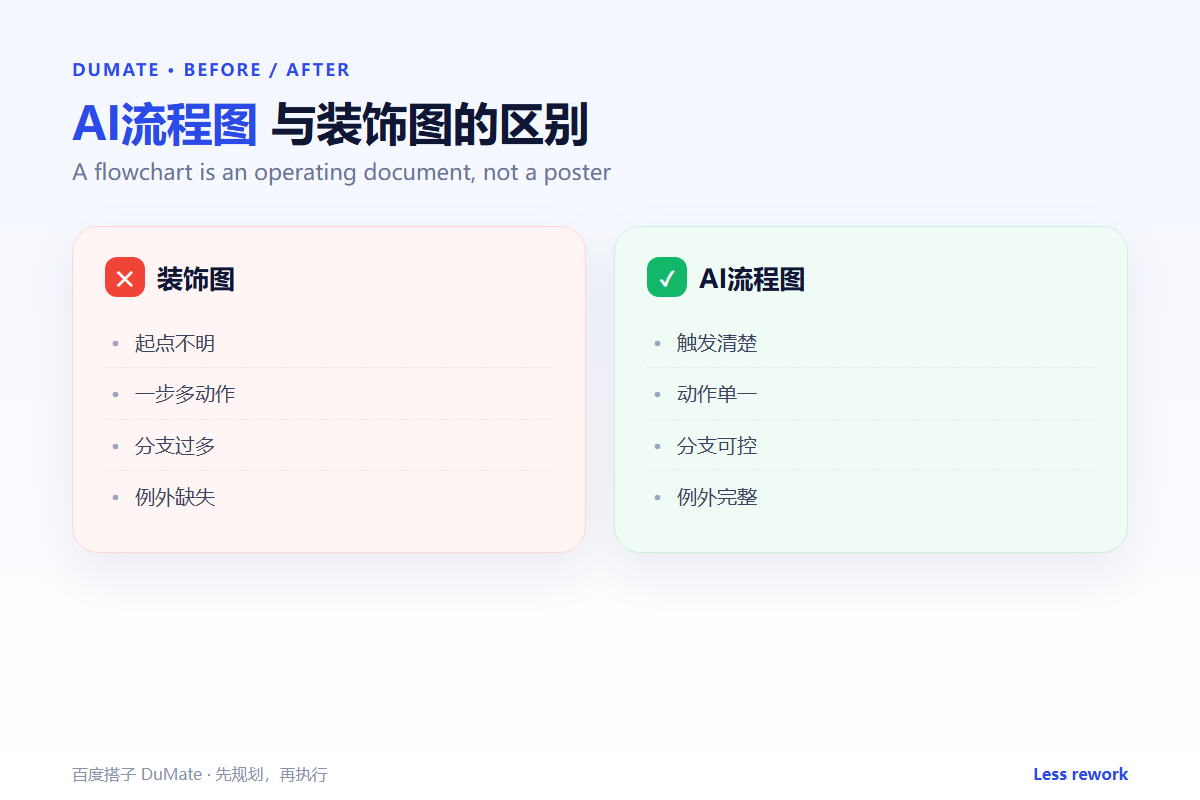
Before and After
Before, an invoice dispute took eleven days and nobody could say where it waited. The team had a process document that described five stages and matched none of them.
After, AI流程图 mapped the trigger to the payment, named six roles, and exposed a decision with no owner. Moving one approval removed four days, and the map became the first page of the training pack.
FAQ
Should we draw the current or the ideal process?
Current first. An ideal map drawn before the current one hides the workarounds that keep the business running. AI流程图 can then show the target beside it.
How detailed should a box be?
One action, one owner. If a box needs a paragraph, it is a subprocess and deserves its own page.
Which notation should we use?
Any consistent one. The value is in the discipline, not in the shape of the symbols.
延伸阅读
For clean wording on the page, see document proofreading, and for testable steps, test cases. Policy text is covered in policy briefing, teaching sequences in lesson plan, and visual delivery in courseware making. External references: NIST AI Risk Management Framework and ISO/IEC 42001.
评论
还没有评论,来说两句吧。