
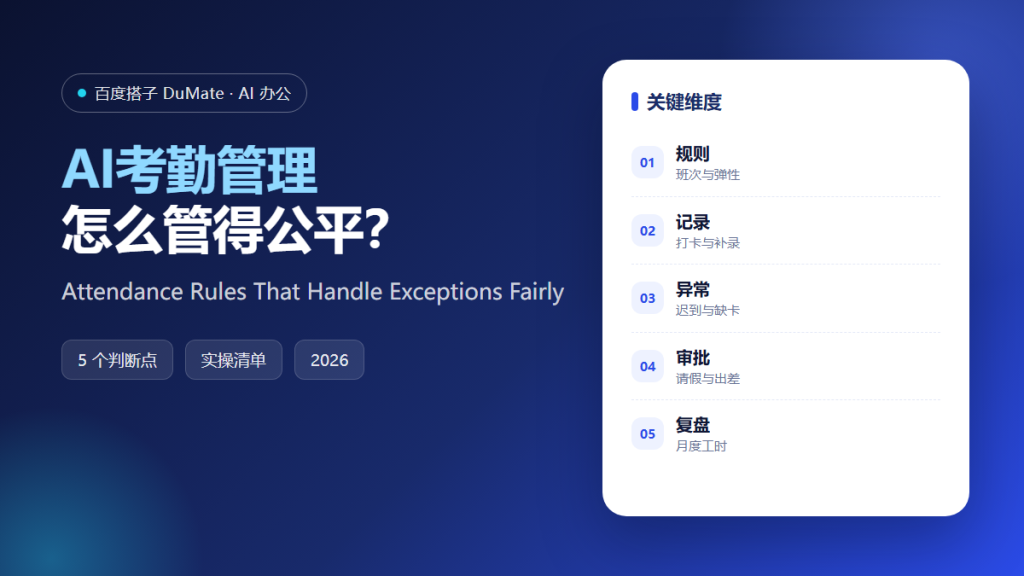
AI考勤管理 is often treated as a clocking problem, but the clock is the easy part. The difficult questions are about rules: who may arrive late, which absence counts as excused, and how a missed punch is corrected without rewarding carelessness. A system that records everything but explains nothing creates disputes rather than clarity.
This guide describes a fair attendance process, the exception categories that need explicit rules, and the reports that help managers act before small problems become formal cases.
Key Takeaways
- Publish schedules and shift rules in advance.
- Define excused and unexcused absence clearly.
- Require evidence for manual corrections.
- Apply the same standard to every team.
- Review patterns, not just individual records.
Why AI考勤管理 Needs Written Exception Rules
Every attendance system eventually encounters a broken badge reader, a family emergency, or a transport strike. If the rules for these events are undocumented, the outcome depends on who is on duty and how persuasive the employee is. AI考勤管理 should attach a category and an evidence requirement to each exception so the decision is repeatable.
Fairness is the second issue. A flexible policy applied only to senior staff looks like a privilege, even when the intent is reasonable. AI考勤管理 can compare exception rates across departments and flag a pattern that suggests inconsistent treatment. The tool identifies the pattern; managers must explain it.
Third, attendance data is sensitive. It can reveal illness, caregiving, or disability, and it must be handled with strict access controls. AI考勤管理 should limit who can see medical details and keep the audit trail separate from the schedule view. Access should be limited by role, and the retention period should be short enough that old records do not become a hidden liability.
How AI考勤管理 Works in Five Steps
Step 1: Publish the schedule
Make shifts, rest days, and swap rules visible at least one week ahead. State the deadline for requesting a change. AI考勤管理 can send reminders, but the schedule should remain a human-approved plan.
Step 2: Capture the record
Use the least intrusive method that fits the workplace: badge, app, terminal, or supervisor log. Record time, location, and device. AI考勤管理 should mark missing punches automatically instead of waiting for payroll to discover them.
Step 3: Classify the exception
Give employees a short list of reasons and ask for supporting evidence where appropriate. Separate lateness caused by the employer, such as a system outage, from lateness caused by the employee. AI考勤管理 can suggest a category, but a supervisor should confirm it.
Step 4: Apply the rule
Calculate the consequence using the published policy: paid, unpaid, warning, or no impact. Show the employee the calculation. AI考勤管理 can produce the statement, and the employee should be able to dispute it before payroll closes.
Step 5: Review the pattern
Look at trends by team, shift, and weekday. A cluster of Monday absences may indicate a scheduling problem rather than a discipline problem. AI考勤管理 can visualize the pattern, but the response belongs to operations and human resources.
‘ alt=’AI考勤管理 checklist: schedule, record, exception, rule and pattern review’ />
An Attendance Policy Checklist
- Shift times and swap deadlines are published.
- Exception categories are defined.
- Evidence requirements are proportional.
- Corrections require a named approver.
- AI考勤管理 reports are reviewed monthly.
Where AI考勤管理 Fails
AI考勤管理 fails when the system is used to punish people for circumstances outside their control. A rigid rule applied to a transport failure destroys trust faster than a late arrival ever could. It also fails when managers correct records informally and leave no trace.
- Rules that differ by manager without documentation.
- Round-the-clock monitoring without a business need.
- Medical data visible to the whole team.
- No appeal path for disputed records.
Before and After
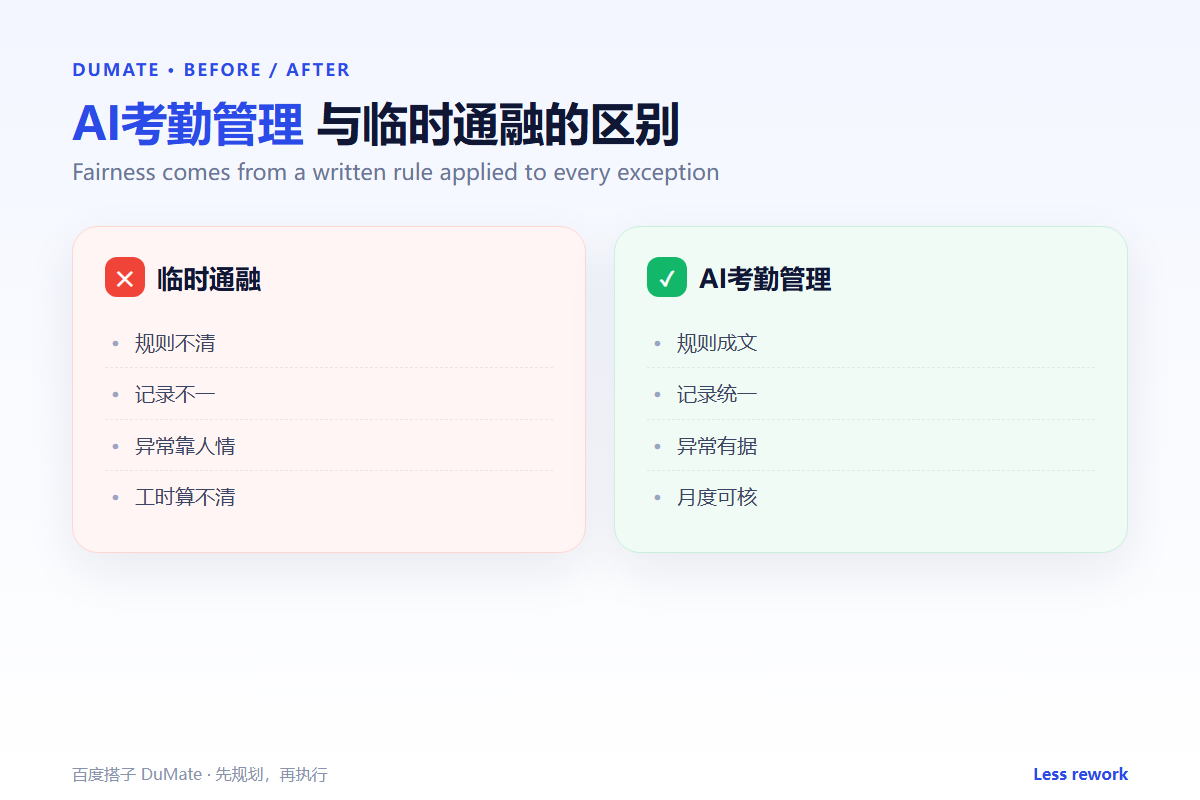
Before, a warehouse tracked attendance on paper and settled disputes by memory. Staff believed the rules favored the day shift, and supervisors spent hours each month reconstructing events. After, AI考勤管理 recorded exceptions with categories and evidence, and a monthly pattern review revealed that most lateness followed a bus schedule change.
Attendance management is not about catching people. It is about making the rules visible enough to follow, because a written rule protects both the employee and the supervisor when memory disagrees.
Keep the first month simple. One task, one owner, and one weekly review are enough to prove the workflow before it spreads across the team.
Write down what changed after each run. A short note is easier to trust than a memory, and it makes the next improvement obvious.
Review the output before it leaves your desk. A two-minute check catches most of the errors that would otherwise come back as questions.
Keep one example of a good result. New team members learn faster from a concrete reference than from a long explanation.
The first version does not need to be perfect. It needs to be complete enough to review, so the team can see the gaps and fix them in the next round.
Write the review notes in the same place as the work. Notes stored somewhere else are rarely read when the next decision arrives.
FAQ
Should we monitor remote workers continuously?
No. Track outcomes and agreed hours. Continuous monitoring rarely improves performance and often damages trust.
How long should records be kept?
Follow local labor law and keep only what payroll, audit, or a dispute requires. Delete the rest on a schedule.
What if an employee forgets to clock in?
Use a correction request with a reason and a supervisor approval. Repeated requests should trigger a conversation, not an automatic penalty.
延伸阅读
Analyze patterns with log analysis and label cases with data labeling. Write the rules with policy briefing and review them with legal consultation. Clarity benefits from document proofreading. External references: NIST AI Risk Management Framework and ISO/IEC 42001.
评论
还没有评论,来说两句吧。