
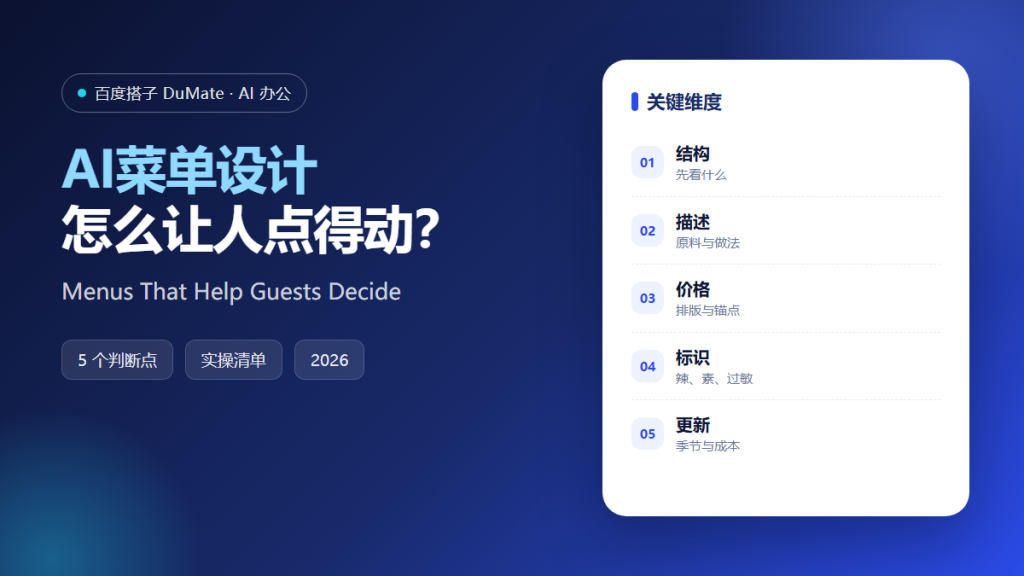
A menu is read in about ninety seconds by a guest who is hungry, talking, and holding a glass. Most menus answer a different question from the one being asked: they list what the kitchen can produce rather than what a guest should choose. AI菜单设计 improves the decision when it starts from that ninety-second scan and arranges the page around it.
The five steps below cover grouping, naming, description length, and the small test that shows whether guests order with more confidence than before.
Key Takeaways
- Decide which decision the menu should make easier.
- AI菜单设计 should group dishes by how guests choose, not by kitchen station.
- Lead each dish name with the main ingredient.
- Keep descriptions to two short lines.
- Test with five guests and time how long ordering takes.
Why AI菜单设计 Needs a Decision Target
Every menu already guides behavior, whether or not the owner intended it. Position, type size, and the order of sections decide what gets read first. A design without a target usually pushes guests toward the cheapest item, because price becomes the only clear signal. AI菜单设计 should name the target, such as a higher-margin main or a faster lunch turn, and then arrange the page to support it.
Guests also choose by category, not by ingredient list. They ask whether they want something light or rich, quick or long, familiar or new. A section called grill, fryer, and cold station mirrors the kitchen and forces the guest to translate. Grouping by the guest’s question shortens the scan and reduces the questions a server has to answer twice per table.
The third pressure is price. A long column of numbers invites comparison and turns the page into a spreadsheet. Hiding prices entirely creates distrust, and leading with them makes the decision purely financial. AI菜单设计 works best when prices are aligned, unfussy, and separated from the description by enough space to read the dish first.
How AI菜单设计 Works in Five Steps
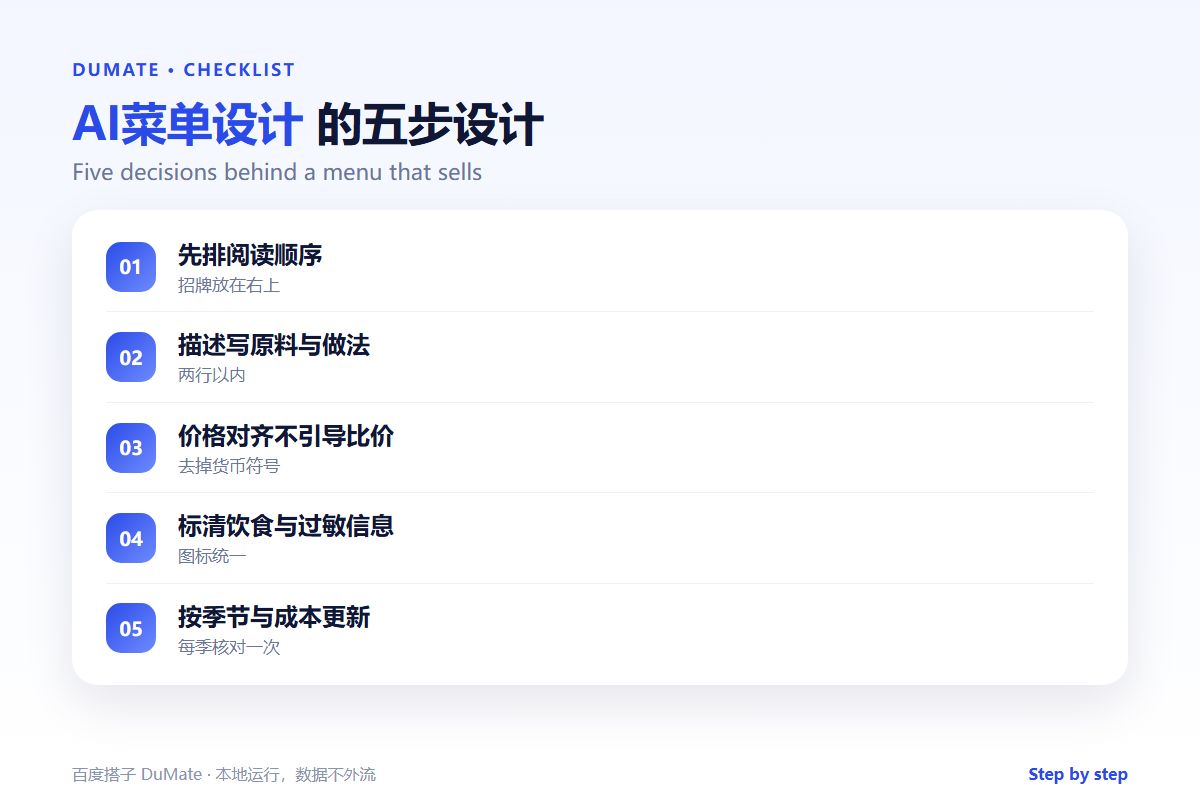
Step 1: Name the target
Choose one behavior for the menu to encourage: a signature dish, a faster lunch, or a higher spend per table. Write it down with the current number. A target that cannot be measured before and after is a preference rather than a design goal.
Step 2: Group by guest language
Arrange sections by the words guests use: small plates, mains, something sweet, or by time of day. Cap each section at seven items and place the strongest seller where the eye lands. AI菜单设计 should keep the total number of sections small, because every heading costs a decision.
Step 3: Rewrite the dish names
Start with the ingredient a guest recognizes, then add the preparation and one accent. Short names are read; long names are skipped. Remove trademarks and internal codes. AI菜单设计 should keep names consistent in grammar, so a list does not mix a verb phrase with a noun pile.
Step 4: Write two-line descriptions
Use the first line for what the dish is and the second for texture or heat. Mention one detail a guest could not guess, such as a smoked component or a sharper dressing. Cut adjectives that every restaurant uses, and never describe more than three ingredients. A description that needs a comma and a parenthesis has already lost the scan.
Step 5: Test the scan
Ask five guests to order while you time them. Record the questions they ask and the item their eyes reached first. AI菜单设计 should move the intended dish into that first position if it is not already there, then repeat the test with five more guests the following week.
A Layout Checklist for AI菜单设计
- Each section holds no more than seven items.
- The target dish sits in the first read position.
- Prices align and carry no currency clutter.
- Descriptions stay under twenty words.
- AI菜单设计 is tested in the room, at the table.
Where AI菜单设计 Fails
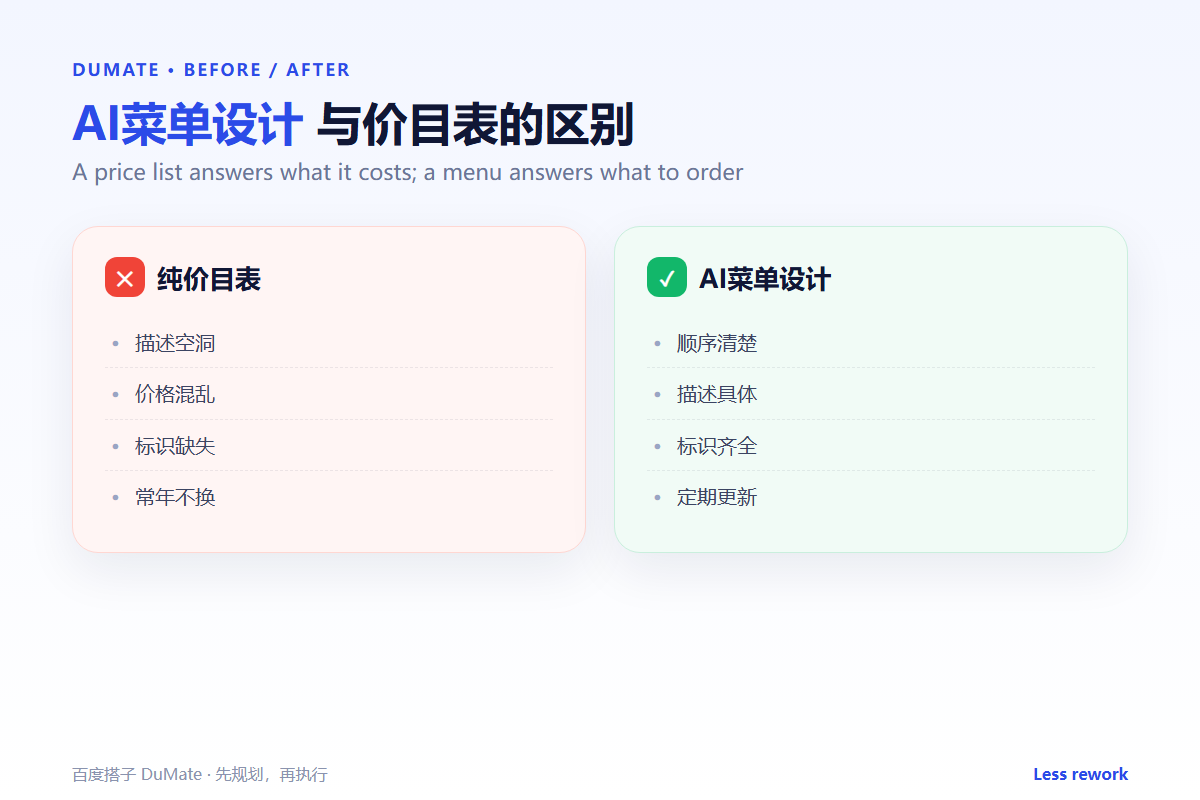
It fails when the page is treated as a catalogue of everything the kitchen can cook. AI菜单设计 also fails when typography competes with content, so the guest admires the layout and still asks the server what is good. Decoration that slows the scan is a cost, not a style.
- More than forty items with no hierarchy.
- Descriptions written for reviewers rather than guests.
- Prices in a separate column, far from the dish.
- Seasonal items left on a printed page for months.
Before and After
Before, a neighbourhood restaurant printed sixty-two items across eleven sections named after kitchen stations. Servers answered the same four questions at nearly every table, and the signature dish sat at the bottom of page two.
After, AI菜单设计 reduced the list to thirty-eight items in six sections and moved the signature dish to the first read position with a two-line description. Orders for that dish rose from nine to twenty-three a week, and the average time to order fell by about two minutes.
FAQ
Should prices include currency symbols?
Usually no. A clean numeral is enough, and removing symbols reduces visual noise. Keep the unit consistent across the whole menu.
How many items should a menu have?
Few enough that the kitchen executes each one well. Most small restaurants improve when they cut a quarter of the list and give the remaining dishes clearer descriptions.
Can AI菜单设计 set prices?
No. It can show where the eye lands and how descriptions read. Pricing belongs to a person who knows food cost, rent, and the local market.
延伸阅读
Carry the design into the room with poster design and write the dish lines with product copy discipline. Product image direction keeps photography consistent, brand naming settles the house style, and packaging design extends the same system to takeaway. External references: NIST AI Risk Management Framework and ISO/IEC 42001.
评论
还没有评论,来说两句吧。