
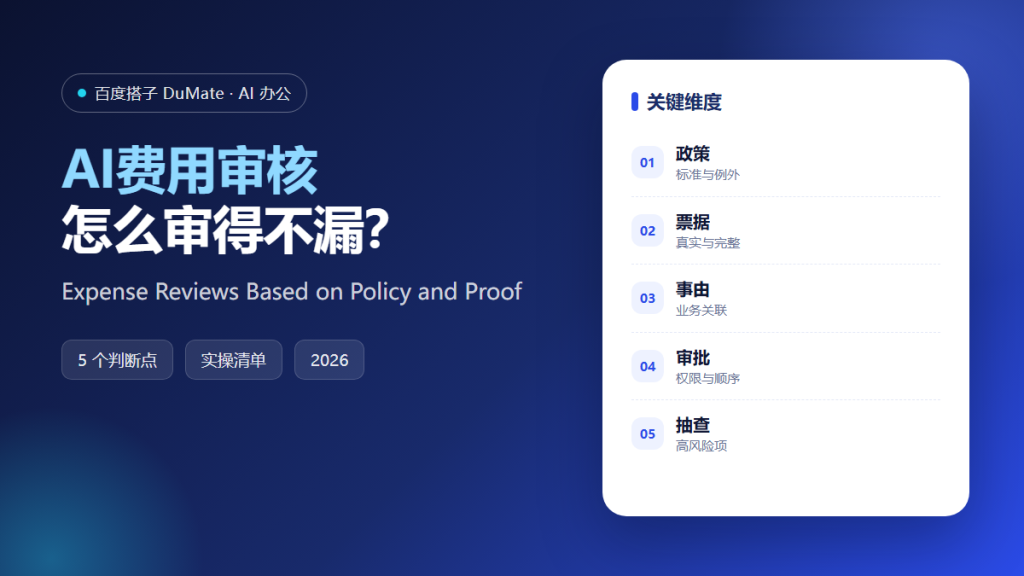
AI费用审核 protects both the company’s money and the employee’s time. A claim should be approved because it fits the policy and has evidence, not because the claimant is senior or persistent. When the rules are unclear, reviewers become negotiators, and the same expense can be treated differently in two departments.
This guide describes a five-step review process, the proof that should accompany common claims, and the exception path that keeps judgment visible.
Key Takeaways
- Publish the policy before the trip or purchase.
- Require receipts for every material claim.
- Check the business purpose, not just the amount.
- Route exceptions to a named approver.
- Review patterns to improve the policy.
Why AI费用审核 Needs a Written Policy
Employees cannot follow a rule they have never seen. A policy that lives in a folder from three years ago produces avoidable disputes about meals, taxis, and hotel rates. AI费用审核 should reference the current limit for each category and show the employee the rule before the claim is submitted.
The second issue is proof. A receipt shows that money was spent, not that the expense was necessary. AI费用审核 should ask for the business purpose, the attendees, and the project code. For a client meal, that may mean names and the topic discussed; for travel, the meeting and the alternative considered.
Third, exceptions need a route. A rigid system that rejects every unusual claim pushes employees to hide costs or split receipts. AI费用审核 should allow an exception with a reason and a named approver, and it should record the decision so similar cases can be handled consistently.
How AI费用审核 Works in Five Steps
Step 1: Check the claim
Confirm the date, amount, currency, category, and project code. Look for duplicates and personal items mixed into a business receipt. AI费用审核 can flag a claim that exceeds the category limit before a human opens it.
Step 2: Verify the proof
Match the receipt to the claim and check that the vendor, date, and total agree. For mileage, compare the distance with the route. AI费用审核 can read a photographed receipt, but a blurry or altered image should go to manual review.
Step 3: Test the business purpose
Ask what the expense achieved. A taxi to a client meeting is different from a taxi to a restaurant with no client present. AI费用审核 can compare the stated purpose with the project and calendar data, then flag inconsistencies for the manager.
Step 4: Handle the exception
If the claim falls outside policy, route it to the approver named in the rules. Record the reason, the amount above the limit, and the decision. AI费用审核 should never approve an exception on its own; it can only prepare the summary.
Step 5: Review the pattern
Look for repeated exceptions, late submissions, and categories with frequent errors. A cluster of taxi claims may indicate that the hotel policy is impractical, not that employees are dishonest. AI费用审核 can produce the trend report for the policy owner.
‘ alt=’AI费用审核 checklist: policy limits, receipts, purpose, exceptions and trends’ />
An Expense Review Checklist
- The claim matches the receipt.
- The business purpose is specific.
- The category limit is applied correctly.
- Duplicates have been excluded.
- AI费用审核 sends exceptions to a named approver.
Where AI费用审核 Fails
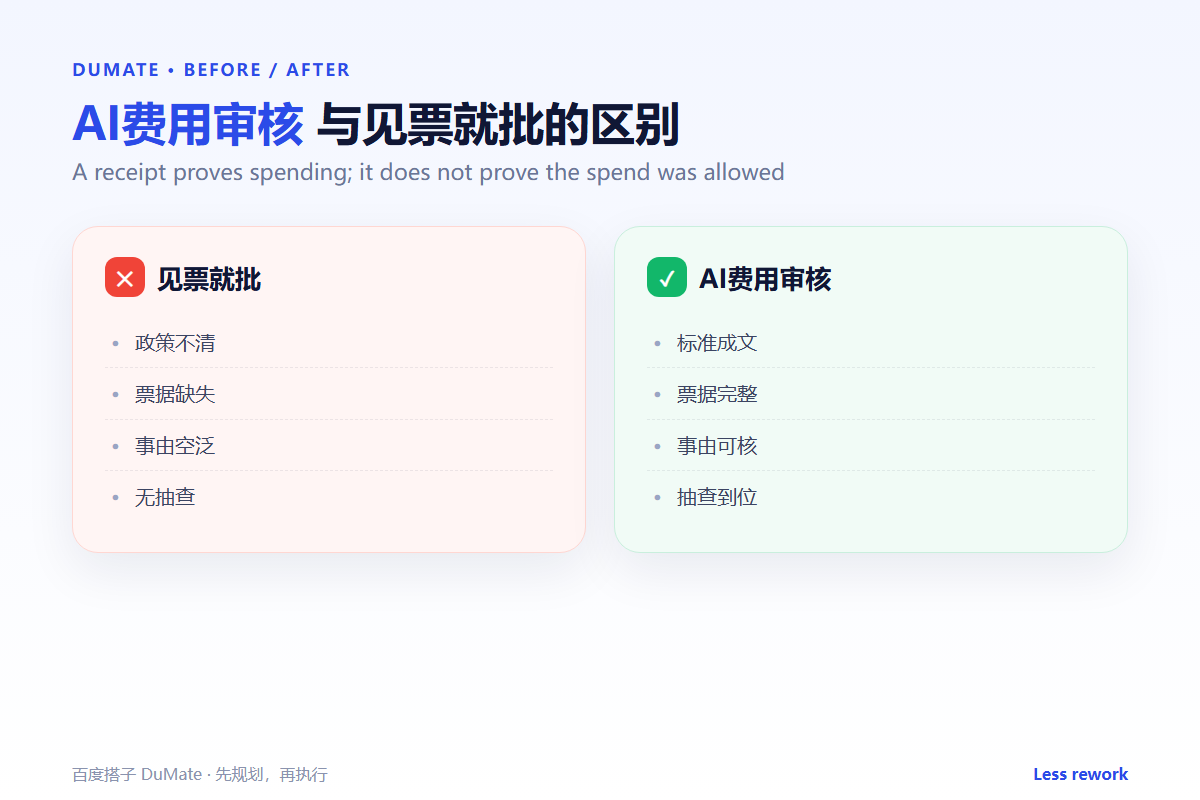
AI费用审核 fails when the tool is tuned only to reject. A review process that blocks legitimate claims creates shadow spending and resentment. It also fails when reviewers accept a receipt as sufficient proof of business value.
- Limits that are not published or updated.
- Approving a claim because of the claimant’s seniority.
- Ignoring split receipts and repeated exceptions.
- No feedback loop into policy design.
Before and After
Before, a sales team submitted expenses at the end of each quarter, and finance rejected a third of them for missing details. The rejections arrived weeks later, after the employee had already paid. After, AI费用审核 checked the policy and receipt at submission, asked for the missing purpose, and routed two genuine exceptions to the regional director.
An expense review is not a hunt for wrongdoing. It is a test of whether the rule and the reality still fit.
Keep the first month simple. One task, one owner, and one weekly review are enough to prove the workflow before it spreads across the team.
Write down what changed after each run. A short note is easier to trust than a memory, and it makes the next improvement obvious.
Review the output before it leaves your desk. A two-minute check catches most of the errors that would otherwise come back as questions.
Keep one example of a good result. New team members learn faster from a concrete reference than from a long explanation.
The first version does not need to be perfect. It needs to be complete enough to review, so the team can see the gaps and fix them in the next round.
Write the review notes in the same place as the work. Notes stored somewhere else are rarely read when the next decision arrives.
FAQ
Do we need a receipt for every expense?
Set a materiality threshold. Small claims may use a summary, but every claim should have enough evidence to identify the vendor, date, and amount.
Who should approve exceptions?
A named role with authority above the limit, not the immediate manager alone. The approver should be independent of the claimant’s budget incentive.
How do we reduce late claims?
Shorten the submission window, send reminders, and make the process fast for clean claims. Most lateness is caused by friction, not fraud.
延伸阅读
Write the rules with policy briefing and review them with legal consultation. Check the budget in budget planning and the accounts in financial statements. Clear claim forms benefit from document proofreading. External references: NIST AI Risk Management Framework and ISO/IEC 42001.
评论
还没有评论,来说两句吧。