
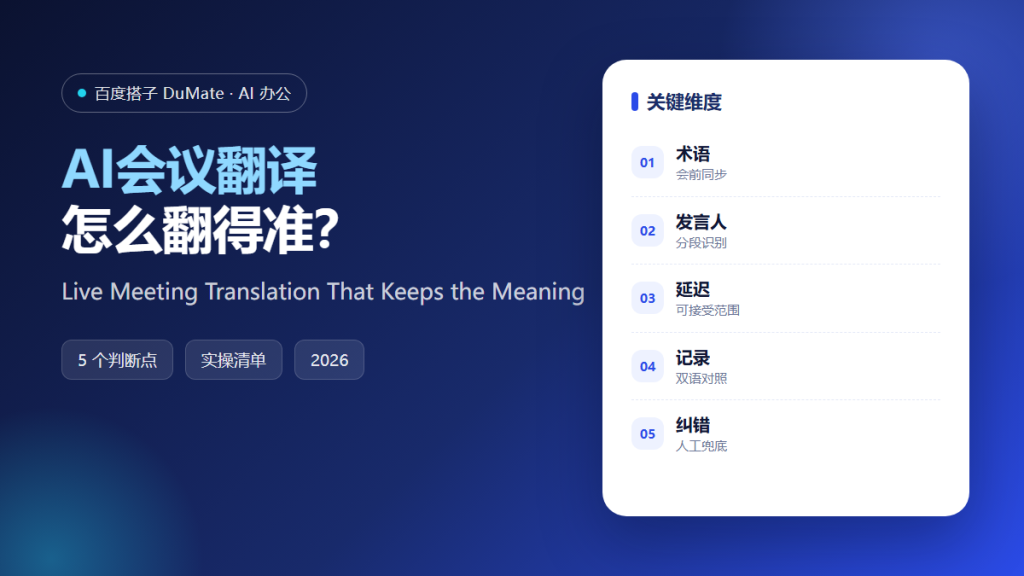
Most teams treat AI会议翻译 as transcription with a second language attached. They count words, check that every sentence appeared, and call the meeting covered. The result is a long bilingual document nobody reads, while the one thing the room needed, a clear record of what was decided and who agreed to do it, is buried on page nine.
This guide sets out a five-step method for AI会议翻译 that treats the decision as the unit of work, plus the checks that keep a bilingual record trustworthy after the call ends.
Key Takeaways
- Decide what the record must contain before the meeting starts.
- AI会议翻译 should capture decisions, owners, and dates rather than every sentence.
- Build a term base for names, products, and acronyms.
- Translate for the reader in the other language, not word by word.
- Confirm the record with one owner within a day.
Why AI会议翻译 Needs a Decision Record
A meeting produces three kinds of speech: thinking aloud, negotiation, and commitment. Only the third one survives the week. A system that gives all three equal weight produces a transcript that is accurate and useless, because the reader cannot tell a proposal from a promise. AI会议翻译 earns its place when it separates the commitment and shows it in both languages side by side.
Language also carries obligation. In one language a request may sound like a suggestion, and a literal translation can turn a polite maybe into a task. Teams that review the bilingual record together catch these shifts, while teams that read only their own language version inherit whatever the machine decided. The gap is small in a single sentence and large across forty pages.
The third reason is memory. Decisions made in a mixed-language room are recalled differently by each side, and the difference surfaces months later during a review. A short, agreed record removes that argument. AI会议翻译 is valuable not because it is fast, but because it gives both sides the same text to disagree with.
How AI会议翻译 Works in Five Steps
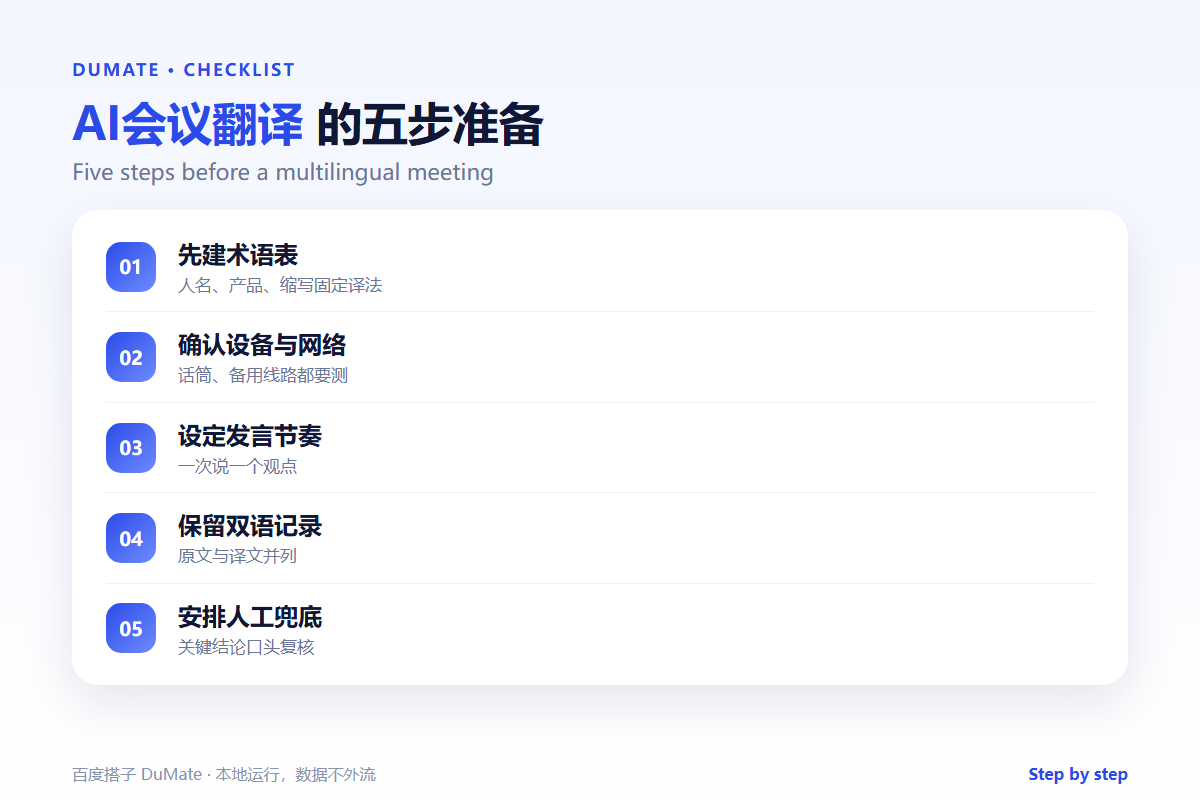
Step 1: Define the record before the call
Agree on the fields the record must hold: decision, owner, deadline, and the condition attached to it. Tell participants that these fields will be read aloud at the end. AI会议翻译 should publish the same four fields before the call, so nobody discovers the format when the room is already tired.
Step 2: Build a term base first
Collect the names of people, products, projects, and internal acronyms, with an approved translation for each. Add a do-not-translate list for legal entity names and code words. A term base of two hundred entries removes most of the confusion that makes AI会议翻译 output feel unreliable, and it takes an afternoon to assemble. Review it once a quarter, because product names change faster than manuals do.
Step 3: Mark the decision moment
Use a spoken phrase such as decision, or a shared button, to flag the instant the room agrees. The marker tells the system where to focus, and it tells the note taker which thirty seconds to check. Without a marker, the record is assembled by guessing from tone, and guessing fails in exactly the meetings that matter.
Step 4: Translate for the reader
Long clauses do not survive translation. Split them, keep the subject visible, and repeat the noun instead of using a pronoun that may point at the wrong person. AI会议翻译 should produce sentences a reader can act on alone, because the reader was probably not in the room and cannot ask what was meant.
Step 5: Reconcile within one day
Send the bilingual summary to the owner of each action, not to the whole attendee list. Ask for a one-word confirmation or a correction. Record the correction in the term base so the next meeting inherits it. A record confirmed in a day is a commitment; a record confirmed in a week is a historical document.
A Review Checklist for AI会议翻译
- Every decision has one named owner and a date.
- The term base is updated before the meeting, not after.
- Both language versions say the same thing about money and scope.
- Open questions are listed separately from decisions.
- AI会议翻译 output is confirmed by a person who attended.
Where AI会议翻译 Fails
Failure is rarely a translation error. It is a process error that AI会议翻译 makes visible: no agenda, no owner, and a room that never states what it agreed. The tool then produces a fluent record of a meeting that decided nothing, and everyone blames the translation.
- Speaker labels missing, so attribution becomes guesswork.
- Numbers read aloud once and never checked.
- Side conversations merged into the main record.
- No glossary, so product names change spelling every week.
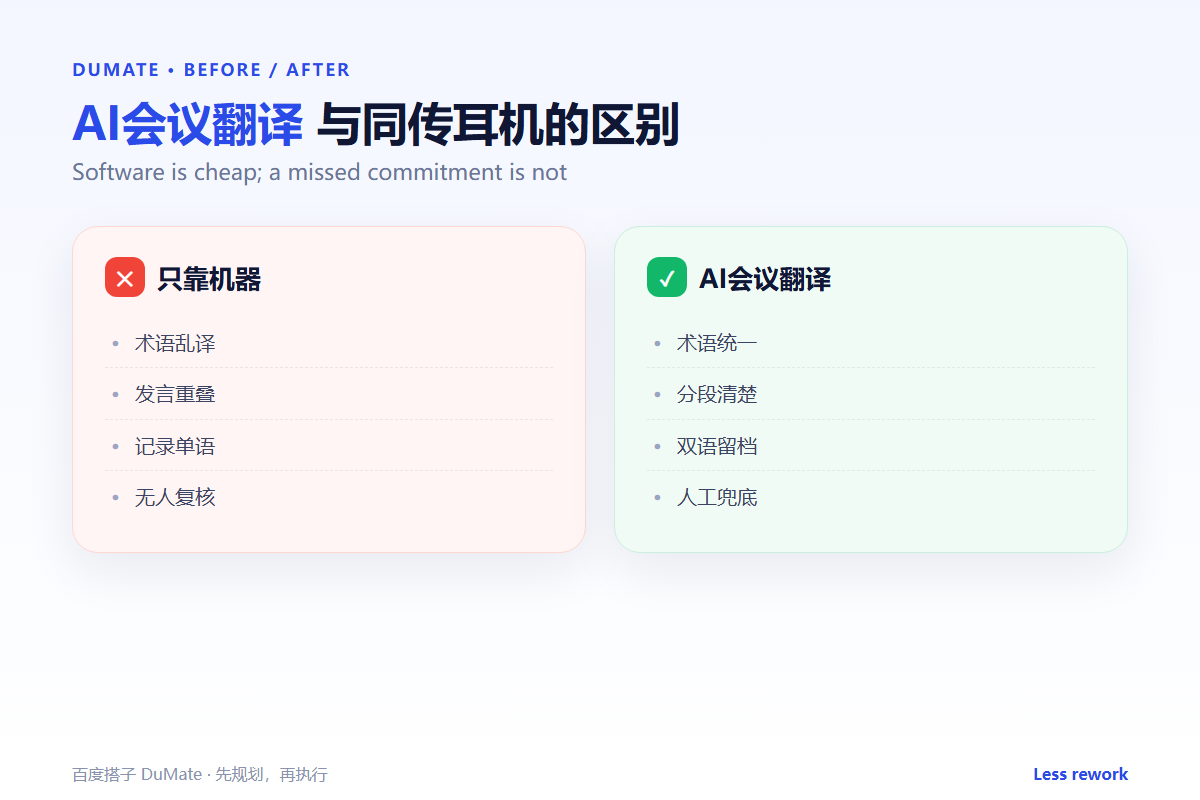
Before and After
Before, a supplier review ran for ninety minutes with two languages and no shared notes. Each side wrote its own summary, and the two versions disagreed on a delivery penalty of roughly forty thousand euros. The argument took three weeks and two calls to settle.
After, AI会议翻译 produced a two-page record with six decisions, each with an owner and a date. The penalty clause was read back in both languages before anyone left, and the two summaries matched. The meeting ended fifteen minutes earlier, and the follow-up call never happened.
FAQ
Can AI会议翻译 replace an interpreter?
For a record, often yes. For negotiation, no. Interpretation carries tone and timing that a text record cannot recover, so keep a person in the room when the stakes are high.
How accurate is the transcript?
Accuracy depends on audio quality and term coverage. Test with one real recording before you commit, and count errors on names and numbers rather than on ordinary words.
Should the record be bilingual?
Yes, when both sides must act on it. One shared document with two columns prevents the quiet divergence that appears when each team keeps its own notes.
延伸阅读
Meeting records improve when meeting scheduling rules set a clear agenda and chat to decisions turns side threads into commitments. Use weekly report workflow to carry actions forward, video subtitle workflow for recorded sessions, and AI privacy policy to govern retention of recordings. External references: NIST AI Risk Management Framework and ISO/IEC 42001.
评论
还没有评论,来说两句吧。