
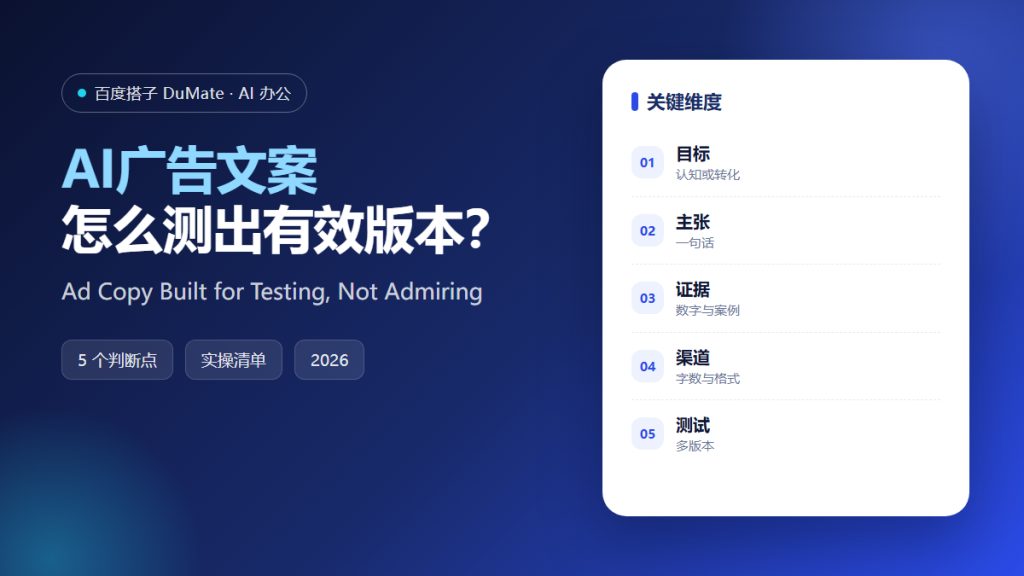
AI广告文案 is judged by response, not by taste. That makes it a different craft from brand writing. A line that sounds clever in a meeting may fail in a feed, and a line that looks plain may convert for months. The only way to know is to test, and the only way to test is to keep the variables small.
This guide covers a five-step process for writing testable ad copy, the channel constraints that shape length, and the review that separates a real winner from a lucky week.
Key Takeaways
- Choose one objective per ad.
- Write one claim the reader can repeat.
- Attach one piece of evidence.
- Adapt the length to the channel.
- Test a few versions with a small budget.
Why AI广告文案 Needs an Objective
Awareness, clicks, and purchases require different language. Awareness copy can be intriguing. Click copy must promise a specific payoff. Purchase copy must reduce risk. AI广告文案 will blend all three if the objective is not stated, producing a line that is interesting but does not move anyone.
The second reason is measurement. If the objective is unclear, the result is unreadable. A high click rate with no conversions may mean the copy overpromised, not that the campaign worked.
The third reason is consistency. A single claim, repeated across channels, builds memory. AI广告文案 makes it easy to generate ten different claims; discipline keeps one.
How AI广告文案 Works in Five Steps
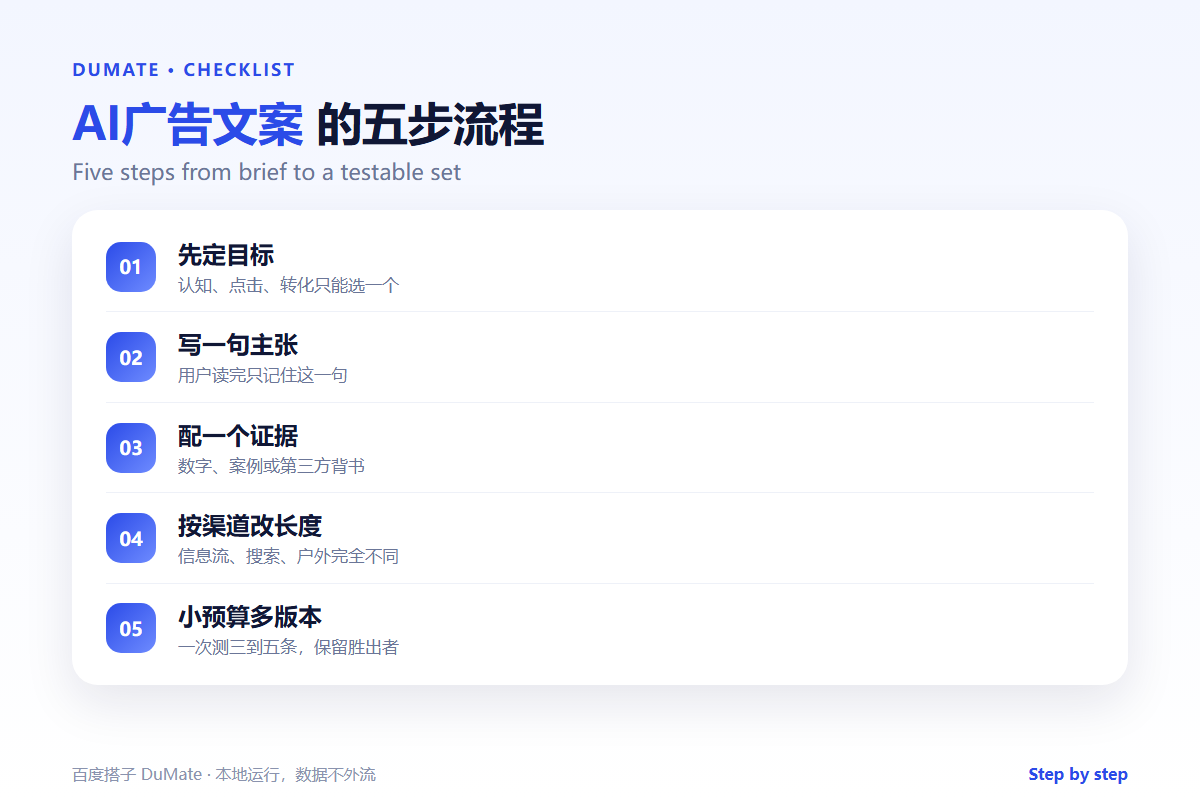
Step 1: Set the objective
Pick one: remember, click, or buy. Write it at the top of the brief. AI广告文案 should be instructed to optimize for that single action.
Step 2: Write the claim
Use a short sentence that names a change the reader cares about. Avoid cleverness that requires a second read. AI广告文案 can generate options, but the writer should choose the one that is true and specific.
Step 3: Attach one proof
Use a number, a customer result, or a credible source. One proof is enough. AI广告文案 often stacks three, which weakens all of them.
Step 4: Adapt to the channel
Search ads need the keyword and a clear benefit. Social feeds need a hook in the first line. Outdoor needs seven words or fewer. AI广告文案 should be given the format limits explicitly.
Step 5: Test and keep the variable small
Change one element at a time: claim, proof, or call to action. Run long enough to see a stable difference. AI广告文案 can produce variants, but the test design is human work.
A Copy Testing Checklist
- The objective is written down.
- One claim per version.
- One proof per claim.
- The format matches the channel.
- Only one variable changes per test.
Where AI广告文案 Fails
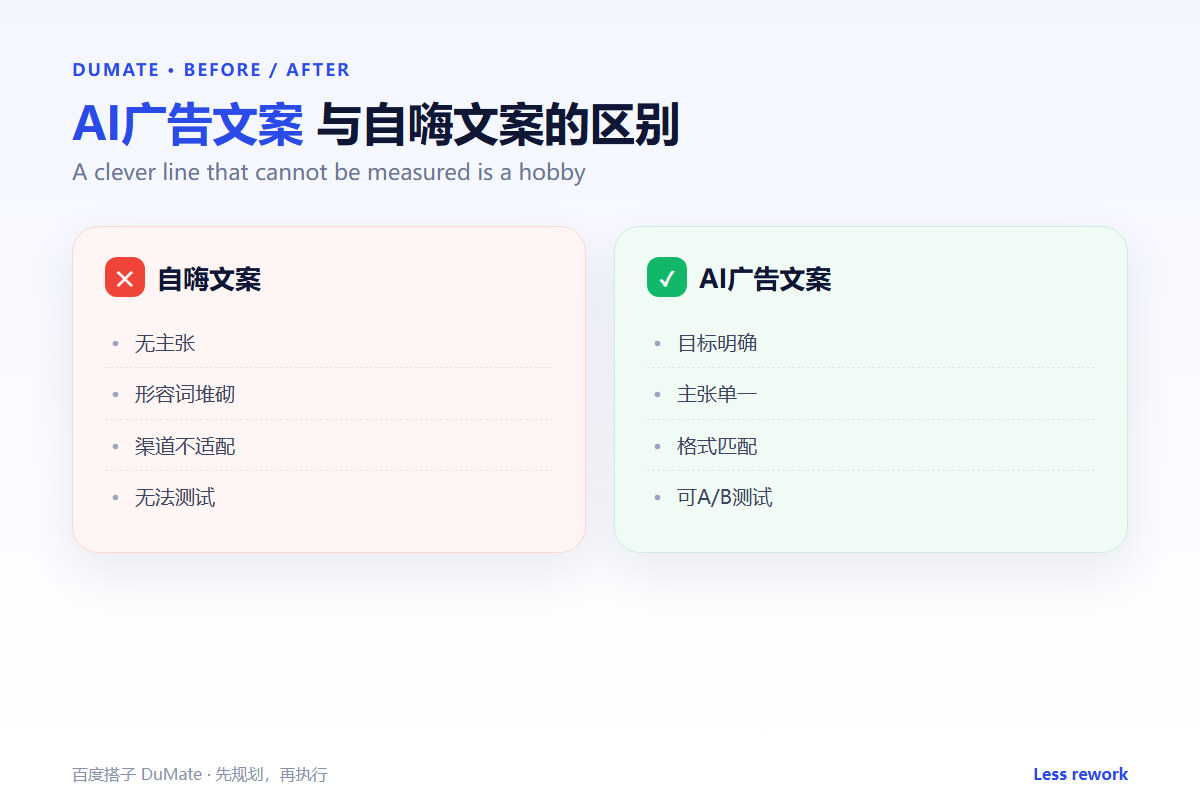
It fails when the brand voice is undefined, because every version sounds like a different company. It also fails when the promise is stronger than the product, which produces clicks and refunds. Finally, it fails when the test changes three things at once, leaving no lesson behind.
- Claims that cannot be substantiated.
- Copy that ignores the landing page.
- The same length on every channel.
- Tests too short to be meaningful.
Before and After
Before, a team wrote one clever line, ran it for two days, and concluded that advertising did not work. After, AI广告文案 produced five versions with one variable each, the team ran them for two weeks, and the winner was a plain sentence that named the customer’s problem. It was not the favorite in the meeting.
Testing is not a creative compromise. It is how creative work finds its audience.
Used consistently, AI广告文案 becomes part of the normal review routine rather than a separate project.
A final check with AI广告文案 takes a minute and catches the errors that are easiest to miss.
A Four-Week Rollout
The first week with AI广告文案 should be a small pilot, not a team-wide launch. Choose one recurring task with a clear output and run it end to end. Keep the sample small enough to check by hand. The point is to see where AI广告文案 saves time and where it creates review work.
During the pilot, keep a short log of inputs, outputs, and corrections. Record the time spent before and after. AI广告文案 feels faster even when it is not, so the log matters. At the end of the week, review the log with one colleague and decide whether to continue, change the input, or stop.
In week two, write a one-page standard for input and output. Include what must be checked and who approves the result. AI广告文案 works better when the standard is visible to everyone. In week three, add permissions and a review step. In week four, compare the results and write a short guide. That guide is what makes AI广告文案 survive after the first month.
Keep the pilot narrow. A broad rollout hides which step failed, and a narrow one shows exactly where the workflow needs help. Expand only after the narrow case is stable.
FAQ
How many versions should I test?
Three to five. More versions split the budget and delay a decision.
Should the claim change per channel?
Keep the claim stable and change the format. Consistency builds memory.
What if the best-performing copy feels boring?
Keep it. Your taste is not the target audience. Check that it is honest, then let the numbers decide.
延伸阅读
For product detail, see AI商品文案. Visual direction is covered in AI海报设计. Use AI数据分析工具 to read results. Tool selection is covered in AI效率工具. For wording, read AI写作助手. External references: NIST AI Risk Management Framework and ISO/IEC 42001.
评论
还没有评论,来说两句吧。以下为本文的引用通告: