
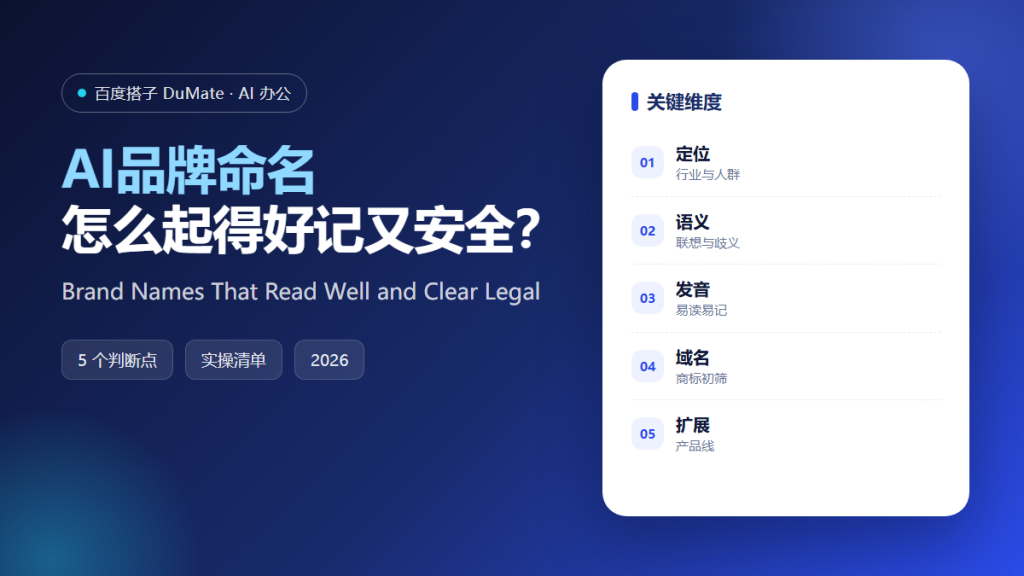
AI品牌命名 produces hundreds of options in minutes, which is both the benefit and the problem. Most of them are forgettable, some are already taken, and a few are accidentally unfortunate in another language. The work is not generation. It is filtering.
This guide covers a five-step naming process, the tests that remove weak candidates, and the legal checks that should happen before anyone prints a sign.
Key Takeaways
- Write the positioning before generating names.
- Say every candidate out loud.
- Check meaning and pronunciation across markets.
- Run a basic domain and trademark search.
- Choose a name that can extend to new products.
Why AI品牌命名 Needs a Positioning Statement
A name has to do a job. It should signal the category, the audience, or the feeling the brand wants to create. Without a positioning statement, AI品牌命名 optimizes for sound, and sound alone produces names that could belong to anything.
The second reason is memory. A name is repeated in conversations, podcasts, and phone calls. If it needs spelling, it loses. AI品牌命名 should be tested by reading the candidates aloud, not by looking at a list.
The third reason is legal risk. A name that cannot be registered is not an option. AI品牌命名 can generate candidates, but the shortlist must go through a proper search before launch.
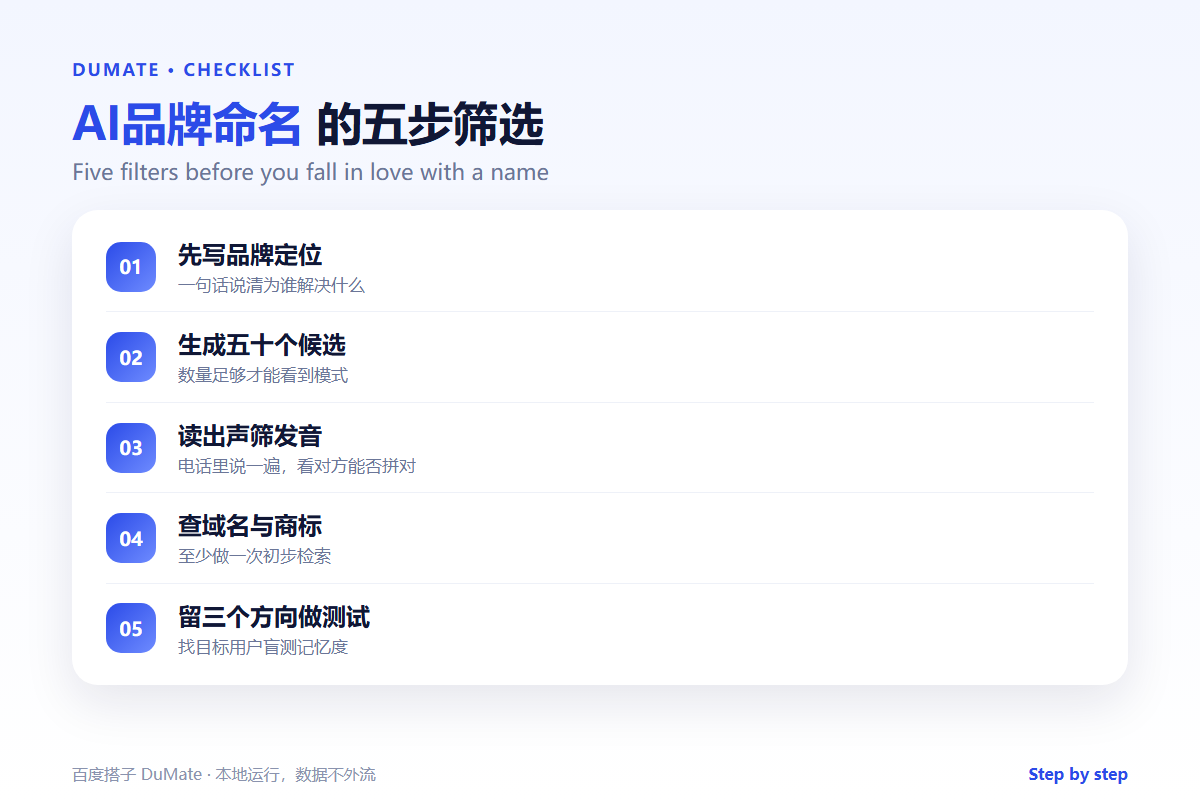
How AI品牌命名 Works in Five Steps
Step 1: Write the positioning
Complete one sentence: for whom, in what situation, the brand provides what change. This becomes the filter for every candidate. AI品牌命名 should see this sentence before generating.
Step 2: Generate a wide set
Ask for fifty to one hundred names across several styles: descriptive, invented, metaphorical, and compound. Volume is useful here because the best name is often in the second batch.
Step 3: Test pronunciation
Read each shortlist name on a call. Ask someone to spell it back. Remove anything that needs explanation. AI品牌命名 cannot hear the difference between clear and clever.
Step 4: Check domain and trademark
Look for a usable domain and run a preliminary trademark search in the relevant classes. Treat the result as a filter, not legal advice.
Step 5: Test extension
Imagine the name on three future products and in three sentences. If it only works for the first product, it is a product name, not a brand name.
A Naming Shortlist Checklist
- It fits the positioning statement.
- It is easy to say and spell.
- It has no unfortunate meaning in key markets.
- A domain and trademark path exists.
- It can extend to future products.
Where AI品牌命名 Fails
It fails when the brief is a list of adjectives such as modern, trustworthy, and innovative. Every brand wants those, and the output becomes generic. It also fails when the name is judged only on a screen, where pronunciation and spelling do not show up.
- Names that sound like competitors.
- Spellings that need a explanation.
- Meanings that do not survive translation.
- Domains that are already squatted.
Before and After
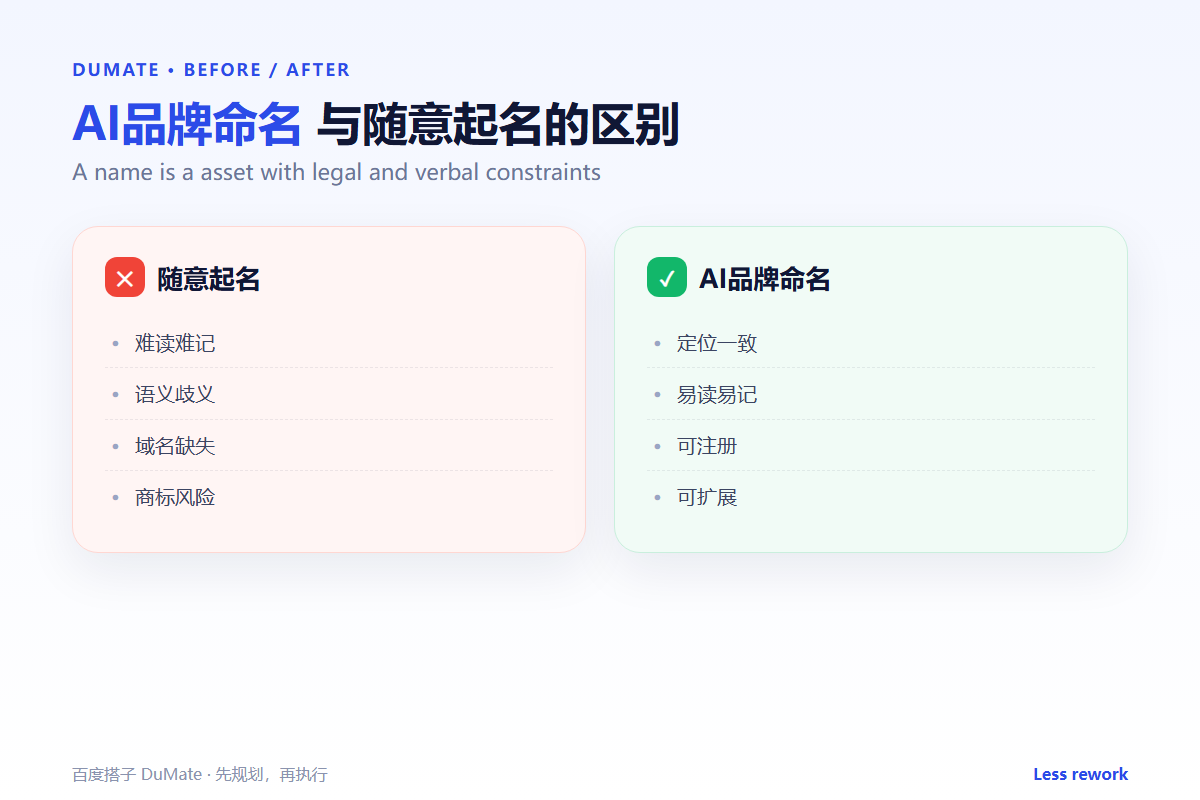
Before, a team chose a name because everyone liked it in the meeting, then discovered the domain was taken and the trademark was blocked. After, AI品牌命名 produced a wide set, the team filtered by pronunciation and extension, and legal review happened before the visual identity work began.
The best name is not the most creative one. It is the one that survives contact with customers, lawyers, and the phone.
Used consistently, AI品牌命名 becomes part of the normal review routine rather than a separate project.
A final check with AI品牌命名 takes a minute and catches the errors that are easiest to miss.
The same AI品牌命名 routine works for small tasks and large ones, which is why teams keep using it.
Making It Stick Across a Team
A rollout fails when only one person knows how to use AI品牌命名. Write a short guide with three sections: when to use it, what good input looks like, and what to check before sharing the output. Keep the guide to one page.
Train in pairs. One person runs the task while the other checks the output against the guide, then swap roles. That exercise surfaces unclear steps faster than a presentation. Keep a shared folder with one strong output, one weak output, and a note explaining the difference. AI品牌命名 becomes easier to teach when people can compare real cases.
Review the guide after the first week of use. Remove steps nobody follows and add the questions that keep coming up. A living guide is more useful than a perfect one written in advance. Finally, assign an owner. AI品牌命名 without an owner drifts, and the guide becomes outdated. The owner does not need to do every task, only keep the standard current. That small responsibility is what keeps AI品牌命名 useful after the initial training.
Make the training practical. People learn the workflow by completing a real task, not by listening to a walkthrough. Set aside thirty minutes for practice and review the result together. Measure one thing: how many outputs pass review without correction. That number is a better indicator than attendance.
FAQ
Should the name describe the product?
Descriptive names are easy to understand and hard to protect. Invented names are easier to protect and need more marketing. Choose based on budget and timeline.
How many names should go to legal review?
Three to five. More than that slows the process and increases cost.
Can AI品牌命名 check trademarks?
No. It can help draft search terms. A qualified attorney or a formal database search should confirm availability.
延伸阅读
For launch messaging, see AI广告文案 and AI海报设计. For drafting the story, read AI写作助手. Keep naming research in an AI知识库. Tool selection is covered in AI效率工具. Industry templates are in AI专家套件. External references: ISO/IEC 42001 and NIST AI Risk Management Framework.
评论
还没有评论,来说两句吧。以下为本文的引用通告: