

AI预算编制 is less about arithmetic than about assumptions. A budget is a set of bets about revenue, cost, and timing, and every number should be traceable to a reason. When the assumptions are invisible, the budget becomes a negotiation instead of a plan.
This guide covers a five-step method for building a budget with an assistant, the assumptions that deserve a written note, and the review rhythm that keeps the plan useful after the first month.
Key Takeaways
- Set revenue, margin, and cash targets first.
- Write the key assumptions in plain language.
- Split costs by department and month.
- Keep a ten percent contingency.
- Review and roll the forecast every quarter.
Why AI预算编制 Needs Written Assumptions
A budget without assumptions cannot be updated. When actual results differ, nobody knows whether the plan was wrong or the world changed. AI预算编制 can produce a complete table in minutes, which makes it even more important to attach the reasoning behind each major line.
The second reason is alignment. Sales, operations, and finance often use different definitions of pipeline, headcount, and cost. Writing the assumptions forces the definitions into the open before the numbers are locked.
How AI预算编制 Works in Five Steps
Step 1: Set the financial targets
Write down revenue, gross margin, and cash flow targets for the year. Add the growth rate implied by each. AI预算编制 should be given these targets as constraints, not as suggestions.
Step 2: Document the assumptions
List pricing, volume, hiring, and cost inflation. Give each a range and a source. AI预算编制 can turn the list into a table, but the owner of each assumption must confirm it.
Step 3: Build department budgets
Split costs by department and by month. Keep the granularity useful: monthly totals per category, not per person. AI预算编制 handles this structure well when the categories are fixed in advance.
Step 4: Add contingency
Reserve roughly ten percent for unknown costs. Explain what qualifies for the reserve and who can release it. AI预算编制 should show the reserve separately, not hide it inside other lines.
Step 5: Review and roll
Compare actuals with the plan every month and roll the forecast every quarter. Update the assumptions, not just the numbers. AI预算编制 can produce the variance table; the discussion belongs to the budget owners.

A Budget Review Checklist
- Targets are stated with growth rates.
- Assumptions have owners and sources.
- Department totals match the summary.
- Contingency is visible and governed.
- Variance explanations are written down.
Where AI预算编制 Fails
It fails when the previous year is copied forward without checking whether the business has changed. It also fails when every department receives the same percentage cut, which punishes teams with different cost structures.
- Assumptions that nobody owns.
- Costs rounded until they lose meaning.
- No contingency or an uncontrolled one.
- No monthly variance review.
Before and After
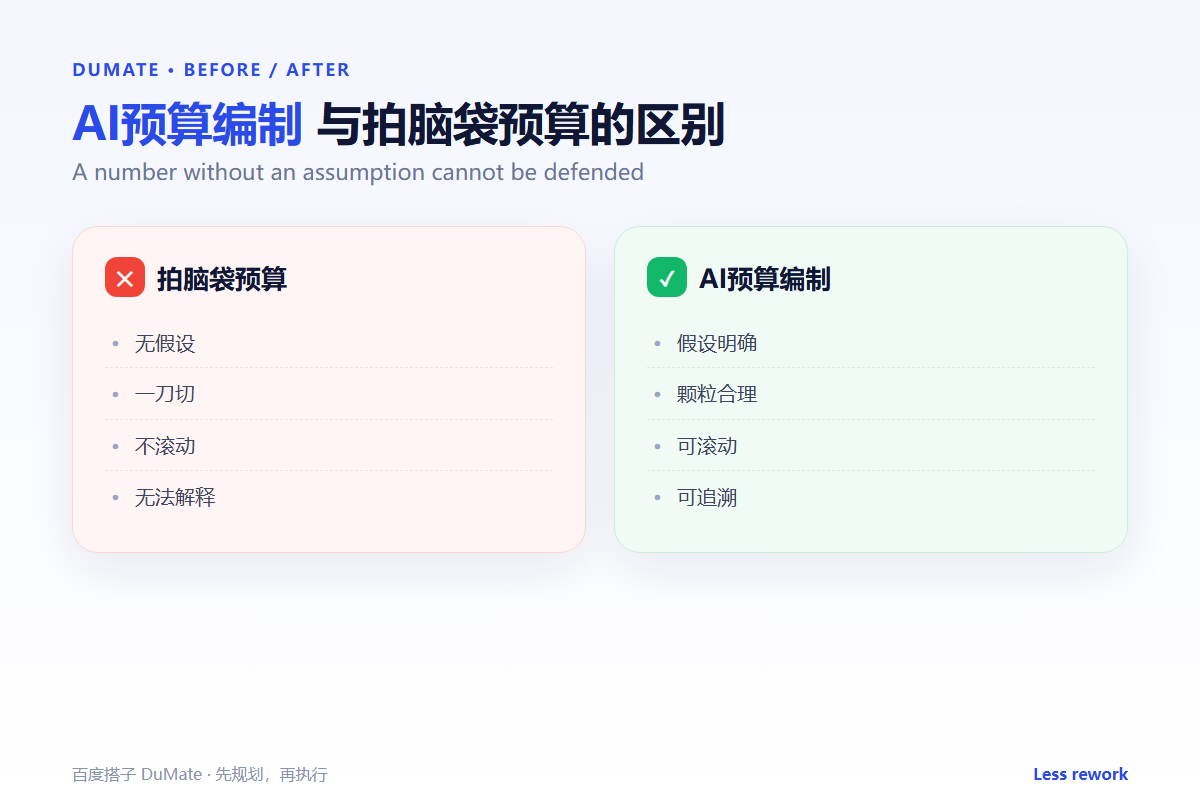
Before, the budget was a single spreadsheet with a total and a growth target, and every monthly review became an argument about definitions. After, AI预算编制 produced a structured plan with named assumptions, and the review focused on two assumptions that had clearly changed.
A budget is a tool for learning, not a prediction to defend.
Used consistently, AI预算编制 becomes part of the normal review routine rather than a separate project.
A final check with AI预算编制 takes a minute and catches the errors that are easiest to miss.
The same AI预算编制 routine works for small tasks and large ones, which is why teams keep using it.
Making It Stick Across a Team
A rollout fails when only one person knows how to use AI预算编制. Write a short guide with three sections: when to use it, what good input looks like, and what to check before sharing the output. Keep the guide to one page.
Train in pairs. One person runs the task while the other checks the output against the guide, then swap roles. That exercise surfaces unclear steps faster than a presentation. Keep a shared folder with one strong output, one weak output, and a note explaining the difference. AI预算编制 becomes easier to teach when people can compare real cases.
Review the guide after the first week of use. Remove steps nobody follows and add the questions that keep coming up. A living guide is more useful than a perfect one written in advance. Finally, assign an owner. AI预算编制 without an owner drifts, and the guide becomes outdated. The owner does not need to do every task, only keep the standard current. That small responsibility is what keeps AI预算编制 useful after the initial training.
Make the training practical. People learn the workflow by completing a real task, not by listening to a walkthrough. Set aside thirty minutes for practice and review the result together. Measure one thing: how many outputs pass review without correction. That number is a better indicator than attendance.
Keep the first month simple. One task, one owner, and one weekly review are enough to prove the workflow before it spreads across the team.
FAQ
How detailed should a budget be?
Detailed enough to assign ownership and monthly enough to compare with actuals. More detail usually adds maintenance cost, not insight.
Who should own the assumptions?
The person closest to the number: sales for pipeline, operations for capacity, finance for cost inflation.
How often should we reforecast?
Quarterly for most teams, monthly if the market moves quickly.
延伸阅读
For statements, see AI财务报表. Prepare data with AI表格处理 and AI数据清洗. Approval rules are covered in AI权限管理. For analysis, read AI数据分析工具. External references: NIST AI Risk Management Framework and ISO/IEC 42001.
评论
还没有评论,来说两句吧。以下为本文的引用通告: