

AI财务报表 is a high-stakes use case because the output looks authoritative. A clean layout can hide a broken formula, and a confident summary can hide a mismatch between the profit statement and the cash flow. The first job is not presentation. It is reconciliation.
This guide covers a five-step process for preparing statements with an assistant, the checks that catch most errors, and the commentary that makes the numbers useful without overstating them.
Key Takeaways
- Fix the accounting period and the scope first.
- Reconcile the general ledger with the detail.
- Check that the three statements explain each other.
- Write three conclusions, not thirty.
- Disclose the basis in the notes.
Why AI财务报表 Needs Reconciliation First
Statements are a system of relationships. Revenue affects profit, profit affects equity, and cash movement explains the difference between profit and cash. If one link is wrong, the whole picture is misleading. AI财务报表 can format the output, but it cannot decide which number is correct.
The second reason is comparability. A number without a period, a currency, and a consolidation scope cannot be compared with anything. AI财务报表 should be given these parameters explicitly, and the output should state them.
The third reason is trust. Readers forgive bad news more easily than unexplained numbers. A short note on the basis and the major movements does more for credibility than a polished chart.
How AI财务报表 Works in Five Steps
Step 1: Fix the period and scope
Write down the accounting period, the currency, and which entities are included. AI财务报表 should use these settings consistently in every table and note.
Step 2: Reconcile balances
Compare the general ledger with the subsidiary detail. Investigate differences instead of plugging them. AI财务报表 can produce a comparison table; the investigation is accounting work.
Step 3: Check the three-statement links
Confirm that net profit flows to equity, that cash movement reconciles, and that the balance sheet balances. AI财务报表 should be asked to show the checks explicitly.
Step 4: Write three conclusions
Cover revenue quality, margin movement, and cash position. Keep each to two sentences with a number. AI财务报表 can draft them from the data, but the analyst must confirm the interpretation.
Step 5: Add notes and basis
Explain accounting policies, one-off items, and any change in estimates. AI财务报表 should not invent a note; it should flag missing information for the preparer.

A Statement Review Checklist
- The period and scope are stated.
- Ledger and detail agree.
- The three statements link correctly.
- Unusual items are explained.
- The notes match the tables.
Where AI财务报表 Fails
It fails when the input is a screenshot rather than a data table, because numbers get misread. It also fails when the prompt asks for a positive story, which encourages selective emphasis. Finally, it fails when the output is published without a reconciliation, because a formatting error becomes a financial claim.
- Numbers typed from an image.
- Period or currency inconsistency.
- One-off gains presented as recurring.
- Notes that contradict the tables.
Before and After
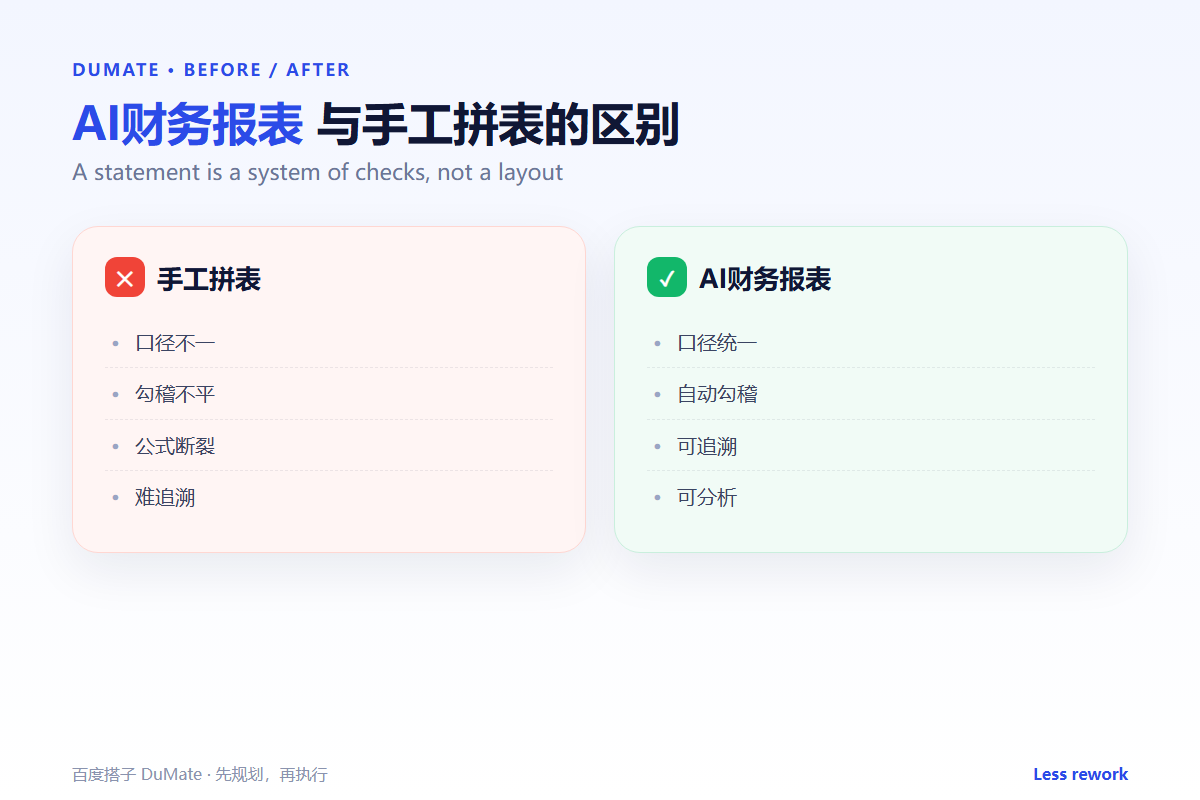
Before, a monthly pack took two days and still contained a cash flow that did not reconcile. After, AI财务报表 produced the tables and the check list, the accountant resolved two differences, and the pack shipped in half a day with a clear basis note.
The time saved came from structure, not from skipping the checks.
Used consistently, AI财务报表 becomes part of the normal review routine rather than a separate project.
A Four-Week Rollout
The first week with AI财务报表 should be a small pilot, not a team-wide launch. Choose one recurring task with a clear output and run it end to end. Keep the sample small enough to check by hand. The point is to see where AI财务报表 saves time and where it creates review work.
During the pilot, keep a short log of inputs, outputs, and corrections. Record the time spent before and after. AI财务报表 feels faster even when it is not, so the log matters. At the end of the week, review the log with one colleague and decide whether to continue, change the input, or stop.
In week two, write a one-page standard for input and output. Include what must be checked and who approves the result. AI财务报表 works better when the standard is visible to everyone. In week three, add permissions and a review step. In week four, compare the results and write a short guide. That guide is what makes AI财务报表 survive after the first month.
Keep the pilot narrow. A broad rollout hides which step failed, and a narrow one shows exactly where the workflow needs help. Expand only after the narrow case is stable.
Keep the first month simple. One task, one owner, and one weekly review are enough to prove the workflow before it spreads across the team.
Write down what changed after each run. A short note is easier to trust than a memory, and it makes the next improvement obvious.
FAQ
Can AI财务报表 replace an accountant?
No. It can format, compare, and draft commentary. Judgment about recognition, estimates, and disclosure stays with a qualified person.
What should be checked first?
The period, the currency, and the scope. Most comparison errors start there.
How much commentary is enough?
Three conclusions with numbers, plus a note on anything unusual. More text usually hides the important point.
延伸阅读
Prepare source tables with AI表格处理 and AI数据清洗. Budget work is covered in AI预算编制. For analysis, read AI数据分析工具. Access control is covered in AI权限管理. External references: NIST AI Risk Management Framework and ISO/IEC 42001.
评论
还没有评论,来说两句吧。以下为本文的引用通告: