
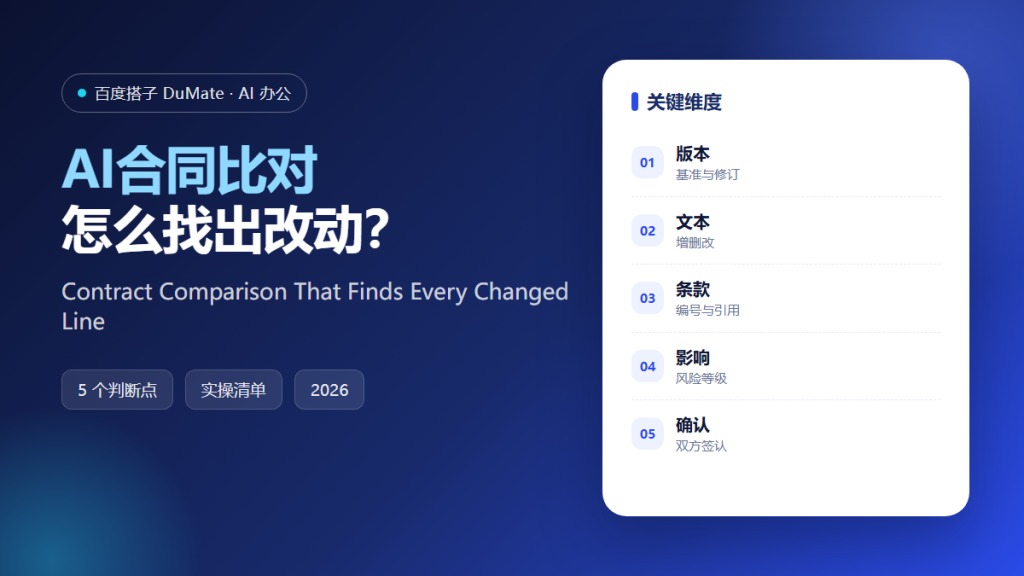
AI合同比对 answers a narrow question: what changed between two versions, and does it matter? A word-level diff is easy to produce. The hard part is separating formatting noise from a moved clause that shifts who bears a cost. AI合同比对 is valuable when it protects the reader from both misses and false alarms.
This guide covers file preparation, clause alignment, and the review habit that catches the changes a diff can hide.
Key Takeaways
- Normalize the files before comparing them.
- Align clauses by number and by heading.
- Classify each change as cosmetic, clarifying, or substantive.
- Read moved clauses in their new position.
- AI合同比对 should lock the compared version and record who approved it.
Why AI合同比对 Needs Clause Alignment
Renumbering creates the illusion of change. When a clause is inserted early, every later number shifts, and a naive comparison reports the whole document as modified. AI合同比对 that aligns by heading and by content, not only by number, keeps the reader focused on real edits. The same problem appears when a table row is split across pages, which a text diff reads as a deletion and an insertion.
Tables and annexes often carry the change that matters. A price schedule adjusted by two percent, or a service level moved from a table into a footnote, can matter more than a paragraph of new recitals. AI合同比对 should cover every part of the file, including headers and attachments.
Negotiation history is the third reason. Knowing who proposed a change, and whether it was accepted or traded away, prevents a team from reopening a settled point. AI合同比对 supports that record when each version is dated and attributed instead of being saved as final_v7. A three-line change log at the top of each draft is usually enough to preserve that history.
How AI合同比对 Works in Five Steps
Step 1: Normalize both files
Convert both versions to the same format, remove tracked changes that were already accepted, and confirm that fonts and page settings match. Many reported differences disappear at this stage. AI合同比对 should run on clean files, with the originals kept for reference. If the document came from email, confirm that the attachment matches the version discussed in the thread.
Step 2: Align the clause map
Build a list of clause numbers, headings, and first sentences for each version, then match them. Mark clauses that were added, deleted, or moved. AI合同比对 can do this quickly, but a reviewer should confirm the matches around definitions and schedules, where structure tends to drift.
Step 3: Separate noise from substance
Tag changes as formatting, clarifying, or substantive. A changed comma is noise; a changed shall to may is substantive. AI合同比对 that labels each edit helps the reviewer spend time on the second and third categories rather than scrolling through spacing corrections. Count the substantive edits before reading them, because a large number usually signals a rewritten clause rather than a typo.
Step 4: Review substantive changes in context
Read each substantive edit with the surrounding clause and any cross-reference. A deleted sentence may be harmless in one place and fatal in another. AI合同比对 can highlight the edit, but only a person can judge the effect on the deal. Check cross-references after a move, since a surviving reference to an old clause number can create an obligation nobody intended.
Step 5: Lock and distribute
Save the compared version with a date, a version number, and the name of the approver. Send one file rather than several annotated copies. AI合同比对 makes the history easy to read, which is why the team should agree on one place to keep it.
‘ alt=’AI合同比对 checklist: normalized files, clause alignment and substantive edits’ />
A Comparison Checklist for AI合同比对
- Both files use the same format and settings.
- Clause numbers and headings are matched.
- Tables, annexes, and definitions were compared.
- Every substantive change has a reviewer note.
- AI合同比对 output names the version and the approver.
Where AI合同比对 Fails
It fails when the tool is trusted to decide importance, because a diff cannot know which clause carries the commercial risk. AI合同比对 also fails when scanned documents are compared without recognition, since invisible text layers produce confident nonsense. The same applies to password-protected files that open as blank pages.
- Tracked changes left on in one file.
- Clauses moved across sections and reported as deleted.
- Footnotes and exhibits excluded from the comparison.
- No record of which version was actually signed.
Before and After
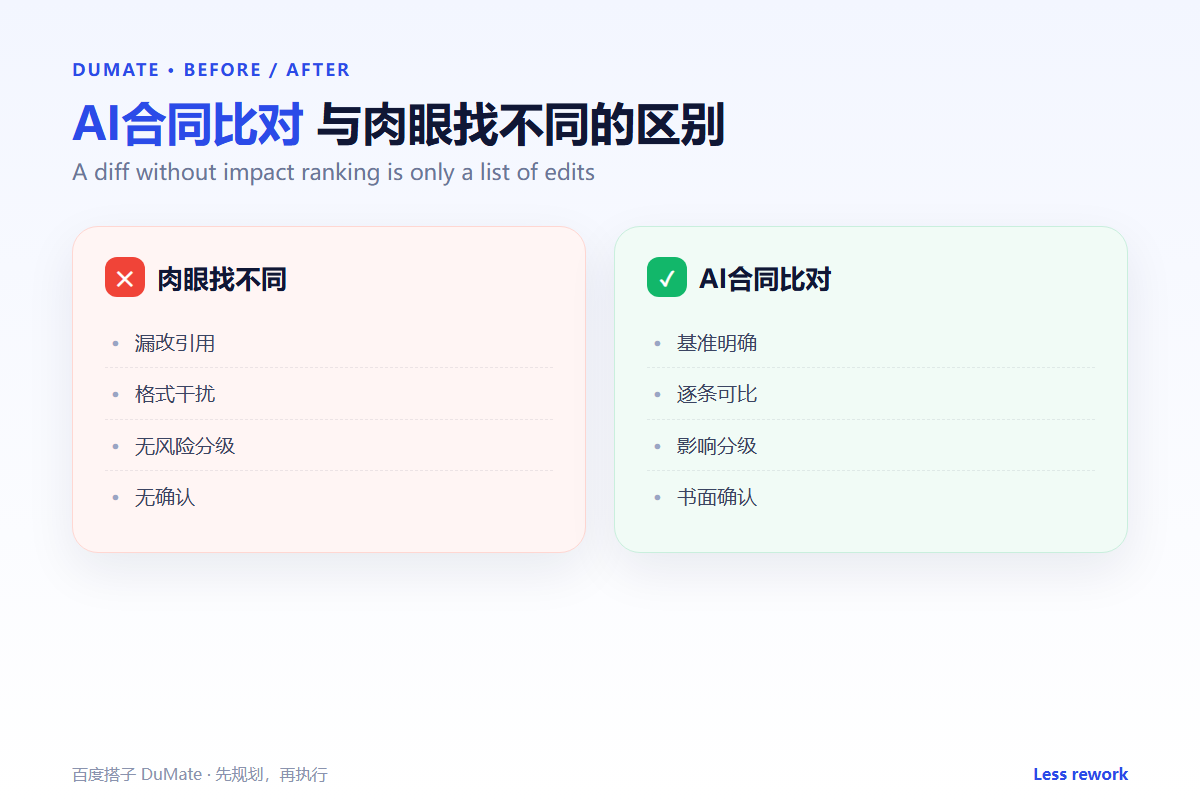
Before, a team compared supplier drafts by eye and missed a change from thirty days to fifteen days in the payment clause. The shift was small in the text and expensive in cash flow. The reviewer had compared two printouts and trusted the highlights.
After, AI合同比对 produced a clause map and flagged the edit as substantive. The reviewer discussed it in one email, restored the original term, and closed the file with a dated version that everyone could find.
FAQ
Can AI合同比对 handle scanned contracts?
Only after recognition, and the result needs checking. Poor scans merge columns and drop footnotes, so keep the image beside the text.
How do we avoid version confusion?
One numbering scheme, one owner, and one approved location. AI合同比对 should always state which two versions were compared. Store the output beside the signed file, not in a personal folder.
What counts as a substantive change?
Anything that alters money, risk, timing, or obligation. When unsure, treat the edit as substantive until someone confirms otherwise. A changed figure almost always qualifies.
延伸阅读
Clean the source text with document proofreading, and take unclear wording to legal consultation. Scanned files may need PDF editing before comparison, tender packs belong with bid review, and a final typo check catches the small mistakes a diff reports as noise. External references: NIST AI Risk Management Framework and ISO/IEC 42001.
评论
还没有评论,来说两句吧。