

What AI待办事项 Should Capture
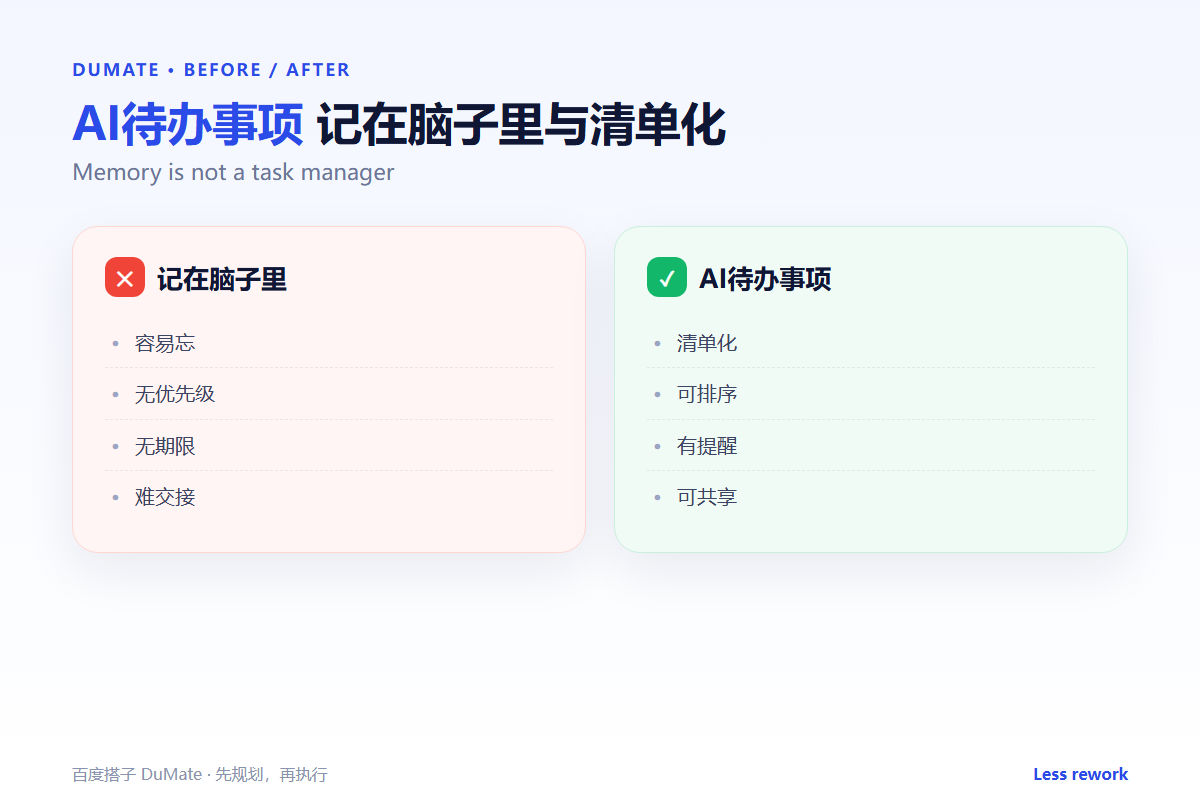
AI待办事项 is not a place to dump every sentence from a meeting. It is a short list of commitments with an owner and a date. If a task has no deadline and no owner, it is a wish, not a task.
- Extract the action, not the discussion.
- Write the next step as a verb.
- Give every task one owner.
- Add a real due date.
- Review and remove stale items weekly.
A Five-Step AI待办事项 Workflow
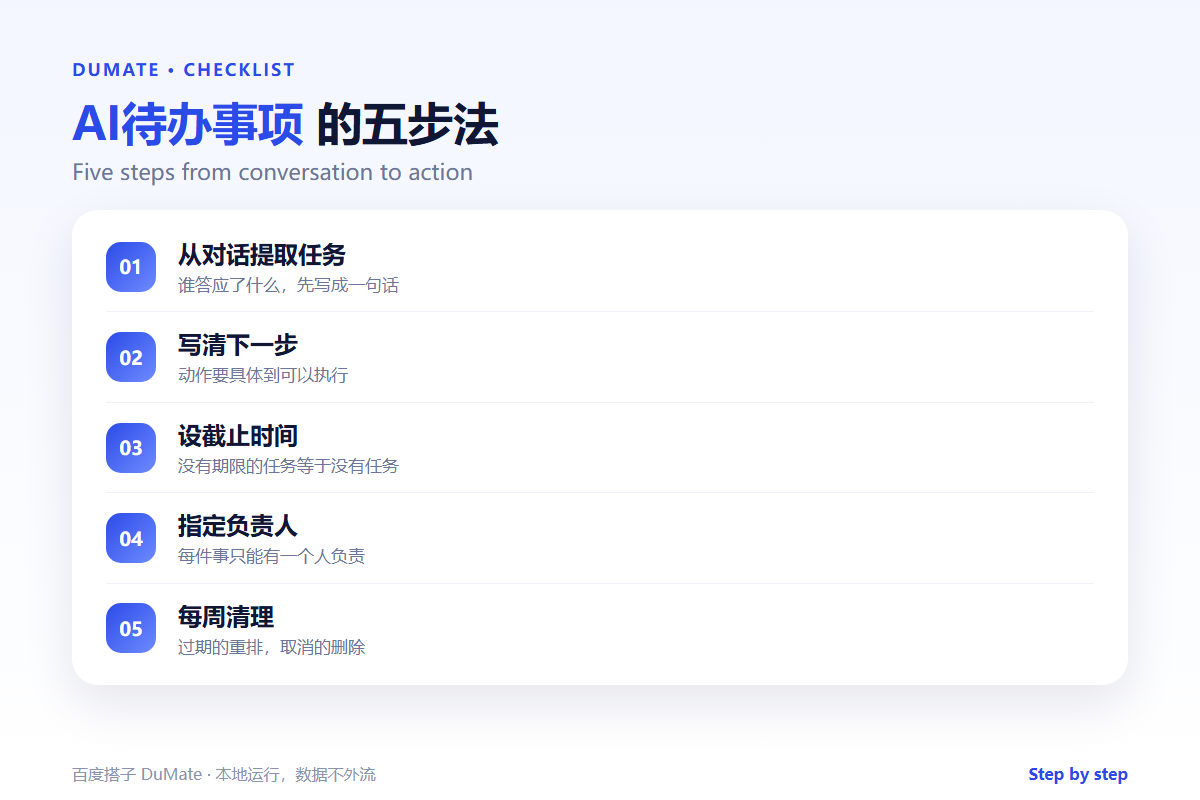
Start with the source: a meeting note, an email, or a chat thread. Ask the tool to list only the commitments. Then rewrite each one so a stranger could execute it.
- Extract commitments from the source.
- Rewrite each as a concrete next step.
- Assign one owner per task.
- Set a date and a priority.
- Review the list every Friday.
One owner, not a team
A task assigned to “the team” usually belongs to nobody. An AI待办事项 list should name a person even when the work is shared. The owner can delegate, but the list must show one accountable name.
Where the Real Risks Sit
The risk is a list that grows faster than it closes. Duplicates, vague verbs, and missing dates create the illusion of progress. A weekly review is the cheapest fix.
| Problem | Question | Fix |
|---|---|---|
| Duplicate | Is this the same task? | Merge and keep one owner |
| Vague | Can someone execute it? | Rewrite with a verb |
| No date | When is it due? | Add or delete |
| Stale | Is it still relevant? | Close or reschedule |
When tasks come from a meeting, the AI会议纪要 workflow is the source of truth. For multi-step work, the AI任务规划 method adds dependencies and checkpoints.
How to Evaluate AI待办事项
Use a real meeting transcript. A good AI待办事项 extraction will find the commitments and ignore the opinions. A poor one will turn every suggestion into a task, which is worse than missing one.
Start with one real task
Take the last meeting you attended. Extract the actions and compare them with what actually happened. The gaps show what the tool missed or invented.
What AI待办事项 cannot do
It cannot know which task matters most. Priority comes from goals, not from wording. Connect the list to the calendar so the important work gets time; the AI日程管理 guide shows how.
FAQ
Should I use one list or many?
One list per project is usually enough. Too many lists recreate the problem you are trying to solve.
How do I handle recurring tasks?
Create a template and a review cycle. The AI技能 approach makes the routine repeatable.
Can the tool remind me?
Yes, but reminders do not replace a weekly review. A reminder without a decision just moves the task forward.
References
评论
还没有评论,来说两句吧。以下为本文的引用通告: