
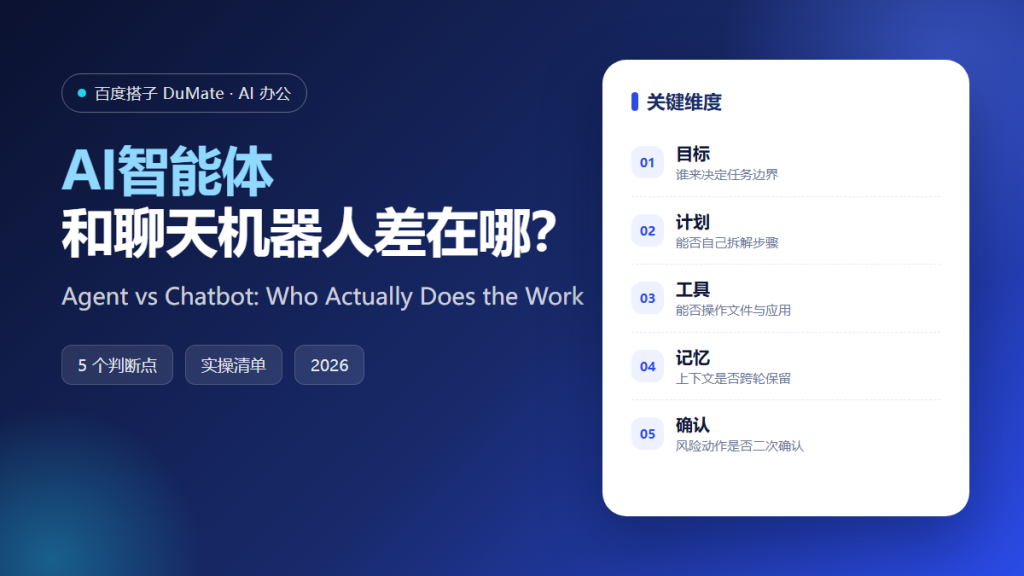
What an AI智能体 Actually Does
An AI智能体 is not a chatbot with a longer prompt. It is a system that takes a goal, splits it into steps, uses tools, and checks the result before delivery. That difference sounds small until you hand it real work: a chatbot answers, while an AI智能体 acts. In this guide we break down the five layers that decide whether an agent can finish a task, and where it still fails.
- An AI智能体 owns a goal; a chatbot waits for the next prompt.
- Planning is the first test: can it produce verifiable steps?
- Tool access decides whether the agent can touch real files and apps.
- Memory without permissions is a liability, not a feature.
- High-risk actions need a confirmation gate and a rollback path.
- Judge an AI智能体 by finished work, not by demo language.
Chatbot vs AI智能体: Five Differences
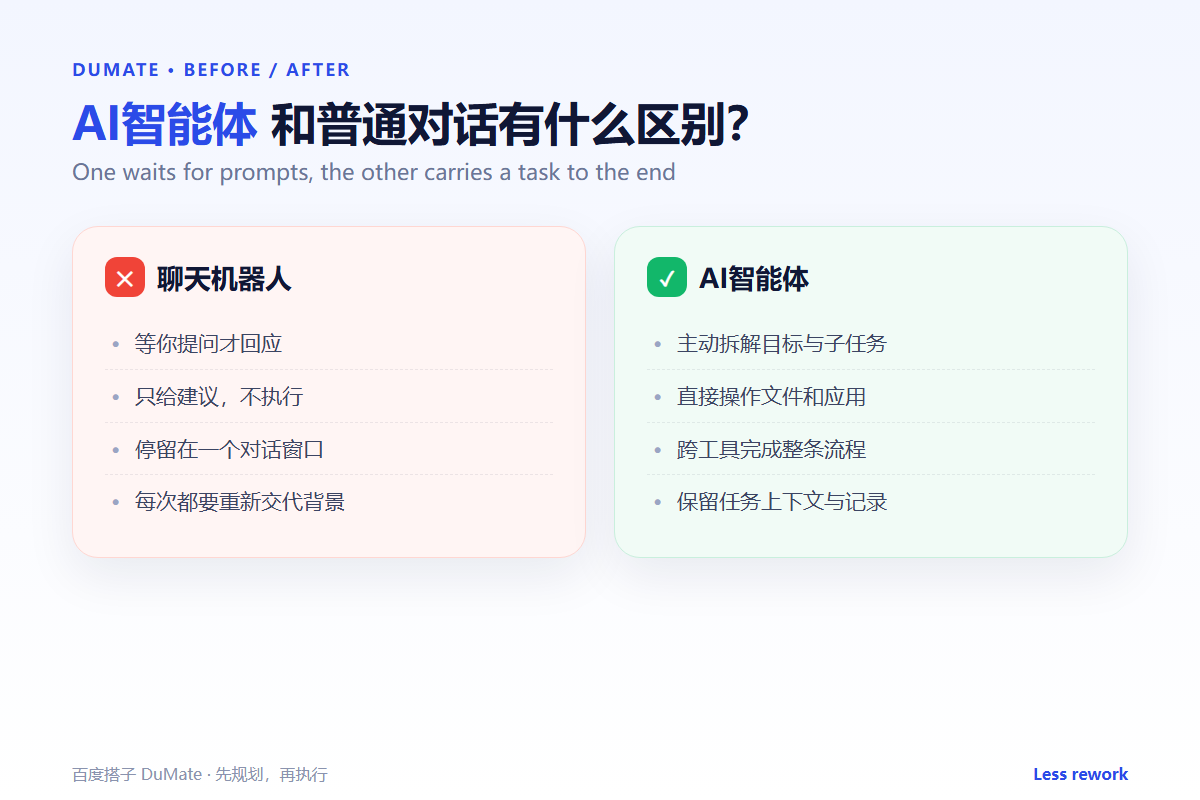
The fastest way to separate the two is to look at what happens after the first answer. A chatbot stops. An AI智能体 continues: it opens the file, edits the row, exports the report, and tells you what changed. However, that extra reach also creates extra risk, so the comparison has to include control, not just capability.
| Dimension | Chatbot | AI智能体 |
|---|---|---|
| Input | One prompt | A goal plus constraints |
| Output | Text | Files, updates, reports |
| Steps | Hidden | Explicit and checkable |
| Tools | None | Files, apps, APIs |
| Failure | Starts over | Logs, retries, or asks |
For a practical example, compare a desktop assistant with a browser chat window. The 桌面AI助手 comparison shows why local file access changes the nature of the task, not just the speed. Similarly, a workflow that moves data between apps needs an agent that can plan around application boundaries.
Layer One: Goal and Scope for an AI智能体
A vague goal produces a vague result. Before the agent starts, write the finish line as a sentence a colleague could verify. For instance, “organize the project folder by client and produce an index” is testable. “Clean up my files” is not. The first layer is therefore a contract between you and the system.
Write the finish line first
Include the format, the location, and the deadline. Add the items that must not change. An AI智能体 that knows the boundary is less likely to surprise you later. This single step prevents most rework, because the agent can check its own output against a written standard.
Layer Two: Planning and Tool Use
Planning turns a goal into a sequence. A good plan lists inputs, actions, and outputs for each step. It also marks dependencies, so the agent does not export a report before the source table is cleaned. Consequently, the plan becomes the audit trail when something goes wrong.
Tool use is the second half of this layer. An AI智能体 that can read local files, call an API, or operate a desktop application can complete work that a chat model cannot. The AI跨应用操作 guide explains how data moves between applications without copy-paste, and why permission boundaries matter at every hop.
Tools turn text into action
More tools are not automatically better. Each tool adds a failure mode: a missing file, an expired login, a changed button. Therefore, start with the smallest tool set that can finish the task, then expand only when the workflow proves stable.
Layer Three: Memory and Context
Memory helps an AI智能体 keep decisions consistent across steps. It should store the goal, the constraints, and the latest verified state. It should not store every intermediate thought. A short, structured memory is easier to audit and less likely to leak sensitive details into later steps.
Context is different from memory. Context is what the agent can see right now; memory is what it carries forward. If the two are mixed, the agent may repeat old assumptions after the source data changes. For this reason, every long task needs a “refresh” point where the agent re-reads the current file or record.
Layer Four: Confirmation and Rollback
Risk lives in verbs: delete, overwrite, send, pay, publish. An AI智能体 should pause before any of them and show exactly what will change. A confirmation screen is not friction; it is the difference between a useful assistant and an expensive accident.
Rollback is the other half. Before a destructive action, keep a copy, a version, or a log. If the result is wrong, you need a way back that does not depend on memory. This is also why the AI自动化流程 checklist puts verification before scale.
Where an AI智能体 Still Fails
Agents fail in boring ways. They misread a filename, assume a column is numeric, or skip a permission check. They also fail when the task depends on tacit knowledge that was never written down. A demo hides these gaps because the presenter chooses the easy path.
- Unstable interfaces break recorded steps.
- Ambiguous goals produce plausible but wrong output.
- Missing permissions stop the task halfway.
- Long chains amplify a small early error.
- No owner means no one fixes the workflow.
These limits do not make agents useless. They simply move the human role from typing to reviewing. The AI办公助手 review reaches the same conclusion after six real tasks: the value appears when the task is repeatable and the check is explicit.
A One-Afternoon Evaluation Plan
You do not need a pilot program to judge an AI智能体. Pick one repeated task, run it end to end, and score the result. First, record the current manual time. Then, ask the agent to produce a plan before it acts. Next, check whether the plan matches the real workflow. Finally, run the task twice and compare the outputs.
- Choose a task with a clear finish line.
- Ask for a written plan and correct it once.
- Run the task on a copy of real data.
- Check permissions and confirmation points.
- Measure review time, not just generation time.

FAQ
Is an AI智能体 safe for local files?
It can be, if the agent runs with folder-level permissions and asks before destructive actions. Local execution reduces exposure, but it does not remove the need for confirmation and logs.
Do I need to replace my current tools?
Usually not. A useful AI智能体 works across the tools you already use. The 百度搭子 hands-on review shows the same pattern: the agent coordinates existing applications instead of forcing a migration.
How do I measure success?
Measure finished tasks and review time. A fast answer that needs a full rewrite is slower than a careful draft that needs one edit.
References
延伸阅读: 《AI会议纪要 怎么生成?From Call to Action Items》、《AI生成PPT 靠谱吗?Outline, Layout and Export》、《AI文件搜索 怎么用?Find by Meaning, Not Name》、《AI任务规划 怎么拆?Plan, Execute, Verify》。
延伸阅读: 《AI邮件助手 怎么少漏重要邮件?Triage and Follow Up》、《AI日程管理 怎么排才不打架?Protect Focus Time》。
评论
还没有评论,来说两句吧。