
AI合规检查 produces assurance only when it produces evidence. A checklist with green marks is a claim; a folder of dated records is proof. AI合规检查 becomes valuable when the difference between the two is visible on every line of the report.
This guide covers obligation mapping, sampling, gap ratings, and the remediation trail that turns a one-off review into a repeatable control.
Key Takeaways
- Start from the obligation, not from the control list.
- Require dated evidence for every green mark.
- Sample, and record how the sample was chosen.
- Rate gaps by impact and likelihood.
- AI合规检查 should assign an owner and a date to each remedy.
Why AI合规检查 Needs a Source of Truth
Obligations arrive from several directions: legislation, industry rules, customer contracts, and internal policy. They overlap and occasionally conflict. AI合规检查 without a register of obligations will test whatever is easy to test and leave the awkward requirement unexamined until an auditor asks about it. A register also makes it possible to show which obligations apply to which business unit, a question that always arrives during due diligence.
Evidence decays. A policy document proves that someone wrote a rule, not that anyone followed it. Training records, access reviews, and ticket logs show practice over time. AI合规检查 that accepts a policy as proof turns an intention into a false assurance. The same logic applies to training slides without attendance records and to access policies without a review log.
Consistency is the third reason. Two reviews conducted with different methods cannot be compared, and a regulator will notice. AI合规检查 works when the same questions, the same sampling rule, and the same rating scale are applied each quarter, so progress is measurable rather than rhetorical.
How AI合规检查 Works in Five Steps
Step 1: List the obligations
Build a register with the source, the requirement, the jurisdiction, and the date it took effect. Write each item as a testable statement rather than a topic. AI合规检查 can extract candidates from documents, but a qualified person should confirm the interpretation. Record the interpretation itself, because the same sentence can be read two ways by two competent people.
Step 2: Map controls to obligations
For each obligation, name the control that satisfies it, the system where it lives, and the person accountable. Note where one control covers several obligations and where none exists. AI合规检查 that maps many-to-many relationships exposes duplication as well as gaps.
Step 3: Test the evidence
Pull a sample and check the records against the control description. Record the sample size, the selection method, and the period covered. AI合规检查 can assemble the file, but the reviewer should confirm that the evidence is current and belongs to the process being tested. Where evidence is missing, say so plainly instead of substituting a description of the process.
Step 4: Rate and prioritize gaps
Score each gap by impact and likelihood, then place it on a short list with a target date. A missing record for a low-risk process is different from an uncontrolled access path to customer data. AI合规检查 should keep the reasoning visible instead of reducing everything to a color. Include the reason for the rating in one sentence, so a later reader can challenge the judgment rather than the score.
Step 5: Track remediation
Give every gap an owner, an action, and a due date, then re-test the same way at the next review. Close items only when evidence exists. AI合规检查 that reports the same open gap for three quarters is telling you something about ownership, not about the tool.
‘ alt=’AI合规检查 checklist: obligations, evidence sampling and remediation owners’ />
An Evidence Checklist for AI合规检查
- Each obligation has a source and an effective date.
- Every control names an accountable person.
- Samples are documented and reproducible.
- Gaps carry a rating and a due date.
- AI合规检查 reports cite the evidence file, not just a status.
Where AI合规检查 Fails
It fails when it becomes a document-collection exercise with no test of practice. AI合规检查 also fails when the scope is defined by what the team can easily reach, leaving third parties, contractors, and legacy systems outside the review. It also fails when the review is scheduled to satisfy a deadline rather than to answer a question.
- Controls copied from a framework without local interpretation.
- Evidence accepted without a date or an owner.
- Findings phrased so vaguely that nobody can close them.
- Reviews repeated without comparing results over time.
Before and After
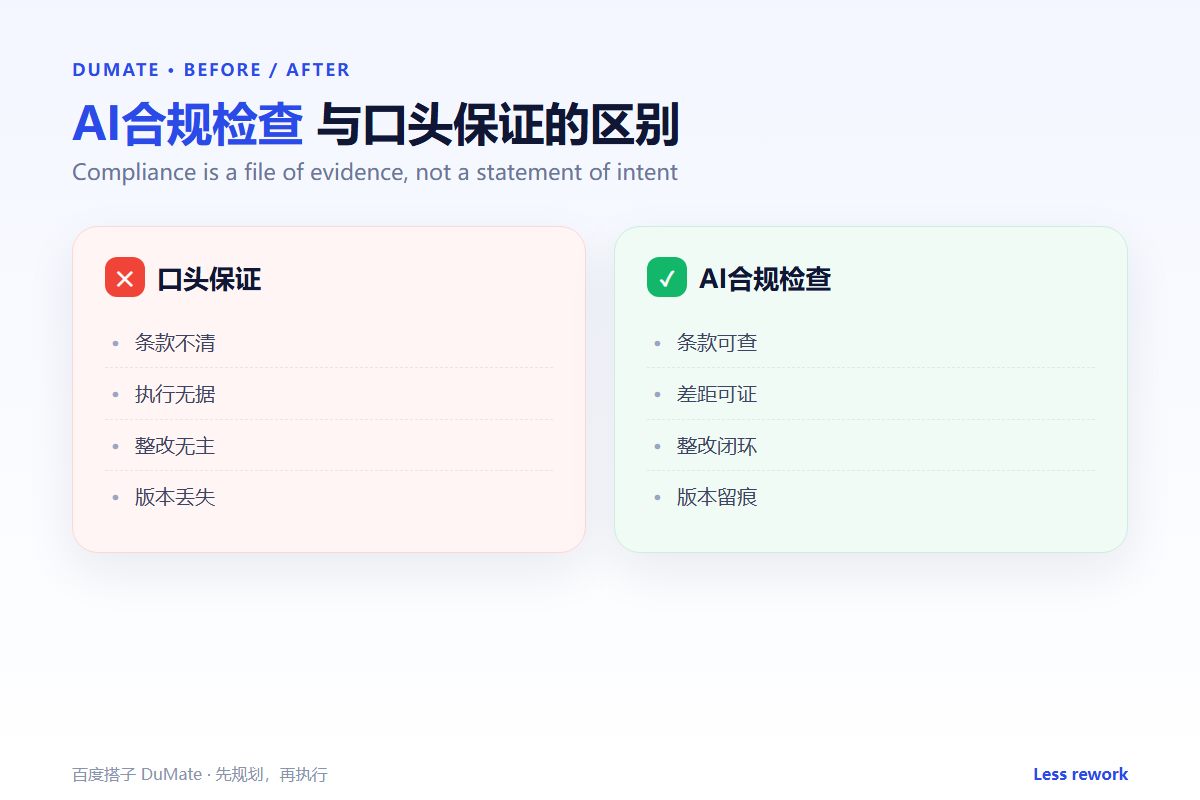
Before, a company prepared for audits by asking each department for its policies a month in advance. The folder was complete, and the first interviews revealed that two of the practices had stopped a year earlier.
After, AI合规检查 mapped each obligation to a control and a sample of records. The review found three real gaps, each with an owner and a date, and the next audit required a week instead of a quarter of scattered preparation. The evidence folder was smaller than before, and every item had a date.
FAQ
How large should a sample be?
Large enough to support the conclusion you plan to state. Small samples can show a control works sometimes; they rarely support a claim that it always works. For low-volume controls, test every instance and describe the period covered.
Can AI合规检查 certify compliance?
No. It organizes evidence and exposes gaps. Certification comes from an independent assessment and from management accepting responsibility.
How often should the review run?
At least annually, and sooner after a major change in systems, suppliers, or regulation. The same method matters more than the frequency.
延伸阅读
Connect findings to a policy briefing for leadership and to legal consultation where interpretation is unclear. Contract duties belong in document proofreading checks before signature, data practices in data labeling records, and technical traces in log analysis. Keep the final report to one page. External references: NIST AI Risk Management Framework and ISO/IEC 42001.
评论
还没有评论,来说两句吧。