
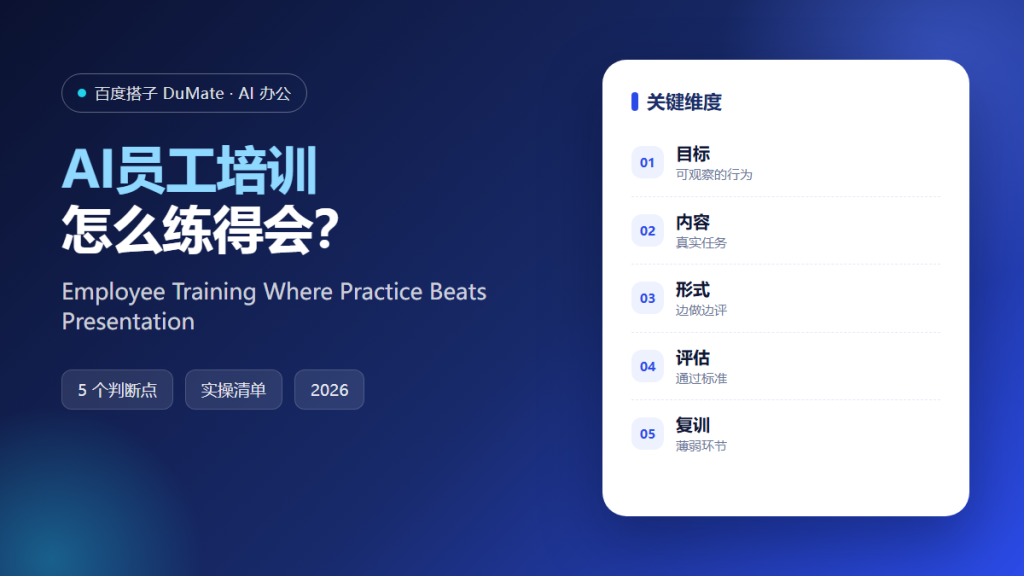
AI员工培训 works best when employees do something, not when they watch something. A slide deck can introduce a policy, but the skill of applying it is built through repetition, feedback, and small failures that are safe to make. The training function should be judged by what people can do on Monday, not by how polished the session looked on Friday.
This guide explains why practice outperforms presentation, how AI员工培训 runs a five-step cycle, and which signs show that a program produces confidence without competence. The goal is a habit that survives the week after the workshop.
Key Takeaways
- Start with a task employees must perform.
- Keep sessions short and repeat them over weeks.
- Give feedback against a visible standard.
- Use real examples with the details removed.
- Measure AI员工培训 by behavior, not attendance.
Why AI员工培训 Needs Active Practice
People forget most of what they hear in a single session. The forgetting curve is steep, and an annual refresher does little to flatten it. AI员工培训 should therefore schedule practice close to the moment of need and repeat it at intervals, so the knowledge is retrieved rather than merely recognized.
Practice also reveals gaps that a quiz cannot. An employee may recite the refund policy and still freeze when a customer asks for an exception. AI员工培训 can generate realistic scenarios, but the value comes from the employee making a decision, explaining it, and hearing where the reasoning broke down.
Finally, practice changes the role of the trainer. Instead of performing expertise for an hour, the trainer designs exercises and reviews attempts. That shift is uncomfortable for subject experts who enjoy presenting, yet it is the only reliable route from awareness to habit. A short cycle also fits around shift work, which makes attendance easier to sustain.
How AI员工培训 Works in Five Steps
Step 1: Name the performance
Write one sentence describing what a trained employee should be able to do. For example: handle a delayed delivery complaint without escalating. Vague goals such as understand the process cannot be practiced or assessed.
Step 2: Build a short scenario
Create a realistic case with a customer, a constraint, and a decision point. Remove names and confidential details. AI员工培训 can produce several variants so employees do not memorize a single script.
Step 3: Let them attempt it
AI员工培训 should ask each person to respond in writing, by voice, or in a role play. Keep the attempt brief. The goal is to surface the current approach, including the shortcuts and misunderstandings that a lecture would never reveal.
Step 4: Review against a standard
Show the criteria before the attempt and use the same criteria in feedback. Point to one thing that worked and one thing to change. AI员工培训 can draft the feedback, but a manager should confirm that the standard matches the actual policy.
Step 5: Schedule retrieval
AI员工培训 should repeat a shorter version after one week, one month, and one quarter. Change the scenario each time. Spacing is what turns a successful attempt into a durable skill, and it costs far less than another full workshop.
‘ alt=’AI员工培训 checklist: performance goal, scenario, attempt, feedback and spacing’ />
A Training Design Checklist
- The performance goal is observable.
- Scenarios reflect real daily work.
- Every learner makes an attempt.
- Feedback uses published criteria.
- Review sessions are spaced over time.
Where AI员工培训 Fails
AI员工培训 fails when the tool is used to generate more slides. A prettier deck does not create practice, and a longer deck reduces the time available for it. It also fails when attendance is treated as evidence of learning.
- Scenarios that are too easy or too strange.
- No feedback beyond a score.
- One session with no follow-up.
- Content that contradicts the current policy.
Before and After
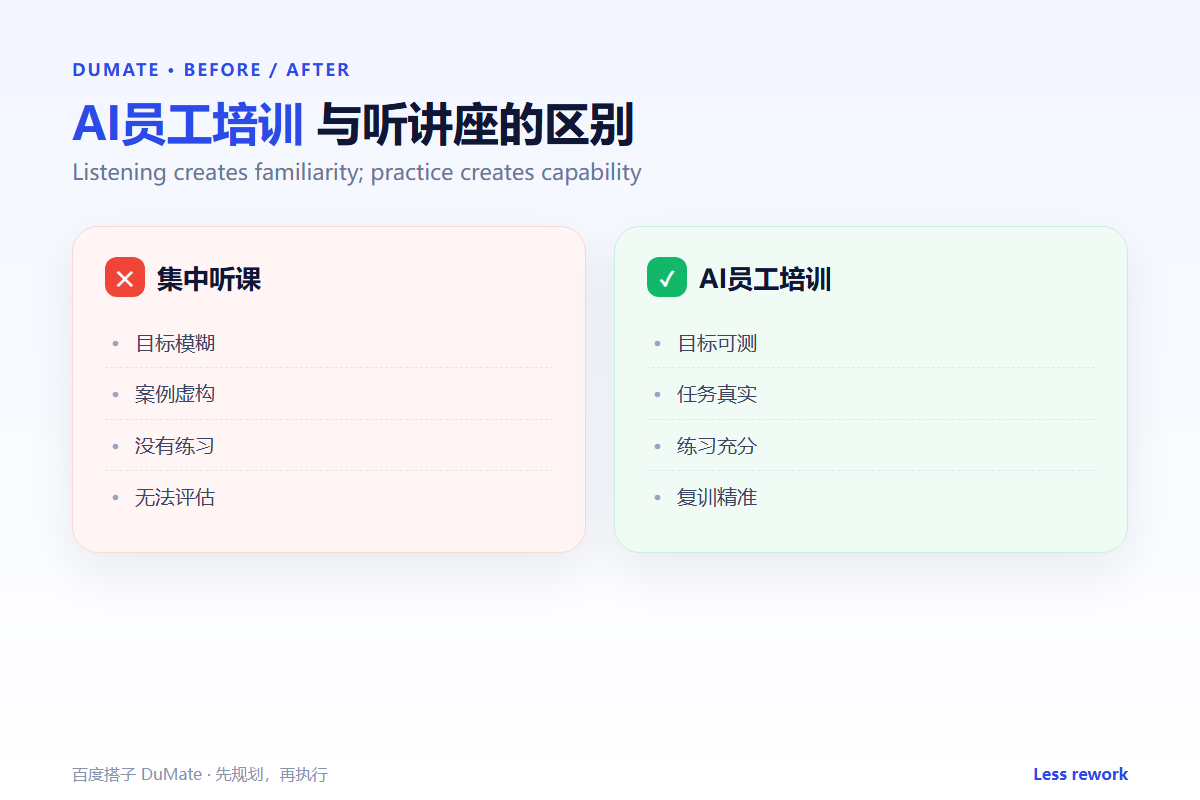
Before, a compliance team delivered a two-hour presentation once a year and measured success by sign-in sheets. Employees could repeat the rule but still routed exception requests to the wrong desk. After, AI员工培训 produced six short scenarios, each followed by a two-minute review, and the error rate fell within a month.
AI员工培训 is not an event that happens to employees. It is a cycle they repeat until the work feels ordinary.
Keep the first month simple. One task, one owner, and one weekly review are enough to prove the workflow before it spreads across the team.
Write down what changed after each run. A short note is easier to trust than a memory, and it makes the next improvement obvious.
Review the output before it leaves your desk. A two-minute check catches most of the errors that would otherwise come back as questions.
Keep one example of a good result. New team members learn faster from a concrete reference than from a long explanation.
The first version does not need to be perfect. It needs to be complete enough to review, so the team can see the gaps and fix them in the next round.
Write the review notes in the same place as the work. Notes stored somewhere else are rarely read when the next decision arrives.
FAQ
How long should a session be?
Twenty to forty minutes for practice, with follow-up sessions of ten minutes. Attention drops quickly when the format is passive.
Can AI员工培训 replace a subject expert?
No. It can generate scenarios and draft feedback, but an expert must confirm accuracy and handle edge cases.
How do we measure results?
Track behavior: error rates, escalation volume, response time, or audit findings. Attendance and quiz scores are weak proxies.
延伸阅读
Design the sequence with lesson plan and build materials in courseware making. Reuse items with question bank. Verbal drills are covered in speaking practice, and individual study plans appear in study plan. External references: NIST AI Risk Management Framework and ISO/IEC 42001.
评论
还没有评论,来说两句吧。