

Most store visits end with a walk-through and a few photos on someone’s phone. The photos arrive without a timestamp, the notes say the aisle could be tidier, and by the time a regional manager reads them the shift has changed twice. AI门店巡检 is not a camera that watches staff; it is a routine that produces a dated record, a named owner, and a deadline for every issue found.
The five steps below cover how to write the checklist, how to collect evidence that can be checked, how to assign fixes, and how to confirm that a fix actually happened.
Key Takeaways
- A checklist item describes a visible condition, not an attitude.
- AI门店巡检 should attach a time, a place, and a photo to every finding.
- Each failed item gets one owner and one deadline, recorded in AI门店巡检.
- Re-inspection is scheduled when the fix is assigned.
- Reports compare stores on the same items, not on a total score.
Why AI门店巡检 Needs Evidence, Not Impressions
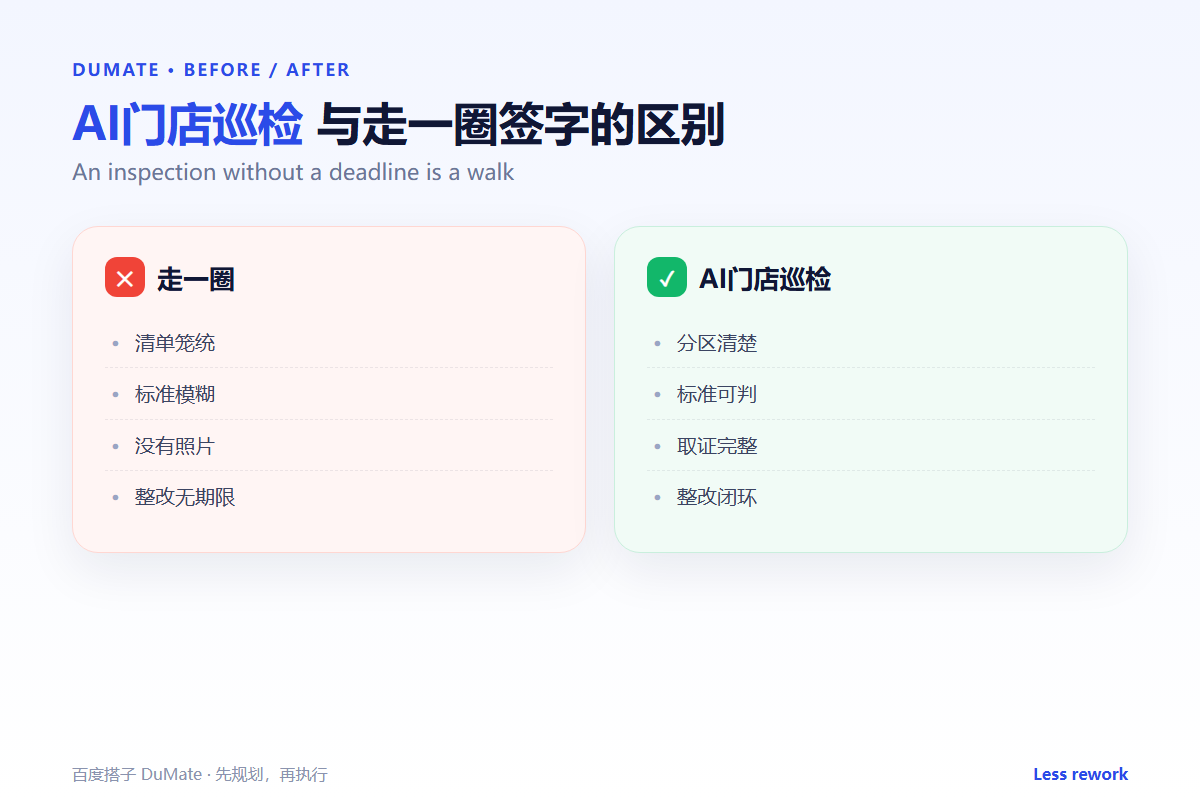
Two managers can walk the same aisle and write opposite reports. One notices a missing price tag, the other notices a friendly greeting, and both are right. A visit that records impressions cannot be compared across stores or across months. AI门店巡检 fixes the unit of observation: a shelf, a sign, a temperature log, a fire door, each with a condition that either holds or does not.
Evidence also changes the conversation. A photo taken at 14:20 with the freezer door open is hard to argue with and easy to fix. A sentence that says the storage area is untidy invites a debate about standards. Teams that adopt AI门店巡检 spend less time defending judgments and more time closing items.
The third reason is fairness. Staff know when a visit is subjective, and they respond by tidying only what the visitor tends to notice. A fixed list applied to every store removes that game. It also protects the manager who has to report a problem at a store whose sales are otherwise strong.
How AI门店巡检 Works in Five Steps
Step 1: Write visible checklist items
Keep the list to twenty-five items across safety, freshness, pricing, availability, and presentation. Each item states a location and a condition, such as a fire door that closes fully and stays unobstructed. Remove anything that requires reading a person’s mood. A short list that is actually checked beats a long one that gets skimmed. AI门店巡检 is designed around what a visitor can see in fifteen minutes.
Step 2: Capture time, place, and photo
Every finding needs a timestamp, a store identifier, and a photo taken at the item. The app should refuse a submission without all three. Geofencing and a live camera prevent the common shortcut of reusing last month’s images. AI门店巡检 is only as good as the record it leaves behind.
Step 3: Score the item, not the store
Mark each item pass, fail, or not applicable, with a note for the last. Avoid a single score that mixes a missing price tag with a blocked exit, because the two carry different risks. When the report lists items rather than a total, AI门店巡检 tells a district manager exactly what to fix first.
Step 4: Assign an owner and a deadline
A failed item goes to a named person with a date: seventy-two hours for safety, seven days for presentation. The assignee uploads a photo of the fix. Items that miss the deadline escalate to the next level automatically, so follow-up does not depend on anyone’s memory. The owner should be the person who can actually close the item.
Step 5: Re-inspect and compare
Schedule the re-check when the fix is assigned, not when the report is written. Compare stores only on the same items, and compare one store against its own past. AI门店巡检 earns trust when a manager can see that a repeated failure is a process problem rather than a careless shift.
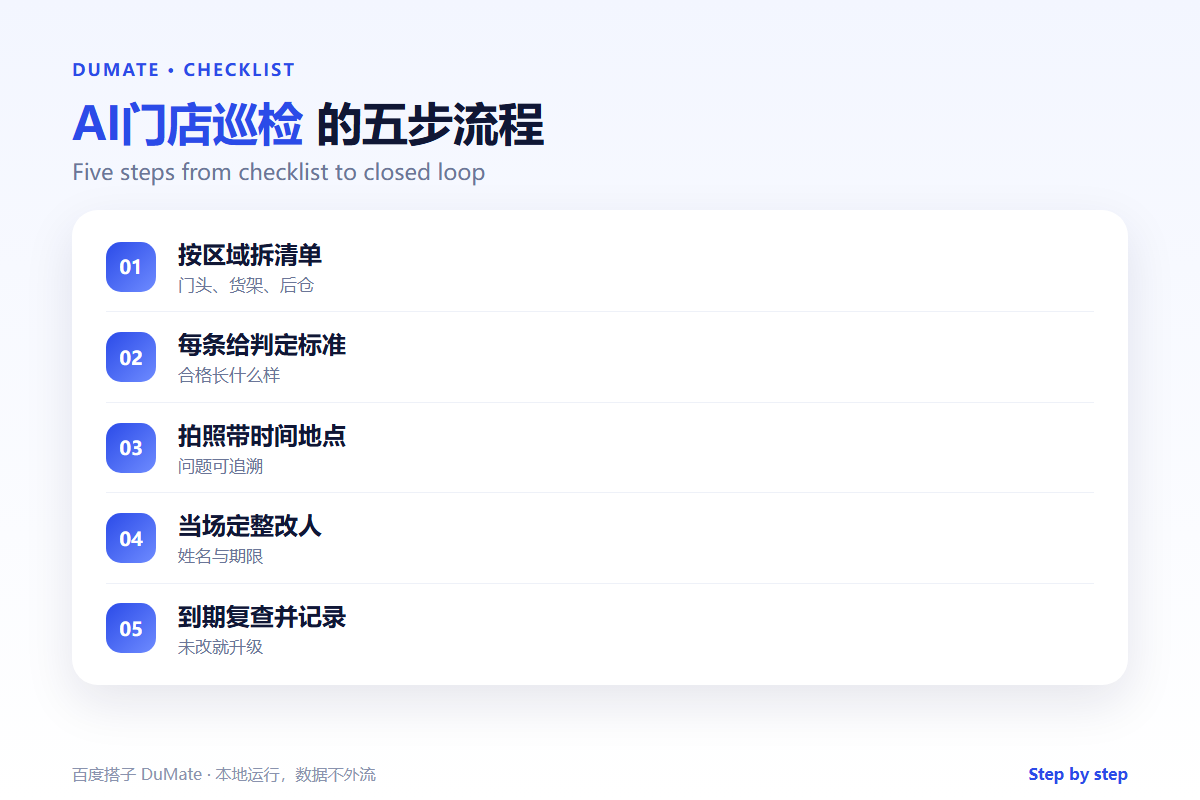
A Visit Checklist for AI门店巡检
- Items name a location and a visible condition.
- Each finding carries a timestamp and a photo.
- Every failure has one owner and a due date.
- Safety items escalate within seventy-two hours.
- The same list is used in every store.
Where AI门店巡检 Fails
It fails when the checklist is written to catch people rather than to protect customers. Staff learn to game a punitive list within a month, and AI门店巡检 produces tidy photos of the wrong things.
- Items that require a manager’s judgment to score.
- Photos taken from the doorway instead of at the shelf.
- Fixes marked complete without a second photo.
- Stores ranked by total score across different formats.
Before and After
Before, a grocery chain inspected 40 stores each month on paper forms. Roughly a third came back incomplete, and the same cold-room fault appeared in six stores for three months because nobody owned the fix.
After, AI门店巡检 used a 25-item list with photo evidence and automatic escalation. Incomplete visits fell to 4 percent, cold-room repairs closed in two days on average, and the district review meeting shrank from ninety minutes to thirty.
FAQ
Does AI门店巡检 mean staff are watched all day?
No. It records conditions at the time of a visit. Continuous cameras need a separate policy, a lawful basis, and a conversation with staff representatives.
How often should stores be inspected?
Monthly for most formats, weekly for food and safety-critical areas. Frequency should follow risk, not the district manager’s travel schedule.
What about small stores without a resident manager?
Use a shorter list of twelve items and let the area lead own the fixes. The list matters more than its length.
延伸阅读
Inspection records become more useful when ops monitoring follows the same stores between visits, expense report workflow handles the repair spend a visit uncovers, and dashboard design rules keep the report readable at a glance. Use incident triage when a safety item fails twice and supplier evaluation when the same fixture keeps breaking. External references: NIST AI Risk Management Framework and ISO/IEC 42001.
评论
还没有评论,来说两句吧。