
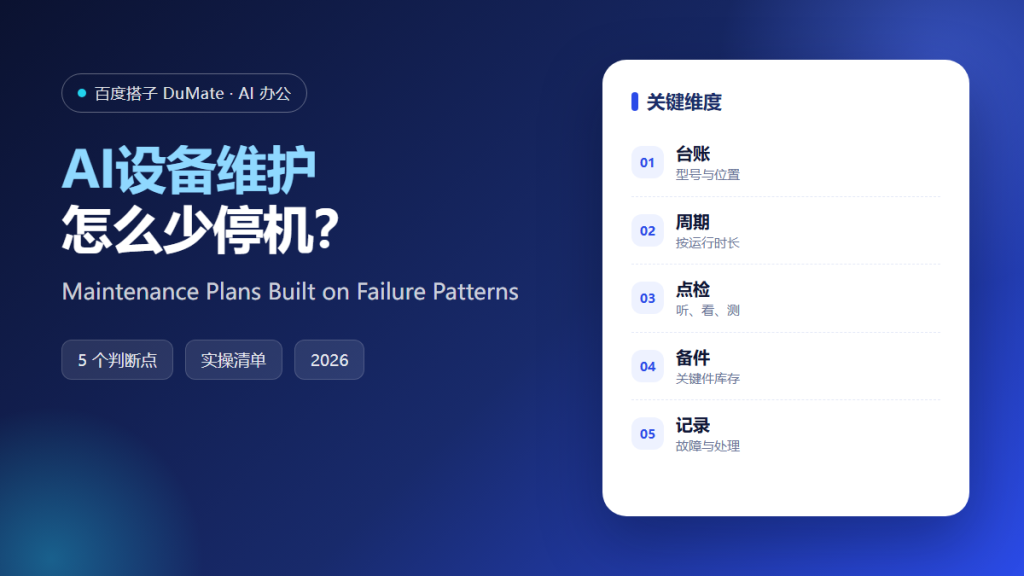
Most maintenance teams still plan by calendar and memory: grease the line every six weeks, replace the belt when it looks worn, call the vendor when the machine stops. The schedule is easy to explain and expensive to follow, because it ignores how the equipment actually fails. AI设备维护 starts from failure history and works backward to a plan.
The method below covers the asset register, the failure codes that make history usable, the thresholds worth monitoring, and the review that keeps the plan honest.
Key Takeaways
- Every asset needs one identifier and one failure history.
- AI设备维护 should schedule work from patterns, not habit.
- Condition data earns its cost only where failure is gradual.
- Spare parts follow lead time and line criticality.
- A weekly review connects work orders to the plan.
Why AI设备维护 Needs a Failure History
A maintenance plan is a set of predictions. Without a record of what failed, how it failed, and how long the repair took, those predictions come from a manual written for a different plant. AI设备维护 needs three fields on every work order: the failure mode, the cause, and the downtime. Those three make a thousand work orders worth more than a sensor.
Failure modes behave differently. A bearing wears, a sensor drifts, a seal leaks, and a software fault appears without warning. Preventive work suits the first two, inspection suits the third, and redundancy or fast response suits the fourth. AI设备维护 that applies one interval to all four wastes money on some assets and misses failures on others.
The third reason is money. Maintenance budgets are usually cut first and defended last. A plan that can show which task prevented which failure survives that argument. AI设备维护 gives the team a way to defend a schedule with evidence rather than with seniority.
How AI设备维护 Works in Five Steps
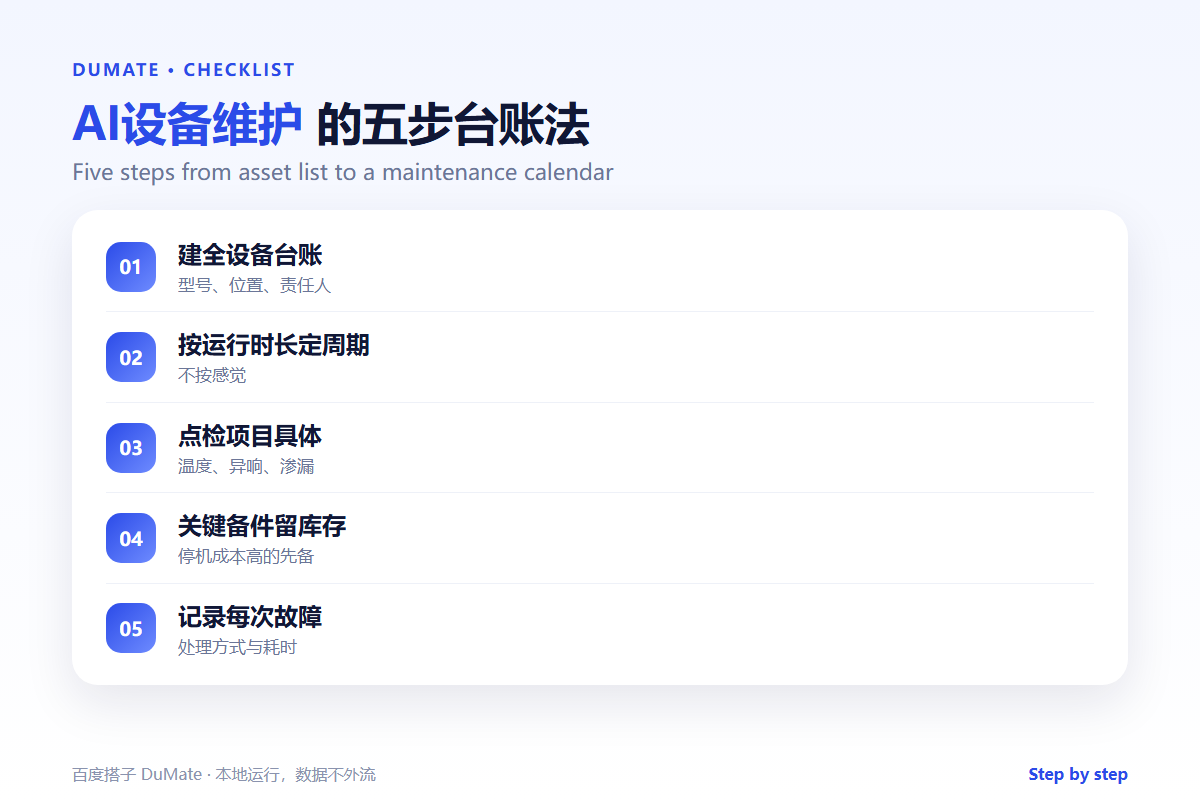
Step 1: Build the asset register
List every machine, its criticality, its age, and the line it supports. Assign an identifier that appears on the work order, the spare part, and the drawing. Merge duplicates left by old systems before adding analytics, because a register with two names for one pump will produce two histories and no pattern. A clean register is the least glamorous part of AI设备维护 and the one that decides whether the rest works.
Step 2: Code the failures
Use a short list of failure modes and causes, and require a code to close a work order. Review the list after a month, since technicians will invent codes when it does not fit. Clean coding is what turns a folder of repair notes into a dataset that AI设备维护 can use.
Step 3: Choose what to monitor
Monitor condition only where failure gives warning: vibration, temperature, pressure, current. For assets that fail instantly, put the money into spares and response time instead. AI设备维护 should not buy sensors for a pump that either runs or burns out in a second.
Step 4: Set intervals and triggers
Combine calendar tasks for slow wear with condition triggers for the rest. Start with the manufacturer’s interval, then move it based on observed failures. A trigger that fires weekly without a finding is a signal to widen the threshold, not to hire another analyst. Review each change against downtime, and write the reason beside the new interval so the next planner can see why it moved.
Step 5: Plan spares and review weekly
Rank spare parts by lead time and criticality, and hold stock for the items that stop the line. Then meet for twenty minutes a week to compare planned work with what actually failed. AI设备维护 improves when the plan is edited in that meeting rather than at the annual review.
A Maintenance Checklist for AI设备维护
- Every asset has one identifier and one history.
- Work orders close with a failure mode and a cause.
- Condition monitoring sits where failure is gradual.
- Spares follow lead time and line criticality.
- The plan is revised weekly, not annually.
Where AI设备维护 Fails
It fails when the data is clean but the schedule is never changed, and it fails when a pilot proves a model and leaves technicians without a new routine. AI设备维护 is a management practice before it is a model.
- Sensors installed but alerts nobody reads.
- Half the work orders closed as other.
- Spares bought for cheap items, not slow ones.
- Downtime measured by the vendor’s definition.
Before and After
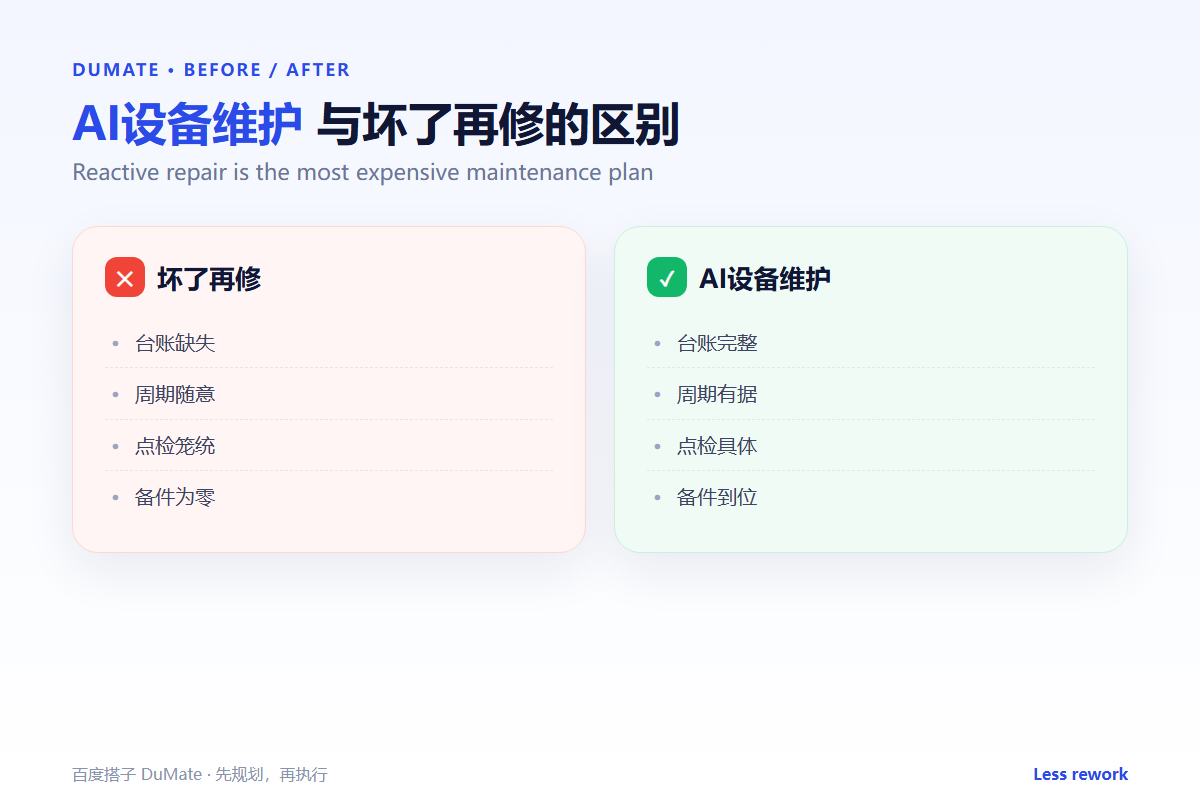
Before, a packaging plant ran a fixed six-week service on 120 assets. Bearing failures caused 14 hours of unplanned downtime a month, and the store held 400 part numbers, many for machines retired years earlier.
After, AI设备维护 grouped assets by failure mode, put vibration monitoring on 18 critical motors, and cut the catalog to 150 items. Unplanned downtime fell to 4 hours a month, and the maintenance lead moved two tasks from calendar to condition at the weekly review.
FAQ
Do we need sensors to start AI设备维护?
No. Begin with coded work orders and a clean asset register. That history shows which assets deserve monitoring and which do not.
How long before the plan improves?
A quarter of consistent coding is usually enough to see the top three failure modes. Change intervals only after two cycles of evidence.
Who should own the plan?
The maintenance lead, with a planner who keeps the register and the codes honest. Ownership by committee tends to produce a plan nobody edits.
延伸阅读
Maintenance work connects to incident triage when a failure interrupts service and to ops monitoring for the signals that precede it. Use inventory forecast to hold the right spares, supplier evaluation to judge vendor response, and log analysis to reconstruct the minutes before a stop. External references: NIST AI Risk Management Framework and ISO/IEC 42001.
评论
还没有评论,来说两句吧。