
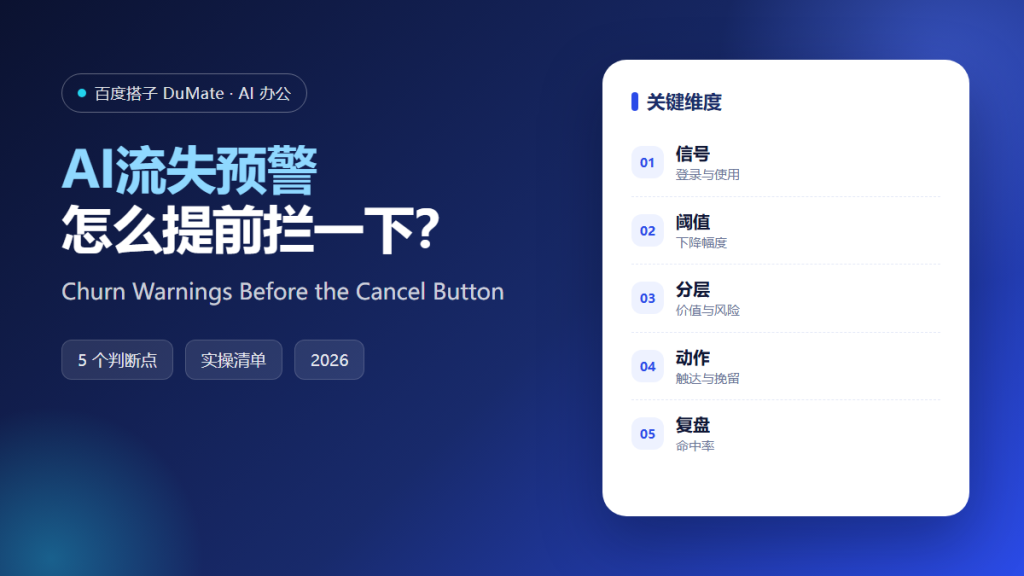
AI流失预警 is useful only if it arrives while there is still time to act. A model that predicts cancellation one day before it happens is an obituary, not a warning. The practical goal is to catch a change in behavior two to four weeks earlier.
This guide covers a five-step warning system, the signals that usually move first, and the review that separates a real risk from normal fluctuation.
Key Takeaways
- Define churn precisely.
- Track login, core usage, and support sentiment.
- Use graded thresholds, not one cutoff.
- Match each level to an action and an owner.
- Review hits and false alarms monthly.
Why AI流失预警 Needs Early Signals
Billing events are late. By the time a payment fails or a cancellation is submitted, the customer has already decided. AI流失预警 should look at behavior that changes before the decision: fewer logins, fewer core actions, more support contacts, and shorter sessions.
The second reason is cost. Retention actions are not free. Graded thresholds let the team spend a human call on the highest-risk accounts and an automated message on the rest.
How AI流失预警 Works in Five Steps
Step 1: Define churn
Write the rule: no core action for thirty days, or a downgrade, or a cancellation. AI流失预警 should use a definition everyone accepts, not a vague sense of disengagement.
Step 2: Choose early signals
Pick three: login frequency, core feature usage, and a support signal such as repeated tickets. Test which one moves first for each segment. AI流失预警 should report lead time, not only accuracy.
Step 3: Set graded thresholds
Create yellow, orange, and red levels. A yellow account gets an automated nudge; orange gets a personal message; red gets a call. AI流失预警 should output the level, not just a probability.
Step 4: Assign actions and owners
Each level needs an owner and a script. A warning without an action creates anxiety and no result. AI流失预警 should be connected to the CRM or support queue.
Step 5: Review hits and false alarms
Every month, check how many warned accounts stayed and how many churned. Adjust the thresholds. AI流失预警 improves when false alarms are treated as a cost, not ignored.
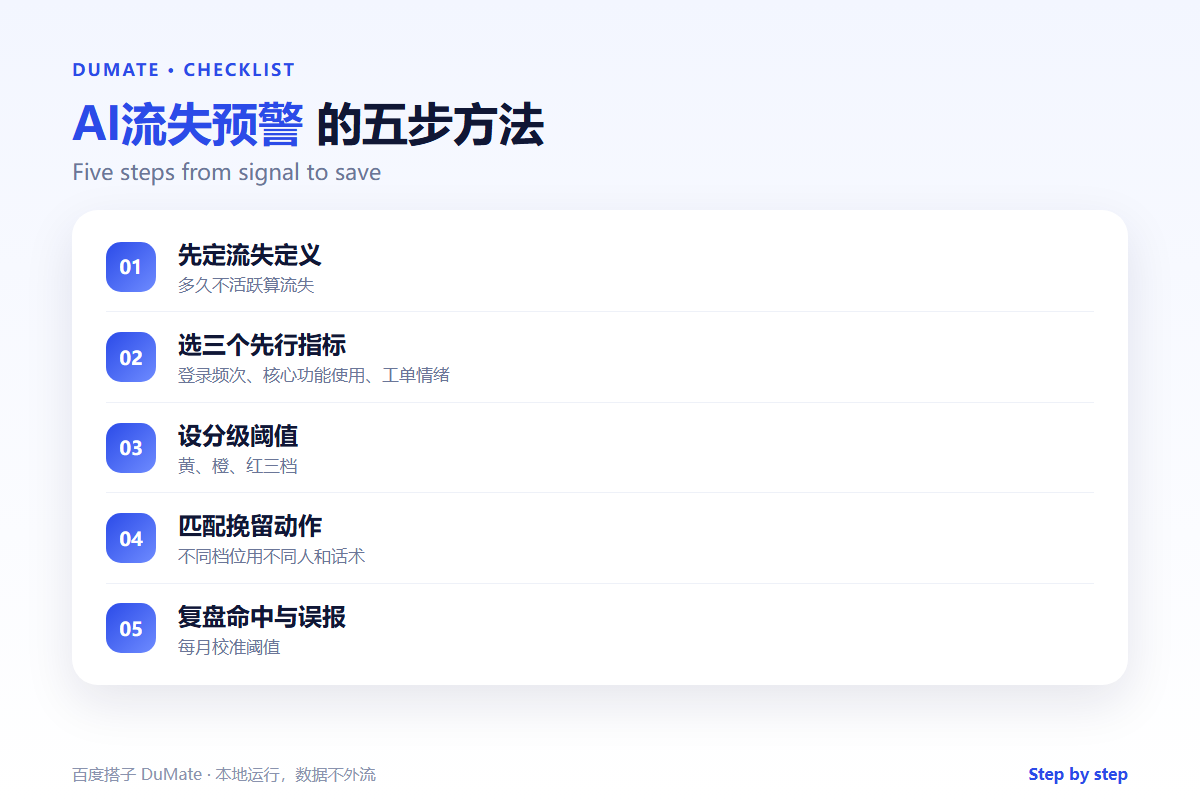
A Warning System Checklist
- Churn is defined in measurable terms.
- Signals lead the event by weeks.
- Thresholds are graded.
- Every level has an owner.
- False alarms are reviewed.
Where AI流失预警 Fails
It fails when the model is trained on a period with a different product or price, because the patterns no longer apply. It also fails when the retention team is not staffed to act on the warnings.
- Signals that only appear at cancellation.
- One threshold for all account sizes.
- Warnings with no owner.
- No feedback from outcomes.
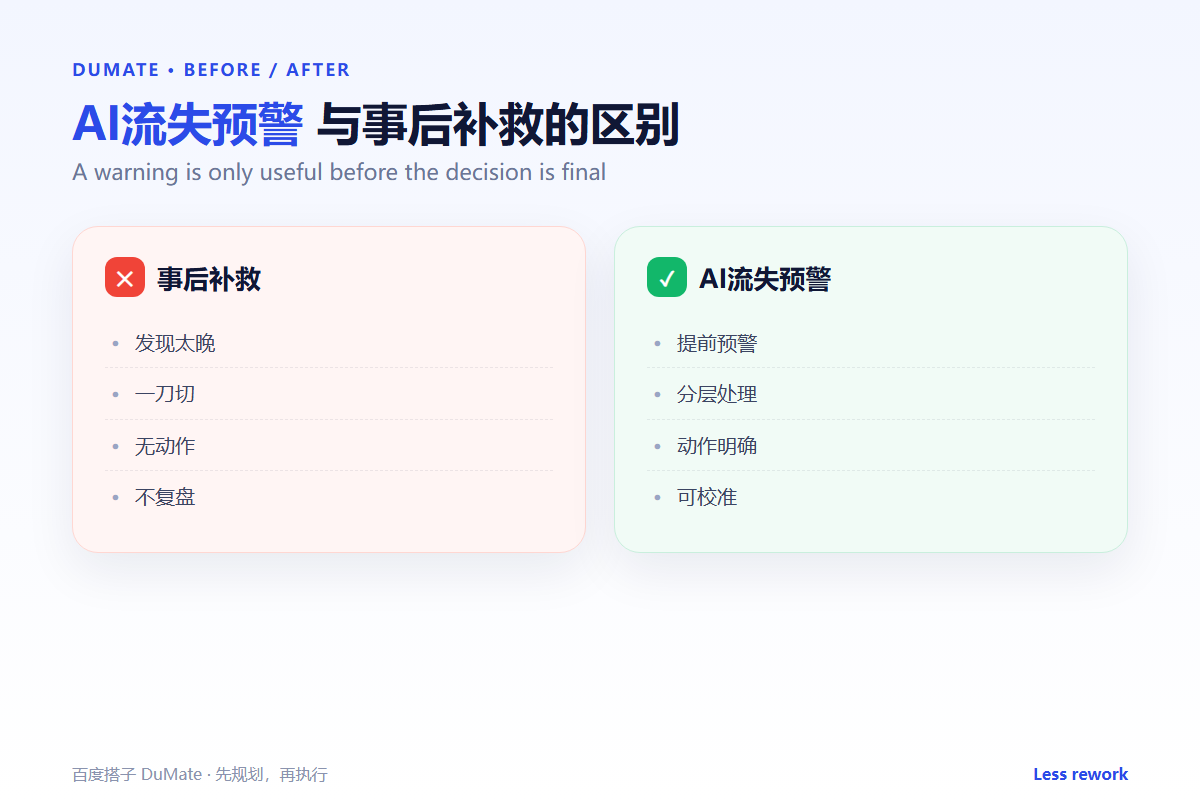
Before and After
Before, the team learned about churn from the monthly revenue report. After, AI流失预警 flagged accounts three weeks earlier, and a personal call saved two of the first ten high-risk accounts.
The value is not the prediction. The value is the time it buys.
Used consistently, AI流失预警 becomes part of the normal review routine rather than a separate project.
A final check with AI流失预警 takes a minute and catches the errors that are easiest to miss.
The same AI流失预警 routine works for small tasks and large ones, which is why teams keep using it.
Measuring Whether It Works
Measure AI流失预警 with three numbers: time spent, rework required, and output accepted without changes. Track them for four weeks before drawing a conclusion. Set a baseline from the manual process, because without a baseline any result looks like progress.
Time alone is misleading. A task that finishes faster but needs a full rewrite is not an improvement. Pair time with rework, and pair both with the quality of the final output. AI流失预警 should be compared with how the work was done before, not with an ideal.
Review the numbers monthly with the people doing the work. They know why a week was slow or why rework increased. AI流失预警 improves when the review includes the operators, not only the managers. Keep the dashboard small: three numbers and one note are enough.
Also record the exceptions. A week with an unusual campaign or a system outage is not a fair test. Note the context next to the numbers so a later reader does not compare incomparable weeks. When the numbers are stable, expand the scope; when they move the wrong way, fix the input before adding more use cases. The goal is not to prove that AI流失预警 works, but to know when it works and when it does not.
Keep the first month simple. One task, one owner, and one weekly review are enough to prove the workflow before it spreads across the team.
Write down what changed after each run. A short note is easier to trust than a memory, and it makes the next improvement obvious.
FAQ
How accurate should the model be?
Accuracy matters less than lead time and precision at the top level. A small, actionable list beats a large, vague one.
What if we have few customers?
Use rules instead of a model. Behavioral thresholds work well for small accounts.
Should we contact every flagged account?
No. Match the action to the risk level and the account value.
延伸阅读
For segments, see AI用户分群 and AI客户画像. For analysis, read AI数据分析工具. Outreach is covered in AI邮件助手. Access rules are in AI权限管理. Tool selection is in AI效率工具. External references: NIST AI Risk Management Framework and ISO/IEC 42001.
评论
还没有评论,来说两句吧。以下为本文的引用通告: