
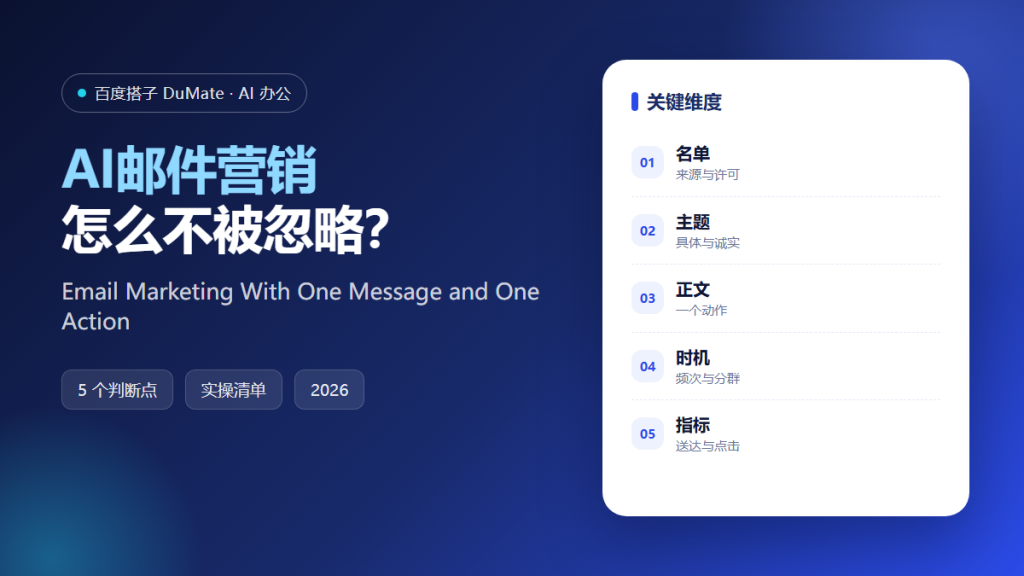
AI邮件营销 is judged by one number that most dashboards hide: how many readers did the single thing the email asked for? An open rate can rise while the list learns nothing, and a click rate can fall while the right segment acts. The message and the action have to match, one to one, or the program is only making noise in an inbox.
This guide sets out a five-step routine for building that match, the checklist that keeps a send honest, and the habits that turn a useful email into an unread one.
Key Takeaways
- Decide the action before writing the subject.
- Make the subject a promise the body keeps.
- Remove every competing ask.
- Send to the segment that has a reason to act.
- Suppress people who never engage.
Why AI邮件营销 Needs a Single Action
An inbox is a queue of requests, and each email competes with everything else in it. When a message asks readers to read, click, share, and reply, most of them do none of those things. AI邮件营销 with one action gives the reader a simple decision: yes or not now. That decision is what a list can learn from.
A single action also makes measurement honest. If the goal is to book a call, then a click on a logo is not a success, and a forwarded email is not a failure. AI邮件营销 that names one action can compare two versions of a message without arguing about which metric matters. A message that measures everything ends up defending everything, which is how a newsletter grows a second column and a third link.
The third reason is trust. A list that receives one clear request per week stays readable; a list that receives four reminders about four different things starts to filter. AI邮件营销 should behave like a correspondent, not a broadcast tower, because permission is lent and easily withdrawn.
How AI邮件营销 Works in Five Steps
Step 1: Choose the action first
Write the action in one sentence before anything else: book a demo, read the guide, update a payment method. If two actions seem equally important, split the send or pick the one that leads to the other. AI邮件营销 should serve the action, and everything else is decoration.
Step 2: Make the subject a promise
A subject line works when it states what the reader gets and the body delivers it in the first sentence. Clever wording that hides the offer buys one open and costs the next ten. Read the subject after writing the body, and cut any word the email does not earn. Specific beats urgent, and a promise about the reader’s task beats a deadline invented for the send.
Step 3: Delete the second ask
Most drafts contain a main request and a small extra one, such as follow us or browse the blog. The extra ask divides attention and rarely produces anything. Remove it, or move it to a footer that does not compete with the button. If the second ask truly matters, give it its own email next week and measure that one alone.
Step 4: Let AI邮件营销 pick the segment
Send to people whose last action makes the offer relevant: a trial that ended, a cart that was abandoned, a guide that was downloaded. AI邮件营销 is good at building those small groups from behavior, and the tighter group usually replies better than the full list.
Step 5: Test, suppress, repeat
Test one element at a time, then suppress addresses that have not opened anything in six months. A smaller list with higher engagement protects delivery for everyone else. Keep the winning version as a template, and write the reason it won in the same note. AI邮件营销 improves when the suppression rule is written down, so nobody has to relitigate it every quarter.
‘ alt=’AI邮件营销 checklist: one action, one promise and one segment’ />
A Send Review Checklist
- The email asks for exactly one action.
- The subject names the benefit.
- The first sentence repeats the promise.
- The button text describes the next step.
- The segment has a reason to receive it.
Where AI邮件营销 Fails
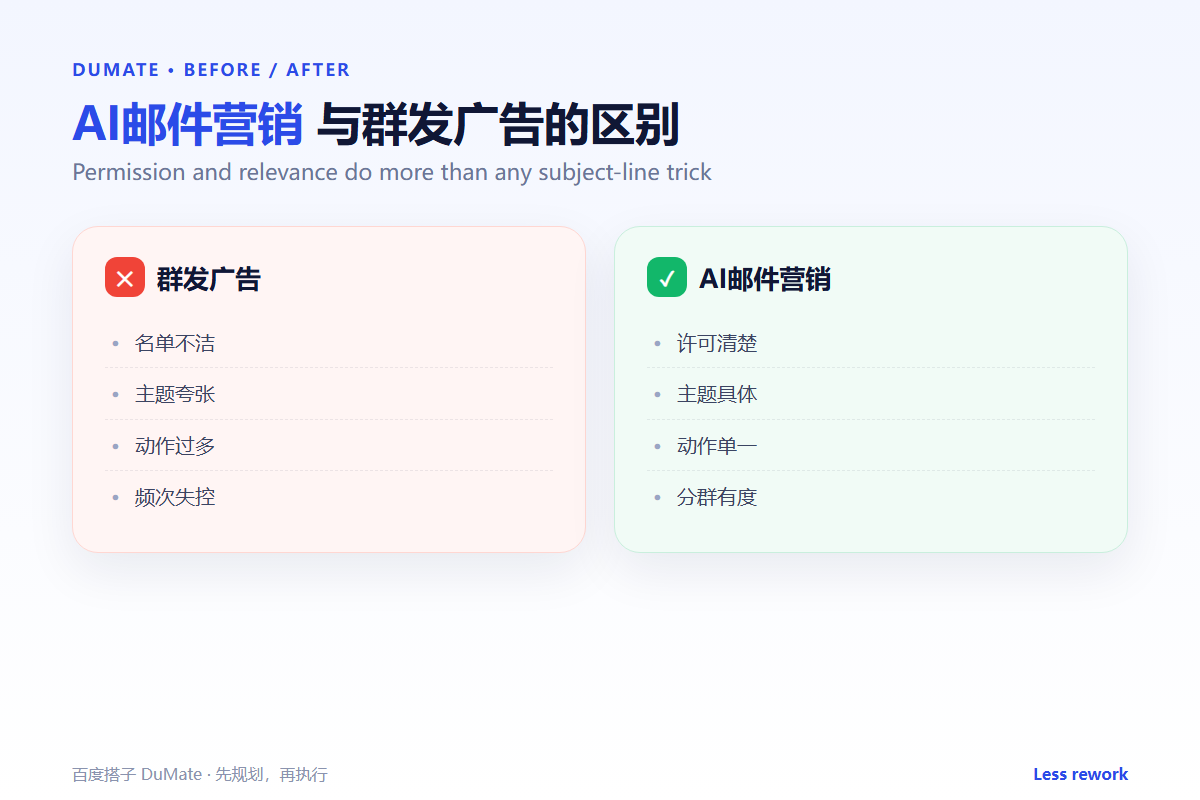
AI邮件营销 fails when volume substitutes for relevance. A weekly newsletter sent to everyone, written for no one, trains the list to ignore the name in the inbox. A list asked for everything eventually gives nothing.
- Three calls to action in one message.
- Subject lines that exaggerate.
- Sending to purchased or stale lists.
- No suppression after months of silence.
Before and After
Before, a team sent a monthly digest with a product update, two articles, and a survey link, and measured opens. After, AI邮件营销 was used to build a segment of trial users and send one message asking them to book a setup call.
The list shrank by a third. The number of booked calls doubled, and the replies were from people who had actually wanted the help. The smaller list was also cheaper to send to, and the savings funded the next test.
FAQ
How often should we send?
As often as you have something the reader needs. A predictable rhythm helps, but a schedule is not a reason to send an empty message. Two useful emails a month beat eight reminders that say the same thing.
Does design matter?
Less than the offer. A plain email that loads quickly and reads well often beats a designed template that hides the button.
What about people who never open?
Suppress them after a clear window and a final re-permission note. AI邮件营销 depends on delivery, and delivery depends on engagement.
延伸阅读
For the offer behind the email, see product copy. List logic starts with customer profile, and retention risk is covered in churn warning. For the paid version of the same message, read ad copy, and check every send with typo check. External references: NIST AI Risk Management Framework and ISO/IEC 42001.
评论
还没有评论,来说两句吧。