
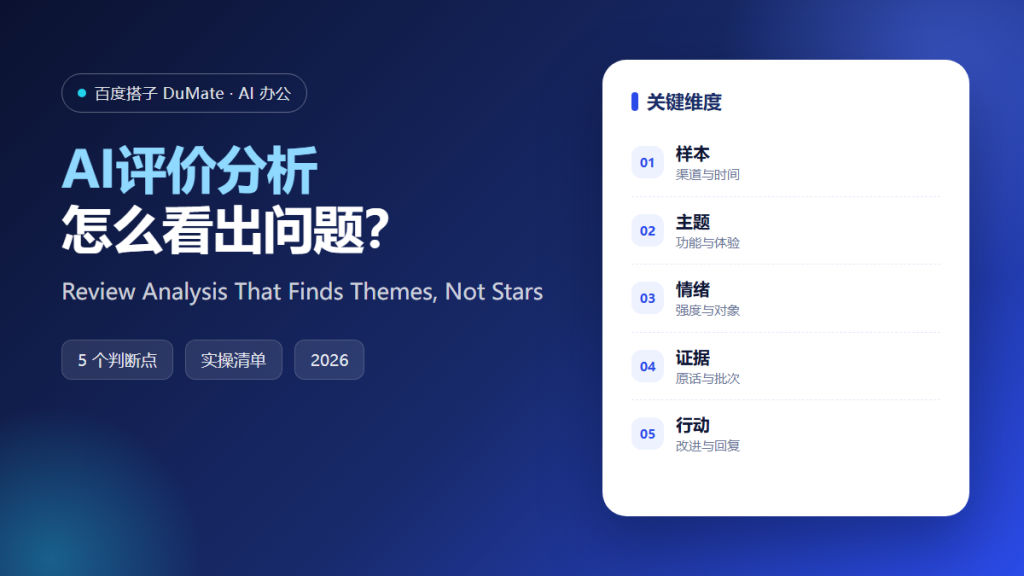
AI评价分析 starts with an admission that a star average hides more than it reports. Two products can hold the same 4.2 score while one is praised for durability and the other is forgiven for late delivery. AI评价分析 only becomes useful when the text behind the number is read.
This guide sets out how AI评价分析 turns review text into themes with owners, the five-step routine that keeps those themes stable across products, and the traps that make a review dashboard look busy while nothing on the shelf changes.
Key Takeaways
- Read the comments before the score.
- Group feedback into a short, fixed theme list.
- Separate product faults from delivery faults.
- Weight every theme by volume and by revenue at risk.
- Give each repeating theme one named owner.
Why AI评价分析 Needs Theme Extraction
A rating answers a question about satisfaction, not about cause. Someone gives three stars because the item arrived scratched, someone else because the instructions were unclear, and a third because the price felt high. AI评价分析 that stops at the score treats three unrelated problems as one, and the team responds with a discount that fixes none of them.
Themes also make comparison possible. Once comments are labeled, a category manager can see that one supplier’s returns cluster around stitching while another’s cluster around sizing. AI评价分析 gives the same vocabulary to reviews from a marketplace, a support inbox, and a survey, which is what allows a monthly trend to mean something.
The third reason is accountability. A theme such as a seal that fails after two weeks can be handed to a person, given a date, and closed with evidence. A score of 4.2 cannot. AI评价分析 is useful only when its output can be assigned, and an assigned theme is the smallest unit of work a review program can produce.
How AI评价分析 Works in Five Steps
Step 1: Collect the raw text
Pull reviews from every channel that accepts them, including the ones nobody reads, such as marketplace replies and chat transcripts. Keep the date, the product variant, and the order identifier with each comment. A comment without a date cannot be compared with the month before. AI评价分析 built on a partial sample will mislead the team that acts on it.
Step 2: Remove duplicates and prompted praise
Campaigns produce clusters of similar wording posted within a few days. Mark them, weight them down, and keep them in a separate file. A rating spike that comes from an incentive is not evidence of anything except the campaign. Leave the raw rows in place, because a future audit may need to see what was excluded and why.
Step 3: Label with a fixed list
Write twenty to thirty themes before reading the new batch, then force every comment into one of them or into an other bucket. AI评价分析 should suggest labels, but a person confirms them at the start. The fixed list is what makes month-to-month comparison honest. Review the list once a quarter, not after every report.
Step 4: Weight by volume and value
Count mentions, then multiply by the revenue attached to the affected orders. A packaging complaint on a low-cost item and the same complaint on a flagship product deserve different urgency. Volume alone rewards cheap products with noisy buyers. Show both figures side by side and let the reader see the gap.
Step 5: Route and close
Send each theme to the team that can change it: design, sourcing, logistics, or copy. Ask for one change and one date. At the next review, check whether the theme’s share of comments moved. AI评价分析 has done its job when a theme disappears, not when a chart is prettier. Close the loop in writing so the next analyst inherits the reason.
‘ alt=’AI评价分析 checklist: review text, theme labels and owner routing’ />
A Theme Review Checklist
- Every channel is included in the sample.
- Incentivized reviews are flagged and weighted down.
- The theme list is fixed for the quarter.
- Each theme has a volume count and a value estimate.
- Each repeating theme has an owner and a due date.
Where AI评价分析 Fails
Most programs fail on maintenance rather than modelling. The theme list grows to a hundred entries, labels drift, and two analysts classify the same complaint differently. AI评价分析 still produces a report that looks authoritative, which is worse than producing none at all.
- Themes written after reading the data, which guarantees a fit.
- Sentiment scores reported without the underlying sentences.
- Translation done once, so idiom and sarcasm are lost.
- No follow-up, so the same theme returns every quarter.
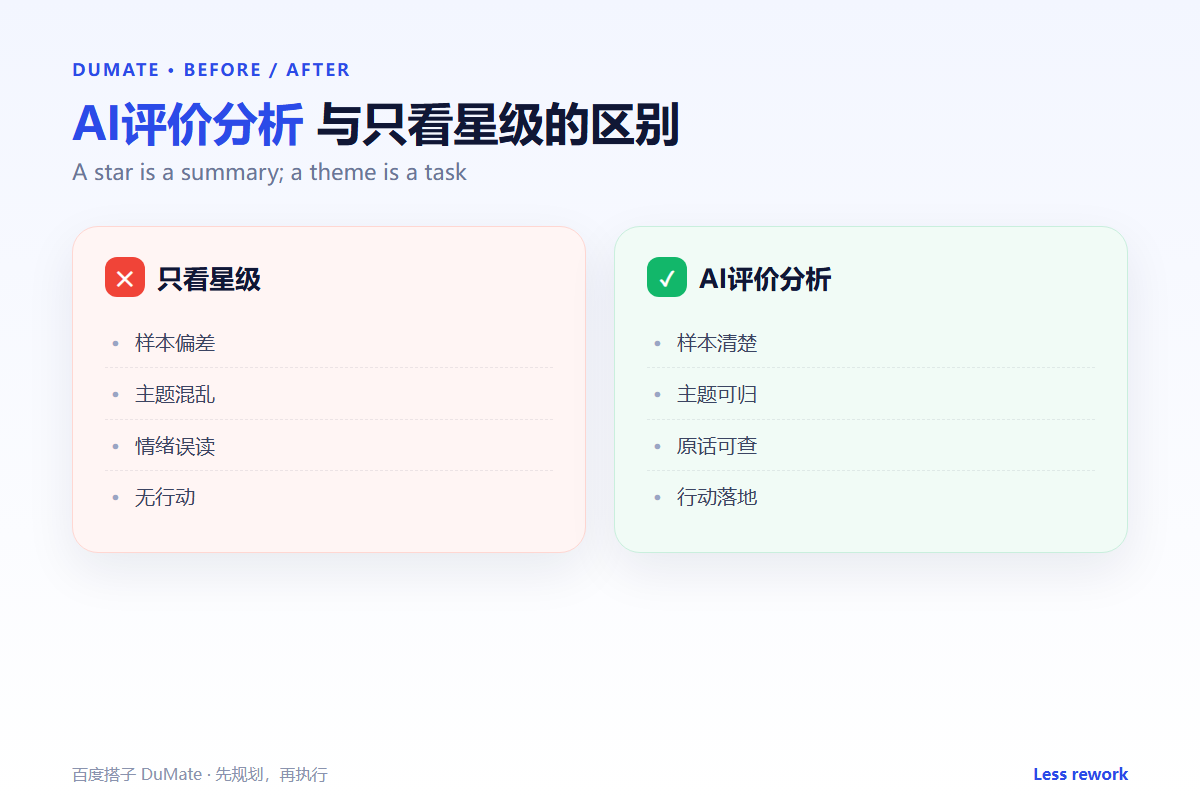
Before and After
Before, a home goods brand tracked a single rating and rewarded the team when it rose by a tenth of a point. The rise came from a review campaign, and the return rate climbed at the same time.
After, AI评价分析 labeled eighteen months of comments into twenty-two themes. Three themes accounted for most returns, all of them tied to one factory’s lid tolerance. The fix was a specification change, and the rating followed without another campaign.
FAQ
How many themes are too many?
Past thirty, reviewers start guessing and consistency falls. Merge rarely used themes into a parent and keep the detail in a note.
Can ratings be ignored entirely?
No. They are a fast signal of direction. AI评价分析 uses them to decide where to look, then reads the text to learn what happened.
How often should the analysis run?
Monthly for trends, weekly for a product that has just changed supplier or packaging.
延伸阅读
For early warning signals, read sentiment monitoring. To connect themes to buyer history, see customer profile. Retention risk is covered in churn warning, and audience grouping in user segmentation. For the wording that answers a recurring complaint, see product copy. External references: NIST AI Risk Management Framework and ISO/IEC 42001.
评论
还没有评论,来说两句吧。