
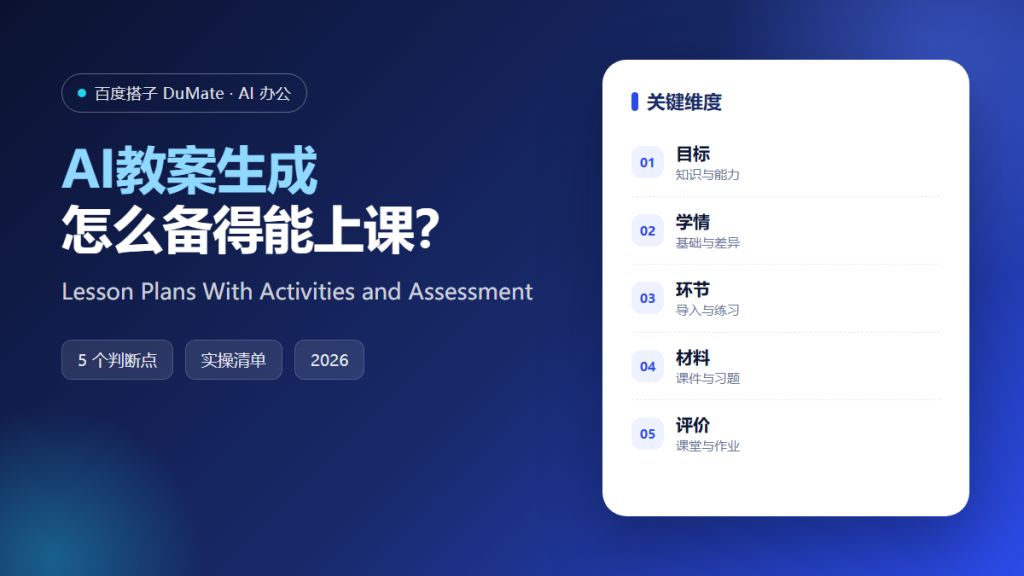
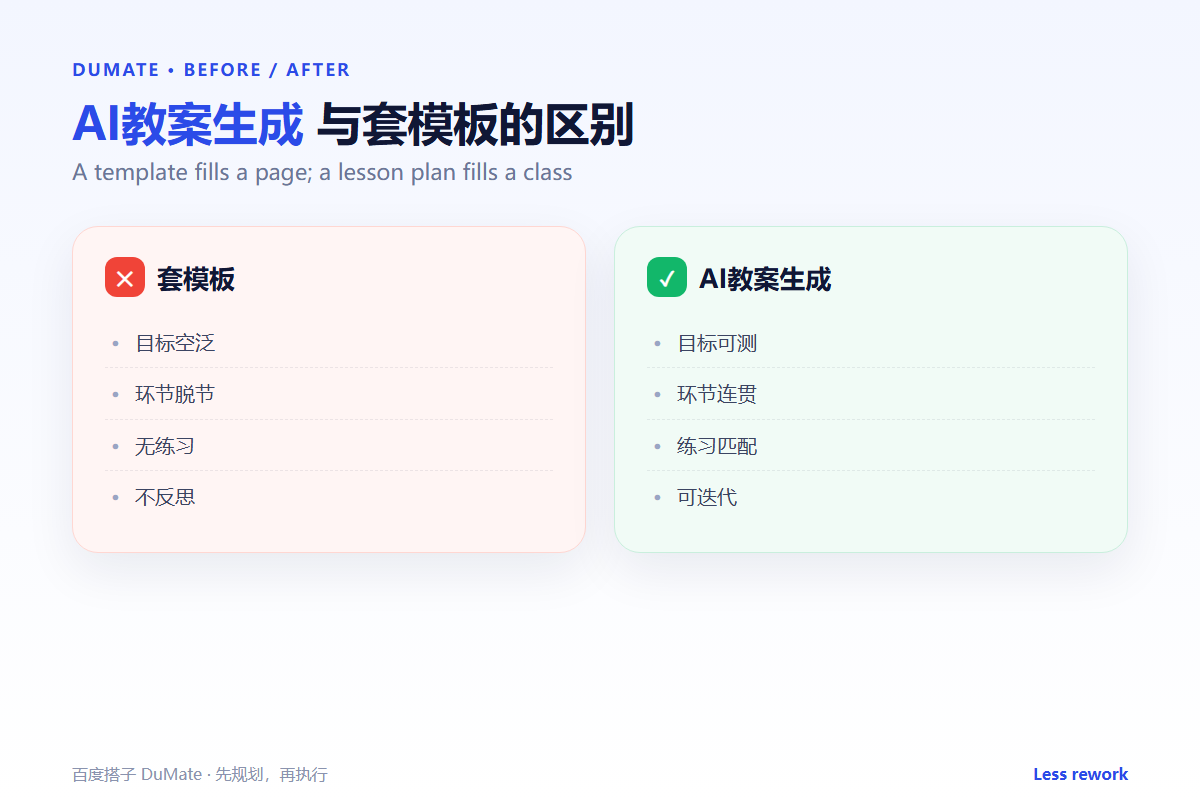
AI教案生成 can fill a template in a minute, and that is the problem. A template describes activities; a lesson plan describes learning. The difference shows up in the classroom, when the activities end and nobody can say what changed.
This guide covers a five-step lesson design process, the objectives that can be observed, and the reflection that improves the next class.
Key Takeaways
- Write objectives students can demonstrate.
- Assess what students already know.
- Design five stages with transitions.
- Match practice to the objective.
- Reflect after the class.
Why AI教案生成 Needs Observable Objectives
Understand the topic is not observable. Explain the causes in three sentences, compare two methods, or solve a problem with a given tool are observable. AI教案生成 can design activities around either, but only the observable version tells the teacher whether the lesson worked.
The second reason is alignment. If the objective asks students to analyze, but the practice only asks them to recall, the lesson does not prepare them for the assessment.
How AI教案生成 Works in Five Steps
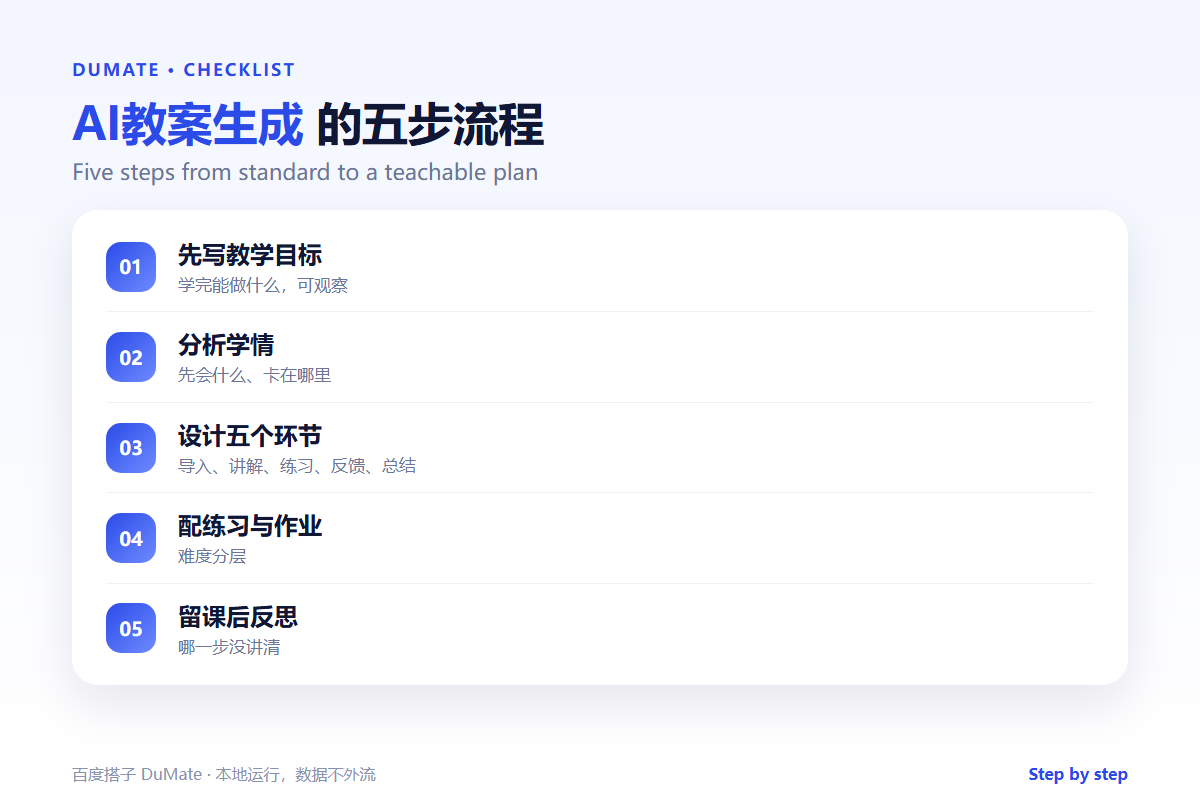
Step 1: Write the objectives
Use a verb that can be seen or heard. Limit the lesson to two objectives. AI教案生成 should use these objectives to select every activity.
Step 2: Assess the starting point
Use a short question or a quick task to find out what students already know. AI教案生成 can design a five-minute diagnostic.
Step 3: Design the five stages
Open with a question, explain briefly, practice together, practice independently, and summarize. Each stage needs a time box. AI教案生成 should keep the transitions explicit.
Step 4: Match practice to the objective
If the objective is analysis, the practice must require analysis. Add one extension for students who finish early. AI教案生成 can produce differentiated tasks.
Step 5: Reflect after class
Note which stage ran long, which question fell flat, and what evidence of learning appeared. AI教案生成 should update the plan for the next cohort.
A Lesson Plan Checklist
- Objectives are observable.
- The diagnostic is short.
- Five stages have time boxes.
- Practice matches the objective.
- Reflection notes are written.
Where AI教案生成 Fails
It fails when the plan is a list of activities with no learning goal. It also fails when the timing assumes perfect attention from the class.
- Too many activities.
- No diagnostic.
- Practice that does not match the test.
- No reflection.
Before and After
Before, a teacher planned six activities and ran out of time before the practice. After, AI教案生成 produced a five-stage plan with time boxes and one extension, and the class ended with evidence of learning.
A lesson plan is a sequence of decisions, not a script.
Used consistently, AI教案生成 becomes part of the normal review routine rather than a separate project.
A final check with AI教案生成 takes a minute and catches the errors that are easiest to miss.
The same AI教案生成 routine works for small tasks and large ones, which is why teams keep using it.
Making It Stick Across a Team
A rollout fails when only one person knows how to use AI教案生成. Write a short guide with three sections: when to use it, what good input looks like, and what to check before sharing the output. Keep the guide to one page.
Train in pairs. One person runs the task while the other checks the output against the guide, then swap roles. That exercise surfaces unclear steps faster than a presentation. Keep a shared folder with one strong output, one weak output, and a note explaining the difference. AI教案生成 becomes easier to teach when people can compare real cases.
Review the guide after the first week of use. Remove steps nobody follows and add the questions that keep coming up. A living guide is more useful than a perfect one written in advance. Finally, assign an owner. AI教案生成 without an owner drifts, and the guide becomes outdated. The owner does not need to do every task, only keep the standard current. That small responsibility is what keeps AI教案生成 useful after the initial training.
Make the training practical. People learn the workflow by completing a real task, not by listening to a walkthrough. Set aside thirty minutes for practice and review the result together. Measure one thing: how many outputs pass review without correction. That number is a better indicator than attendance.
Keep the first month simple. One task, one owner, and one weekly review are enough to prove the workflow before it spreads across the team.
Write down what changed after each run. A short note is easier to trust than a memory, and it makes the next improvement obvious.
Review the output before it leaves your desk. A two-minute check catches most of the errors that would otherwise come back as questions.
Keep one example of a good result. New team members learn faster from a concrete reference than from a long explanation.
The first version does not need to be perfect. It needs to be complete enough to review, so the team can see the gaps and fix them in the next round.
FAQ
How many objectives should a lesson have?
One or two. More objectives usually mean the lesson is trying to do too much.
How long should each stage be?
Adjust to the age group. The summary should never be the part that gets cut.
What should the reflection record?
What worked, what did not, and what evidence of learning you saw.
延伸阅读
For slides, see AI课件制作 and AI生成PPT. For question banks, read AI题库生成. Organize materials in an AI知识库. For drafting, see AI写作助手. Tool selection is in AI效率工具. External references: NIST AI Risk Management Framework and ISO/IEC 42001.
评论
还没有评论,来说两句吧。以下为本文的引用通告: