
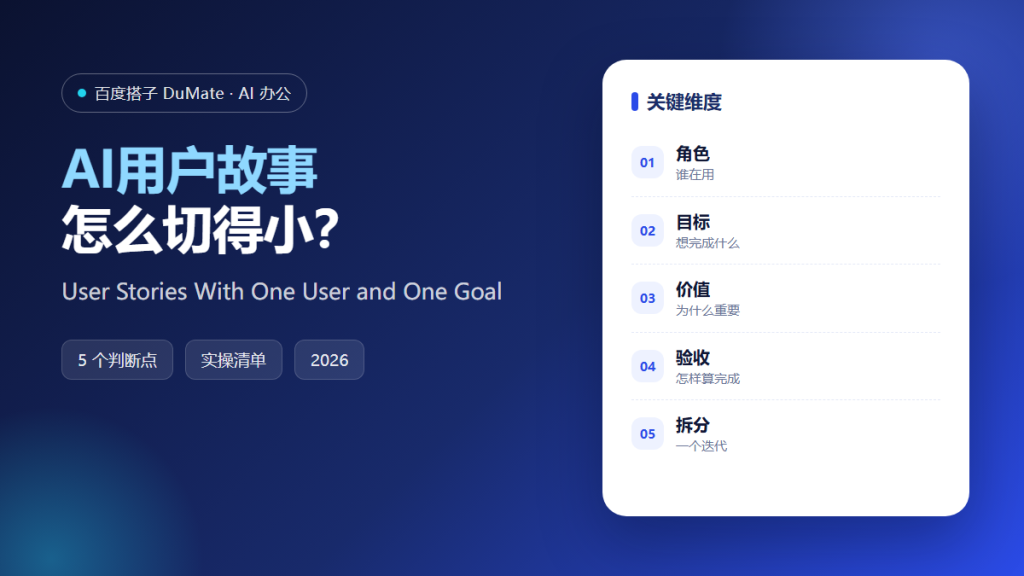
AI用户故事 keeps a team close to the person who will use the product, because a story is written from one user’s point of view rather than from a feature list. The format is simple; the discipline is deciding which user and which goal belong in the same sentence. A story that tries to serve everyone ends up serving no one well.
This guide covers the five steps from persona to acceptance, the checklist that separates a story from a task, and the patterns that make stories too large to finish. It is a small format with a large effect on how honestly a team talks about scope.
Key Takeaways
- Name a real role, not everyone.
- State one goal per story.
- Include the reason so trade-offs are visible.
- Define done as an observable result.
- Split a story before it becomes a project.
Why AI用户故事 Needs a Named User
A story addressed to all users is addressed to nobody. The needs of a first-time buyer and a weekly administrator differ in speed, permissions, and error tolerance. AI用户故事 should begin with a role specific enough that the team can picture the person and the device, including the pressure they are under when the task happens. AI用户故事 also gives the team a name to use when a trade-off appears, because the question becomes what this person would need rather than what the loudest stakeholder wants. A named role turns an abstract priority debate into a concrete choice.
The second reason is focus. A story with two goals invites a design that serves neither. AI用户故事 works best when the goal is small enough to finish in a few days and valuable enough that someone would notice its absence. If nobody would notice, the story is probably a technical task in disguise.
The third reason is conversation. The written card is a promise to talk, not a specification. AI用户故事 should leave room for questions about edge cases, and the answers should be added as acceptance conditions rather than buried in a comment thread that nobody reads later.
How AI用户故事 Works in Five Steps
Step 1: Choose the person
Pick a role from real interviews or support tickets. Write the role, the context, and the frequency of the task. If two roles behave differently, they need two stories, even when the screens look identical.
Step 2: State the goal
Complete the sentence: as this person, I want this outcome, so that this reason. Keep the outcome verb-based. AI用户故事 should describe a change in the world, not a screen or a button, and the reason should explain why the change matters.
Step 3: Add the constraints
List the limits that shape the solution: permissions, data volume, time window, or device. AI用户故事 can draft this list from similar tickets, but the team should confirm each constraint against the current system before estimating.
Step 4: Define done
Write two or three conditions that a tester can observe. Include the unhappy path. A story is ready when the team agrees on what a correct result looks like, not when the card has a number attached to it.
Step 5: Split before starting
If the story cannot finish inside a sprint, split it by workflow, by role, or by data. AI用户故事 that stays whole for three sprints is usually a project wearing a small label, and it will distort every estimate around it.
‘ alt=’AI用户故事 checklist: persona, goal, constraints and done’ />
A Story Quality Checklist
- The role is specific and recognisable.
- The goal is a single outcome.
- The reason explains the value.
- Acceptance covers a failure case.
- The story fits inside one sprint.
Where AI用户故事 Fails
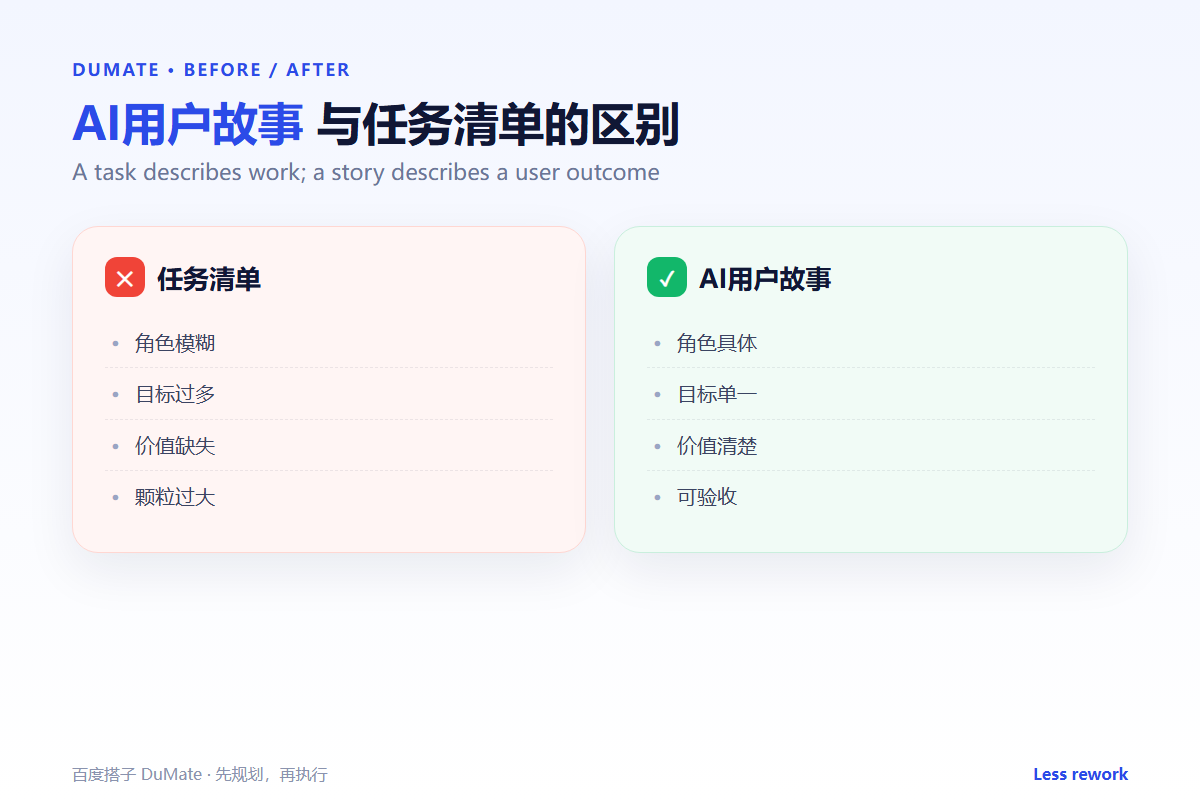
It fails when the card is a task in disguise, such as add a dropdown. It also fails when acceptance is a copy of the title, which leaves the team free to interpret success in incompatible ways. The result is a board full of finished cards and a user who still cannot do the job. A story that describes a screen will be reopened every time the design changes, and the team will blame the design for a problem that started in the wording. Keep the goal and the reason visible, and let the solution move.
- Roles such as user or everyone.
- Two goals joined by the word and.
- No failure path in acceptance.
- Stories written after the build.
Before and After
Before, a checkout team wrote a story for a faster payment flow. Three developers built three different things, and the review turned into a debate about what faster meant. The story had a title, an estimate, and no shared definition of success.
After, AI用户故事 named the returning buyer, the goal of paying with a saved card in two taps, and the condition that a declined card shows a recovery link. The estimate was smaller and the release was boring, which was the point. AI用户故事 gave the team a repeatable way to discuss scope without reopening the same argument.
FAQ
How is a story different from a requirement?
A requirement states what the system must do. A story frames that need around a person and a reason, which helps the team choose between valid options when the specification is silent.
How many stories fit in a sprint?
Judge by finished outcomes, not by card count. A team that completes five small stories has learned more than one that half-finishes twelve and carries the rest into the next planning meeting.
Who should write them?
The person closest to the user drafts, and the team refines together. AI用户故事 can produce a first draft, but the role and reason need real evidence from interviews or tickets.
延伸阅读
Understand the audience with customer profile and user segmentation. Retention signals appear in churn warning. For wording, see product copy, and for verification test cases. External references: NIST AI Risk Management Framework and ISO/IEC 42001.
评论
还没有评论,来说两句吧。