
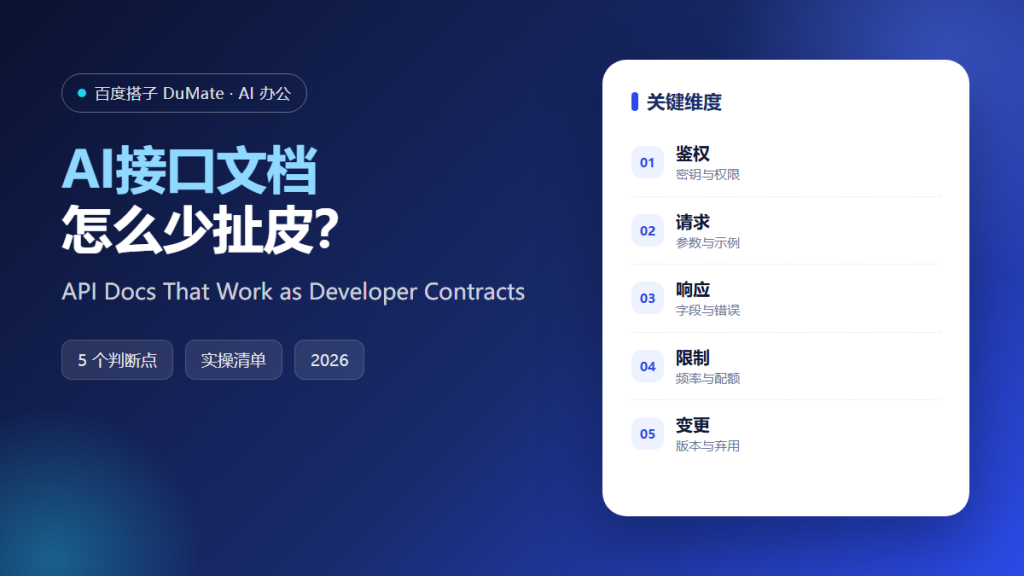
AI接口文档 is a contract, and a contract that omits the failure cases is not finished. A developer should be able to integrate from the page alone, without reading the source code or waiting for a meeting. If the page needs a guide to explain the page, the contract is incomplete.
This guide explains how AI接口文档 covers requests, responses, errors, and change, the five steps to a reviewable page, and the omissions that cost integration teams the most time. The goal is a page that answers the next question before it is asked.
Key Takeaways
- Document the resource before the endpoint.
- Show a real request and a real response.
- List every error code with a cause.
- State authentication and rate limits.
- Version changes and announce removals.
Why AI接口文档 Needs a Contract Mindset
An endpoint is a promise about data. The caller sends a shape and expects another shape back. AI接口文档 is useful when it defines both shapes precisely, including which fields are optional, which are nullable, and which are deprecated. A missing type becomes a runtime failure in someone else’s service. AI接口文档 should state the type of every field, including the ones that look obvious.
The second reason is failure. Most integration time is lost on errors that were never described. AI接口文档 should list the status codes, the error body, the retry behaviour, and the condition that makes a retry pointless. Without that list, every client invents its own guess about what a 409 means.
The third reason is change. A field removed without notice breaks a client in production. AI接口文档 should carry a version, a compatibility note, and a date, so a consumer can plan an upgrade instead of discovering one during a launch week. The changelog is part of the contract, not an appendix for lawyers.
How AI接口文档 Works in Five Steps
Step 1: Describe the resource
Explain what the object represents and how it relates to other objects. Use the business name, then map it to the field names. A reader who understands the resource can guess less and verify more, and support tickets become shorter.
Step 2: Specify the request
List the method, path, headers, and body. Mark required fields and give the type, range, and default for each one. AI接口文档 should show a minimal example rather than a payload with every field filled, because a minimal example reveals what is truly required. Name the encoding for dates and the unit for money, since both cause silent errors.
Step 3: Document the responses
Show a success response with realistic values and explain each field. Include an empty result and a partial result. AI接口文档 that only shows the happy path leaves the client to guess at pagination, nulls, and the meaning of an empty array.
Step 4: Enumerate the errors
Create a table of codes, meanings, and suggested actions. Distinguish a client mistake from a server fault. AI接口文档 should say which errors are safe to retry and which will repeat forever, and it should show a sample error body that matches the schema.
Step 5: Add auth, limits, and version
Describe how a token is obtained, how long it lasts, and what happens when it expires. State the rate limit and the response when it is exceeded. Close with a version and a changelog, including the date of the last breaking change.
‘ alt=’AI接口文档 checklist: resource, request, errors and versioning’ />
A Contract Review Checklist
- The resource and its fields are explained.
- A minimal request example is runnable.
- Every error code has a cause and an action.
- Auth and rate limits are explicit.
- A changelog names breaking changes.
Where AI接口文档 Fails
It fails when examples are invented and never executed, so a copied request returns a validation error. It also fails when the page describes the current build but not the version a client is using. In both cases the documentation looks complete and still costs a support cycle. A page that was true last quarter is a historical document, not a contract. Mark it with a version and a date, or remove it before it teaches a new client the wrong behaviour.
- Undocumented required headers.
- Error bodies with no schema.
- Pagination described in a footnote.
- Silent removal of a field.
Before and After
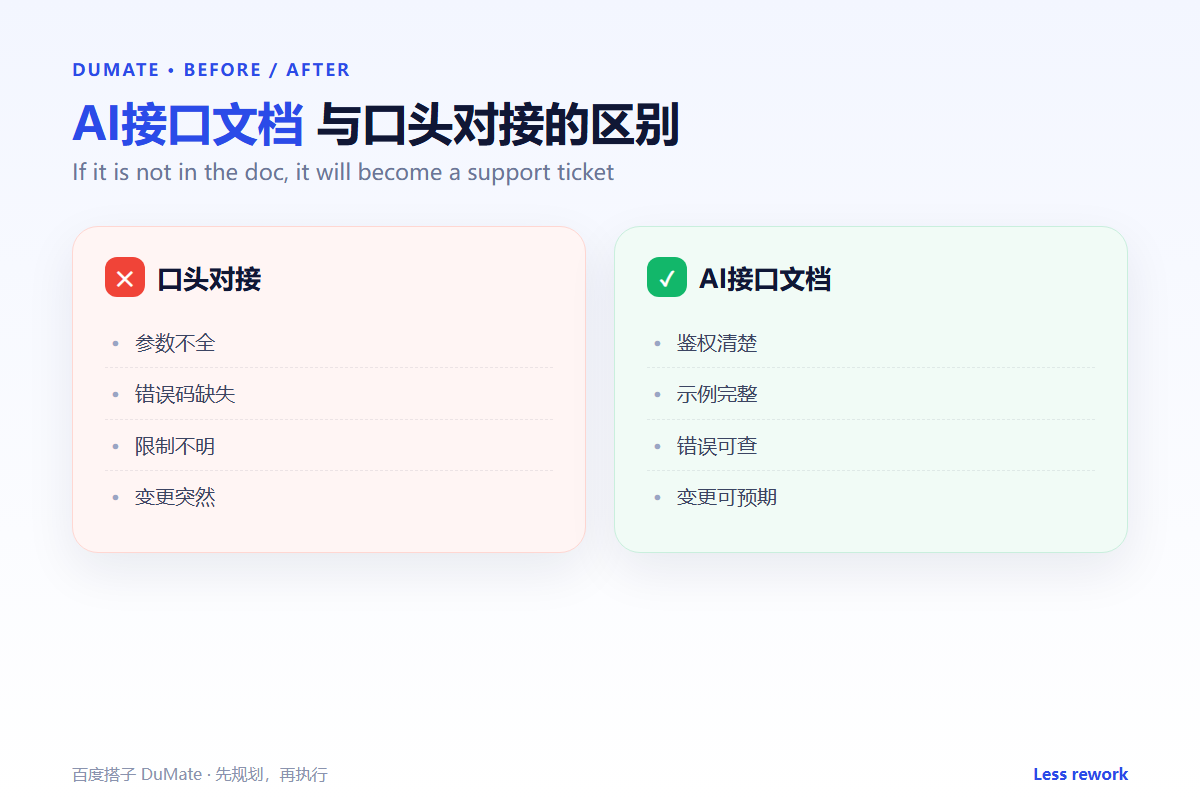
Before, a partner team spent four days on an integration because the documentation omitted a required header and returned a generic 400. The support thread became the real documentation, and the next partner repeated the same four days. The page had a beautiful request example and no mention of the header, so every developer copied the example and hit the same wall.
After, AI接口文档 listed the header, a sample error body, and two retry rules. The next partner integrated in an afternoon and asked one question about pagination, which the page answered the same day. The team also added a short note about what changed in the last release, which ended the repeated questions about a removed field. The documentation also cut the support load, because the answer to most questions was already on the page.
FAQ
Should we generate docs from code?
Yes for field names and types, because generation prevents drift. Descriptions, examples, and error guidance still need a human edit, since a generator cannot explain intent.
How do we document internal APIs?
With the same rigor. Internal clients are still clients, and they break just as loudly when a field changes without a note.
What about deprecation?
Announce it, date it, and keep the old behaviour until the date. AI接口文档 should show both versions during the overlap, with one clear line about what to migrate first.
延伸阅读
For clear technical prose, see official writing and document proofreading. Verify behaviour with test cases, investigate calls in log analysis, and catch small defects with typo check. External references: NIST AI Risk Management Framework and ISO/IEC 42001.
评论
还没有评论,来说两句吧。