
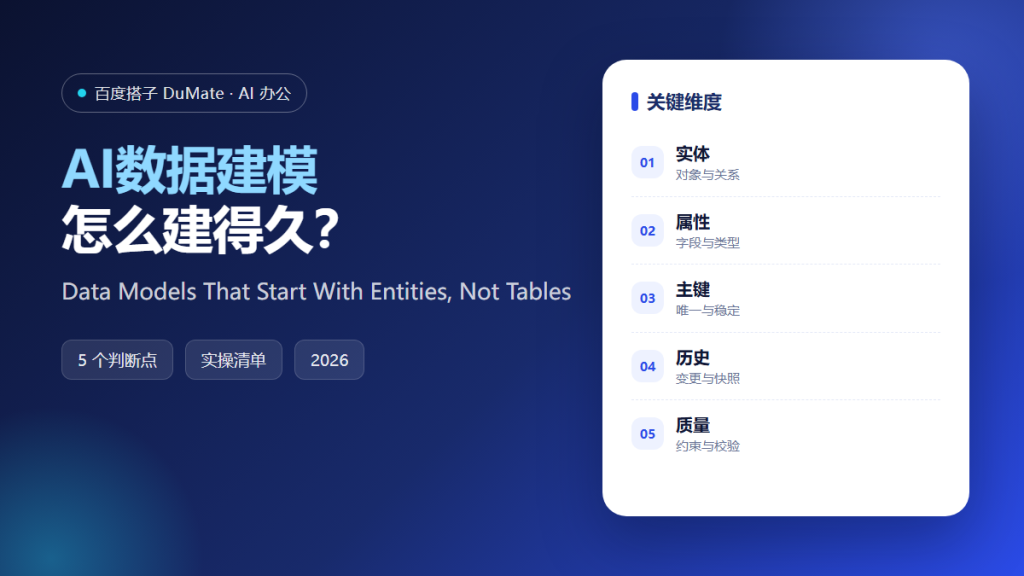
AI数据建模 starts with entities, because tables are an implementation detail and entities are the business. A customer, an order, and a payment exist whether the storage is a relational database or a document store. Getting the nouns right is cheaper than migrating them later.
This guide explains how AI数据建模 separates entities from tables, the five steps from identity to keys, and the modelling mistakes that surface months later as duplicate reports. The sequence matters more than the notation.
Key Takeaways
- Name entities in business language.
- Define identity before attributes.
- Map relationships with cardinality.
- Decide where history must be kept.
- Document keys and ownership.
Why AI数据建模 Needs an Entity Map
Most data problems begin with a missing entity. An address stored as four columns on the customer cannot be reused for a warehouse, and a payment recorded inside an order cannot be refunded separately. AI数据建模 should draw the nouns and their relationships before anyone writes a create table statement. Draw the map on one page and keep it beside the schema, because a model that lives only in a diagram tool will drift from the database within a quarter. Write the merge rule before the first duplicate arrives, and test it on ten real records.
The second reason is identity. Two customer records may be the same person with different emails, or two people sharing a household address. AI数据建模 should force a decision about the identifier and the merge rule, because every downstream join depends on it and a later change touches every report.
The third reason is change. Prices, addresses, and permissions change over time. AI数据建模 should mark which attributes need history and which can be overwritten, so reporting can answer what was true last quarter without reconstructing it from backups. A history table is cheaper than a backup restore and easier to explain to an auditor.
How AI数据建模 Works in Five Steps
Step 1: List the entities
Write the nouns from interviews and forms: customer, contract, shipment, invoice. Group synonyms and remove events that are really attributes. AI数据建模 can propose a list, but domain experts must confirm what the business treats as a thing rather than a status. Ask each team which noun they use in daily work, and write down the variants. A generated key is easier to keep stable than an email address.
Step 2: Define identity
For each entity, choose a stable identifier and the rules for a duplicate. Decide whether the key is natural or generated. AI数据建模 should show how a merge would affect existing relationships before the decision is locked, because undoing a merge is expensive.
Step 3: Map the relationships
Draw one-to-one, one-to-many, and many-to-many links with a verb on each line. Name the optional side explicitly. AI数据建模 often omits the optionality, which later becomes a nullable foreign key with no rule and a report with a mysterious blank row.
Step 4: Normalize, then denormalize on purpose
Start from a normalized shape to remove duplication. Add a denormalized field only when a query or a report justifies it. AI数据建模 should record the reason, so a future reader does not remove the field as an accident or copy it into a second place.
Step 5: Document keys and history
Publish the key list, the ownership of each entity, and the retention rule. Add effective dates where history matters. AI数据建模 is finished when a new engineer can trace a report back to a defined entity, a known key, and a named owner.
‘ alt=’AI数据建模 checklist: entities, identity, relationships and keys’ />
A Model Review Checklist
- Entities use business names.
- Every entity has a stable key.
- Cardinality and optionality are explicit.
- History requirements are recorded.
- Ownership and retention are assigned.
Where AI数据建模 Fails
It fails when the model is copied from an existing spreadsheet, because the columns preserve old compromises. It also fails when a many-to-many relationship is flattened into a text field that nobody can join. Both shortcuts save a day and cost a quarter of reporting work. A text field full of identifiers is a model that gave up, and every report written on top of it inherits the compromise. A link table takes an hour and removes a year of manual matching.
- Tables designed before entities.
- No rule for duplicate records.
- History overwritten in place.
- Keys that change with the source system.
Before and After
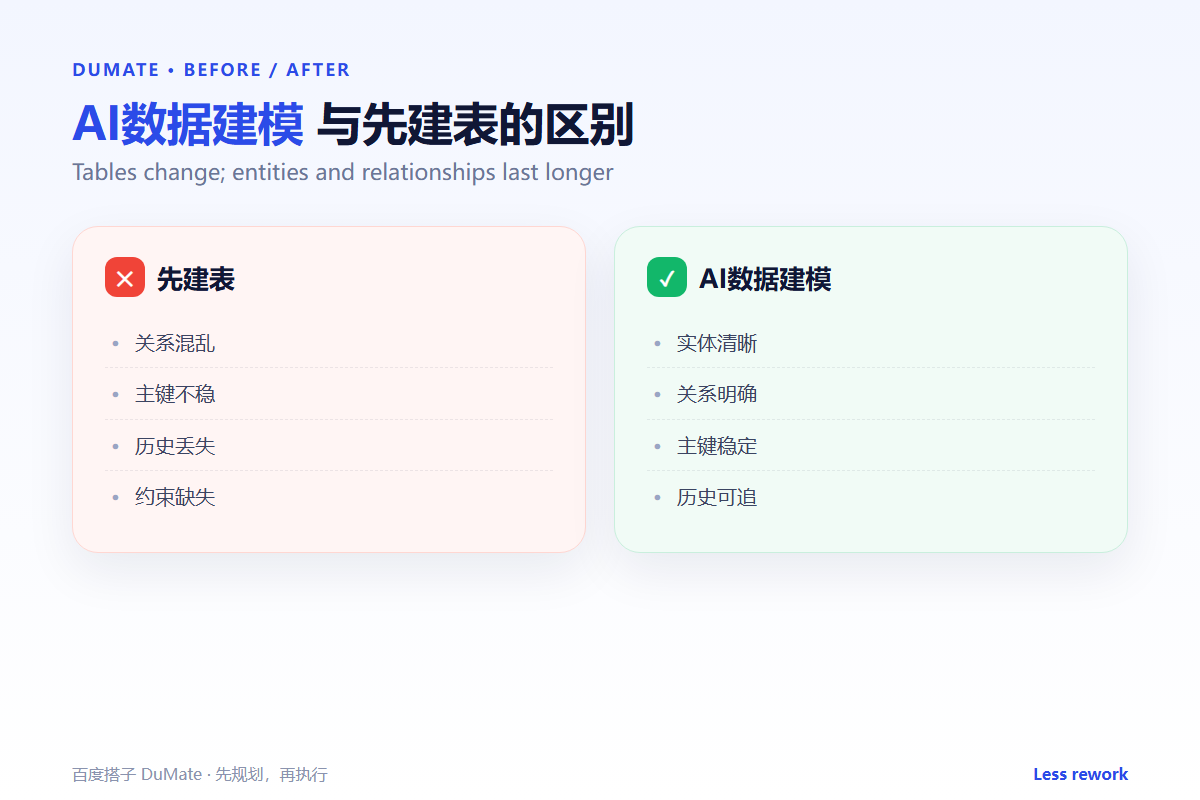
Before, a retailer stored product categories as a comma-separated string. Reports counted a product once per category, and the annual total was wrong by eleven percent. Every team had a different formula for splitting the field. Nobody could answer how many products belonged to two categories.
After, AI数据建模 introduced a category entity and a link table with dates. The migration took a week, and every later report used the same definition without a custom formula or a late-night reconciliation. The link table also made it possible to date a category change and compare it with sales.
FAQ
Do we still need normalization?
Yes as a starting point. Denormalize for a measured reason, not because a join felt slow on a laptop with a sample of a hundred rows.
Does this apply to document databases?
Yes. Entities and identity exist regardless of storage. The difference is where the boundary of a document sits and how often it is rewritten.
How do we handle migrations?
Keep the model and the physical schema separate. AI数据建模 should produce a target model, and the migration plan should map old keys to new ones with a rollback and a validation query. Test the mapping on a copy before touching the production table.
延伸阅读
Label and clean records with data labeling, understand buyers in customer profile, and plan stock with inventory forecast. Demand planning appears in sales forecast, and runtime evidence in log analysis. External references: NIST AI Risk Management Framework and ISO/IEC 42001.
评论
还没有评论,来说两句吧。