
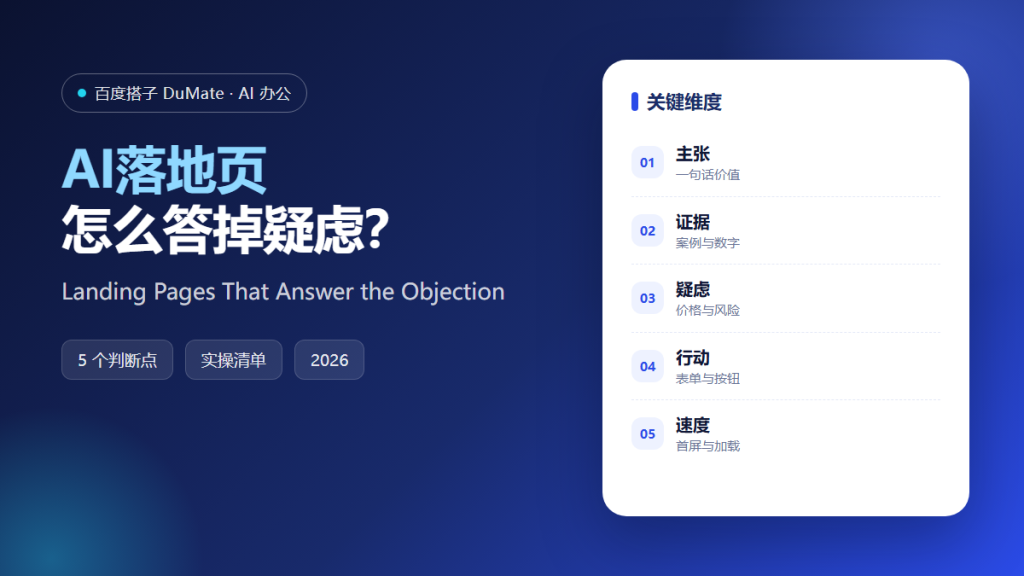
AI落地页 that avoids the objection leaves the visitor to resolve it alone, and most visitors resolve it by leaving. Every offer carries a reason to hesitate: the price, the risk of switching, the effort of setup, or the suspicion that the promise is exaggerated. The page has to say it out loud before the reader does.
This guide explains how to collect real objections, where to place each answer, and the five-step process that turns a page from a brochure into a conversation.
Key Takeaways
- Collect objections from calls, not from guesses.
- Answer the most expensive doubt first.
- Place proof next to the claim it supports.
- Keep one action on the page.
- Review the page on a phone.
Why AI落地页 Needs Objection Handling
A visitor arrives with a question that the page did not write. If the answer is missing, the reader supplies one, and the supplied answer is usually the worst case. AI落地页 that addresses the doubt directly keeps the decision inside the page instead of handing it to a competitor’s comparison table. The doubt does not disappear because the page ignores it; it simply moves to another tab.
Objections also reveal the shape of the page. A pricing doubt needs a table and a refund line; a trust doubt needs a named customer and a date; a setup doubt needs a checklist of what happens in the first week. AI落地页 built around those needs is easier to read than one organized by internal product categories.
Finally, the objection is often the best copy on the page. A sentence that begins with the reader’s fear and ends with a specific answer sounds like a person who has had the conversation before. AI落地页 should borrow that language rather than smooth it into marketing rhythm.
How AI落地页 Works in Five Steps
Step 1: Collect objections from real calls
Read the last fifty sales calls and support threads, and write down every question that began with a hesitation. Keep the customer’s words, including the blunt ones. A list built from transcripts is worth more than a workshop list built from opinions. Group the quotes by wording rather than by product area, and the same fear appears in different clothes.
Step 2: Rank by frequency and cost
Count how often each objection appears, then estimate what it costs when it goes unanswered. A rare doubt about invoicing can be answered in one line; a common doubt about migration can justify a whole section. The ranking decides the order of the page. AI落地页 should rank objections by what a lost deal costs, not by how interesting the question sounds in a meeting.
Step 3: Answer inside the flow
Place each answer where the doubt appears, not in a distant FAQ. If the price appears in the second screen, the refund terms belong beside it. A reader who has to scroll away to find reassurance often does not come back.
Step 4: Let AI落地页 hold the proof
Put the evidence next to the claim it supports: a screenshot beside the feature, a quote beside the promise, a number beside the result. AI落地页 that stacks proof at the bottom asks the reader to connect too many dots, and most will not bother. A screenshot with a date and an account name is worth more than a wall of logos.
Step 5: Keep one action and test it
Every section should point toward the same next step, whether that is a trial, a call, or a quote. Then test the page against the previous version with one change at a time, and keep the version that produces the action rather than the prettier one.
‘ alt=’AI落地页 checklist: objection, proof and one clear action’ />
A Landing Page Checklist
- The headline names the outcome, not the feature.
- The top three objections are answered on the page.
- Each claim has proof within one screen.
- The price or the range is stated plainly.
- The next step takes one click on a phone.
Where AI落地页 Fails
AI落地页 fails when it answers questions nobody asked. A page full of features, awards, and history can be accurate and still miss the doubt that stopped the visitor at the form. A page that answers an invented objection spends space and still leaves the real one open.
- Hiding the price to force a call.
- An FAQ that repeats the sales deck.
- Testimonials with no name or date.
- Two buttons that compete for the same click.
Before and After
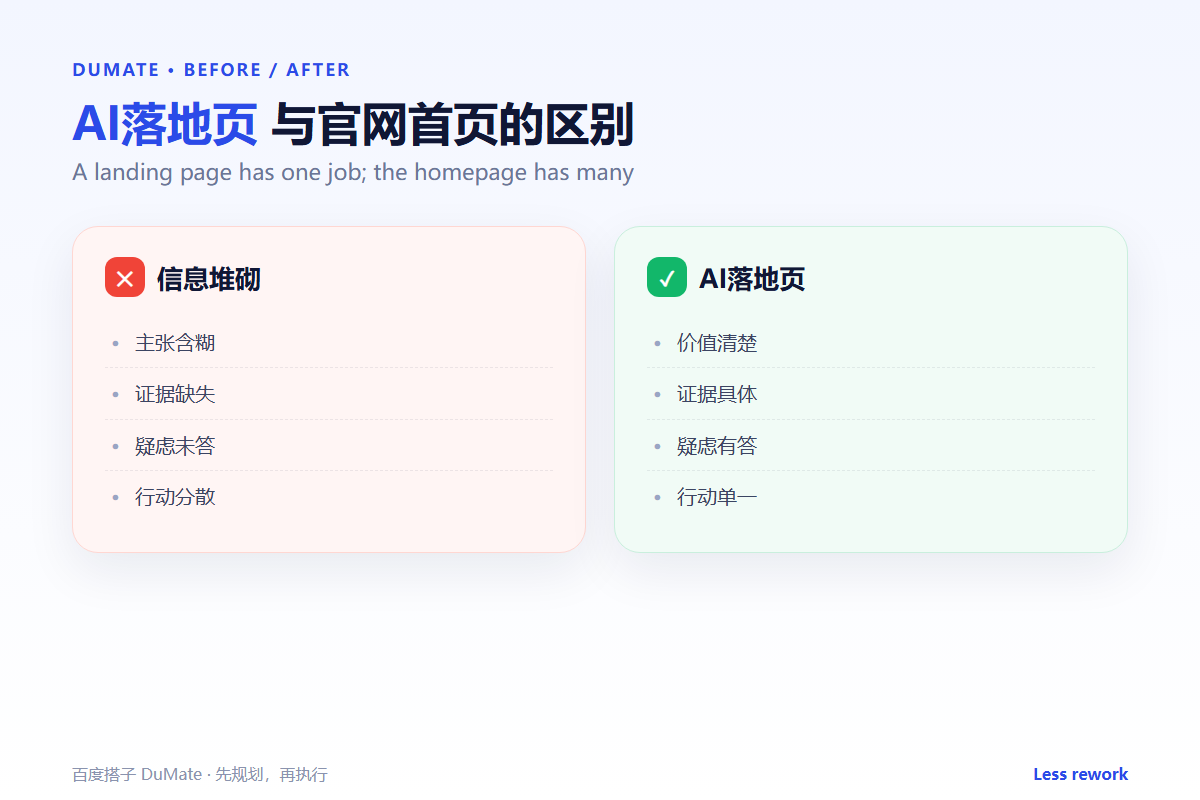
Before, a team built a page that listed every feature and ended with a contact form. Visitors arrived from an ad about migration and left without reading the section that mentioned it. After, AI落地页 was rebuilt around the three doubts from call transcripts, with a migration checklist and a dated customer quote beside the claim.
Traffic stayed the same, and AI落地页 work rarely changes that on its own. Form completions rose by half, and the sales team spent less time answering the same question on the first call.
FAQ
Should the price always be visible?
If the buyer needs the number to decide, hiding it only delays the exit. A range is better than nothing and better than a fake starting figure.
How many objections can a page hold?
Three or four, answered well. A page that tries to answer everything reads like a legal document and persuades no one. Rank them, answer the first three, and revisit the list after the next ten calls.
Do long pages still work?
Length is not the issue; sequence is. AI落地页 can be long if each screen answers the next question in the order a buyer asks it.
延伸阅读
The words that carry the offer are covered in product copy, and the visual proof in product image. For the traffic that arrives first, see ad copy. Small errors that erode trust are listed in typo check, and post-release checks in log analysis. External references: NIST AI Risk Management Framework and ISO/IEC 42001.
评论
还没有评论,来说两句吧。