
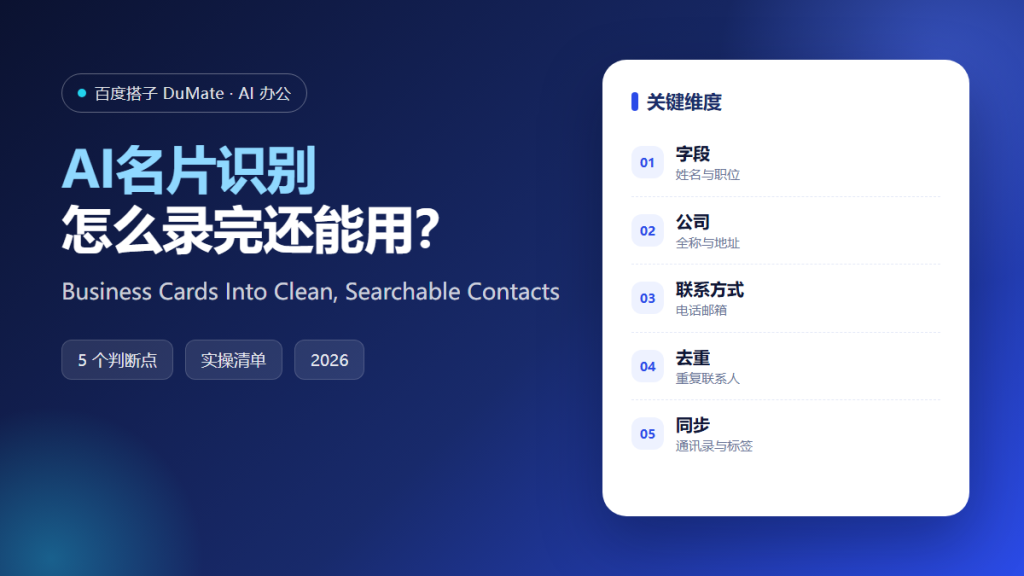
AI名片识别 solves a small but persistent problem: a stack of cards that nobody wants to type. The value is not the transcription itself. It is a searchable contact list with consistent fields, no duplicates, and a note about where each person came from.
This guide covers a five-step process for turning cards into contacts, the fields that need verification, and the tagging system that makes the list useful later.
Key Takeaways
- Photograph the card straight and in focus.
- Verify names, titles, and phone numbers.
- Deduplicate by company and person.
- Tag the source and the date.
- Sync to the address book, not a folder.
Why AI名片识别 Needs Deduplication
The same person appears multiple times with different titles and phone numbers. Without a rule, the list grows faster than the relationships. AI名片识别 can extract fields, but deduplication requires a key, usually company plus name or email.
The second reason is context. A name without a source and a date is hard to use six months later. The tag is as valuable as the phone number.
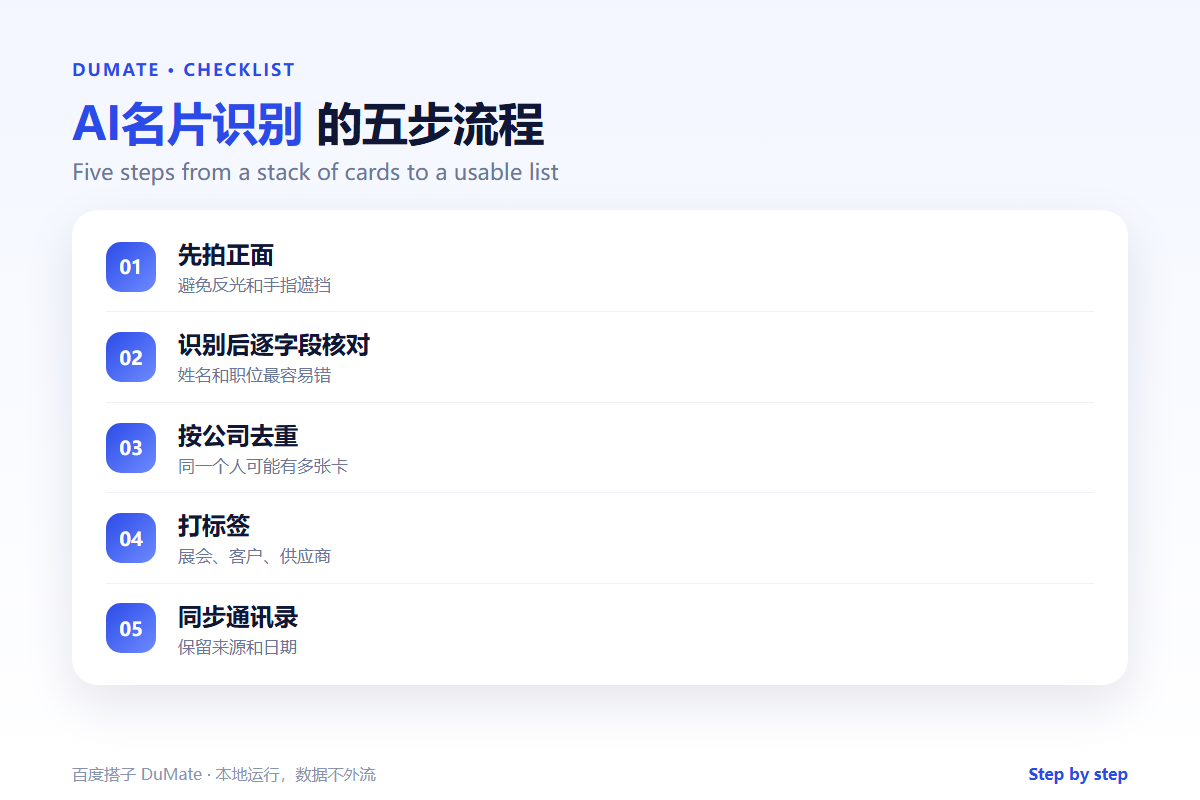
How AI名片识别 Works in Five Steps
Step 1: Capture the card
Place the card on a plain background, avoid glare, and keep the edges in frame. AI名片识别 performs poorly on angled, shadowed photos.
Step 2: Extract the fields
Check name, title, company, phone, email, and address. Titles are often abbreviated and easy to misread. AI名片识别 should preserve the original text when unsure.
Step 3: Verify contact details
Read phone numbers and emails character by character. Send a test message when appropriate. AI名片识别 can confuse similar digits and letters.
Step 4: Deduplicate
Match by email first, then by company and name. Merge duplicates instead of creating a new record. AI名片识别 tools often include a merge function; use it deliberately.
Step 5: Tag and sync
Add the event, the date, and a short note about the conversation. Sync to the address book so the contact is available on the phone. AI名片识别 output that stays in a spreadsheet rarely gets used.
A Contact Checklist
- Name and title are verified.
- Phone and email are correct.
- The record is deduplicated.
- The source and date are tagged.
- The contact is synced.
Where AI名片识别 Fails
It fails on decorative fonts and low-contrast printing. It also fails when the same person has two cards with different details and no rule for which one wins.
- Misread phone numbers.
- Duplicate contacts.
- Missing company names.
- No memory of the meeting.
Before and After
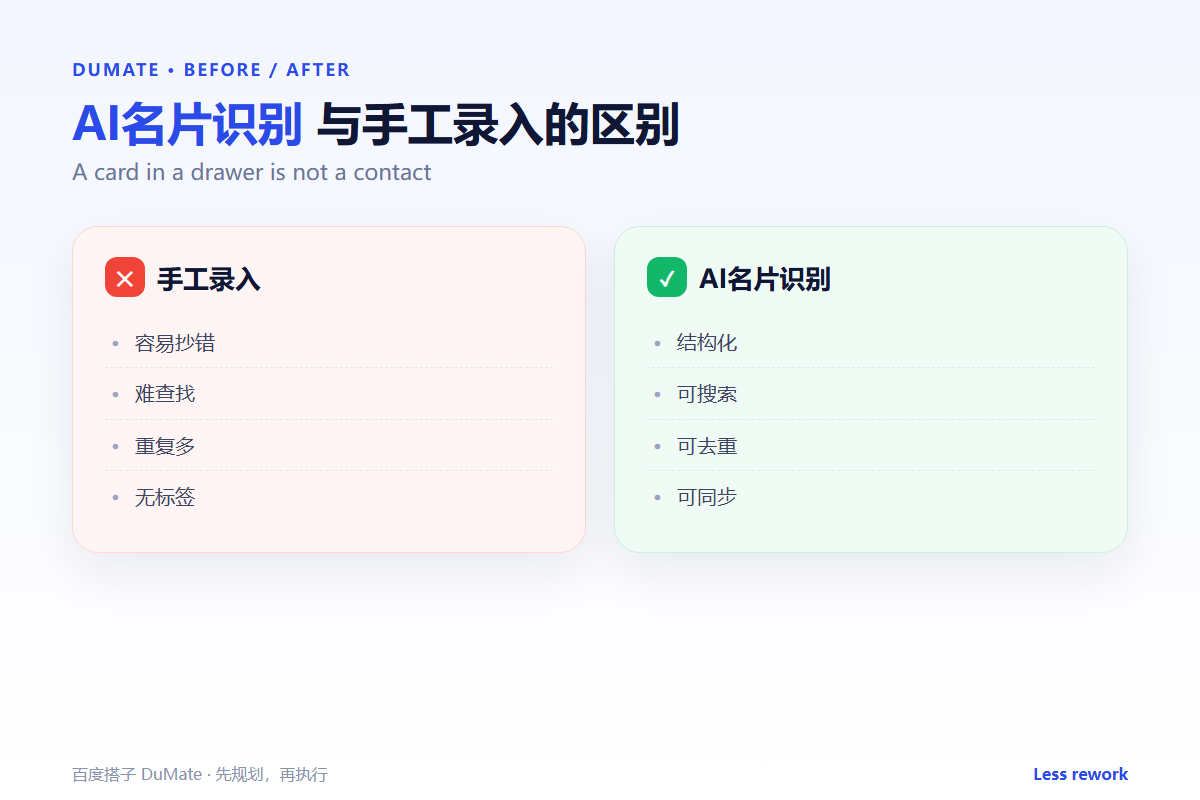
Before, cards went into a drawer and contacts were typed only when needed. After, AI名片识别 produced a clean list with tags, and the team could search by event and company before the next conference.
A contact list becomes valuable when it remembers the context, not just the number.
Used consistently, AI名片识别 becomes part of the normal review routine rather than a separate project.
A final check with AI名片识别 takes a minute and catches the errors that are easiest to miss.
The same AI名片识别 routine works for small tasks and large ones, which is why teams keep using it.
Measuring Whether It Works
Measure AI名片识别 with three numbers: time spent, rework required, and output accepted without changes. Track them for four weeks before drawing a conclusion. Set a baseline from the manual process, because without a baseline any result looks like progress.
Time alone is misleading. A task that finishes faster but needs a full rewrite is not an improvement. Pair time with rework, and pair both with the quality of the final output. AI名片识别 should be compared with how the work was done before, not with an ideal.
Review the numbers monthly with the people doing the work. They know why a week was slow or why rework increased. AI名片识别 improves when the review includes the operators, not only the managers. Keep the dashboard small: three numbers and one note are enough.
Also record the exceptions. A week with an unusual campaign or a system outage is not a fair test. Note the context next to the numbers so a later reader does not compare incomparable weeks. When the numbers are stable, expand the scope; when they move the wrong way, fix the input before adding more use cases. The goal is not to prove that AI名片识别 works, but to know when it works and when it does not.
Keep the first month simple. One task, one owner, and one weekly review are enough to prove the workflow before it spreads across the team.
Write down what changed after each run. A short note is easier to trust than a memory, and it makes the next improvement obvious.
Review the output before it leaves your desk. A two-minute check catches most of the errors that would otherwise come back as questions.
Keep one example of a good result. New team members learn faster from a concrete reference than from a long explanation.
FAQ
Can I scan a whole stack at once?
You can, but verify the results per card. Batch scanning increases the risk of mismatched fields.
Where should the data live?
In the address book or CRM, not in a local folder. Access control matters for personal data.
What should I do with old cards?
Scan, verify, and recycle. Keeping paper adds no value once the record is clean.
延伸阅读
For printed documents, see AI OCR识别. Handwriting is covered in AI手写识别. Document handling is in AI文档处理. Find contacts and files with AI文件搜索. Access rules are in AI权限管理. External references: NIST AI Risk Management Framework and ISO/IEC 42001.
评论
还没有评论,来说两句吧。