
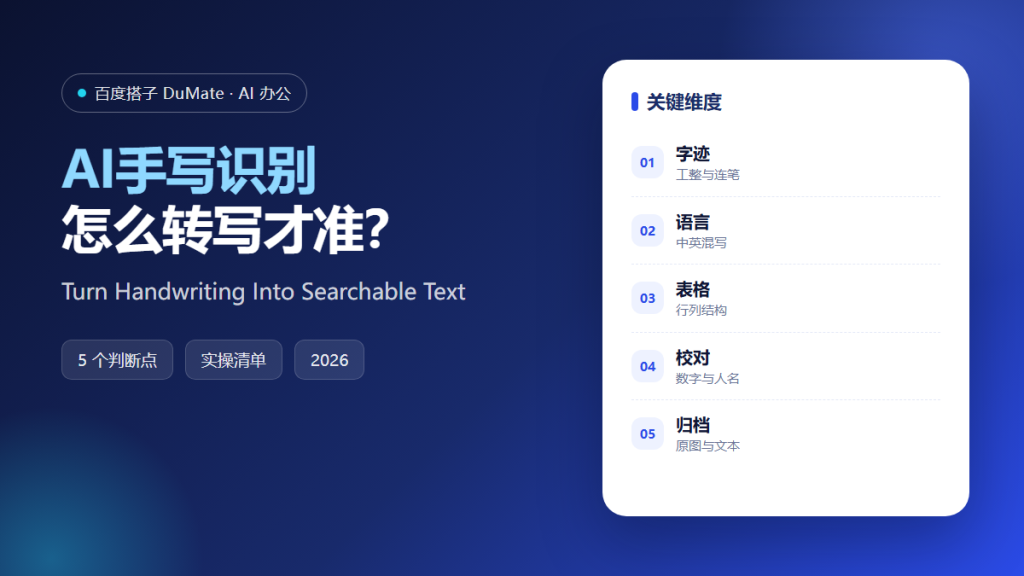
AI手写识别 has improved quickly, but handwriting is still the hardest input in document work. Connectivity, pressure, and personal style create variation that printed text does not have. The practical goal is a searchable draft that a person can verify.
This guide covers a five-step recognition process, the fields that require manual checking, and the archive structure that keeps the original and the text together.
Key Takeaways
- Capture straight, well-lit pages.
- Process one page at a time.
- Verify numbers, names, and dates.
- Keep the original image.
- Archive text and image together.
Why AI手写识别 Needs Verification
Handwriting errors are not random. Numbers, names, and abbreviations fail most often, and those are exactly the fields that matter in forms and notes. AI手写识别 can produce a fluent paragraph with one wrong amount.
The second reason is context. A personal shorthand may be unreadable without the surrounding page. AI手写识别 should work on the full page rather than cropped lines.
How AI手写识别 Works in Five Steps
Step 1: Capture the page
Use even lighting, keep the page flat, and fill the frame. Avoid shadows from your hand. AI手写识别 performs much better on a clean capture.
Step 2: Transcribe by page
Process one page at a time. Do not merge pages before verification, because errors become hard to locate. AI手写识别 should preserve line breaks where possible.
Step 3: Verify critical fields
Check amounts, dates, names, and ID numbers against the image. Read them twice. AI手写识别 can highlight uncertain words, but uncertainty is not the same as error.
Step 4: Keep the original
Store the image next to the text. Every extracted field should be traceable. AI手写识别 output without the image is difficult to defend.
Step 5: Archive by project
Name files consistently and keep a short index. AI手写识别 makes the archive searchable, but only if the text and the image stay linked.
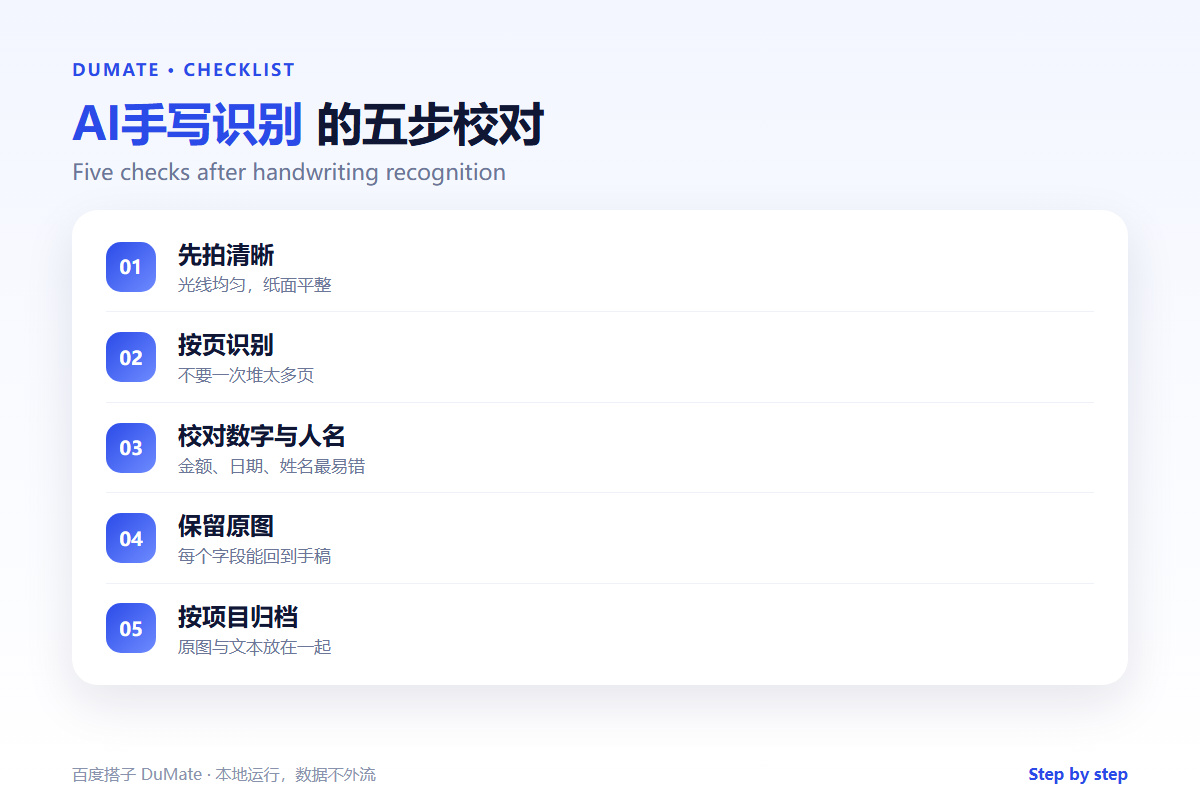
A Recognition Checklist
- The page is flat and evenly lit.
- Transcription is done page by page.
- Numbers and names are verified.
- The original image is stored.
- The archive index is updated.
Where AI手写识别 Fails
It fails on connected cursive, faded ink, and pages with overlapping notes. It also fails when the writer uses personal abbreviations that appear nowhere else.
- Misread decimal points.
- Confused names and signatures.
- Missing marginal notes.
- Lost line order on dense pages.
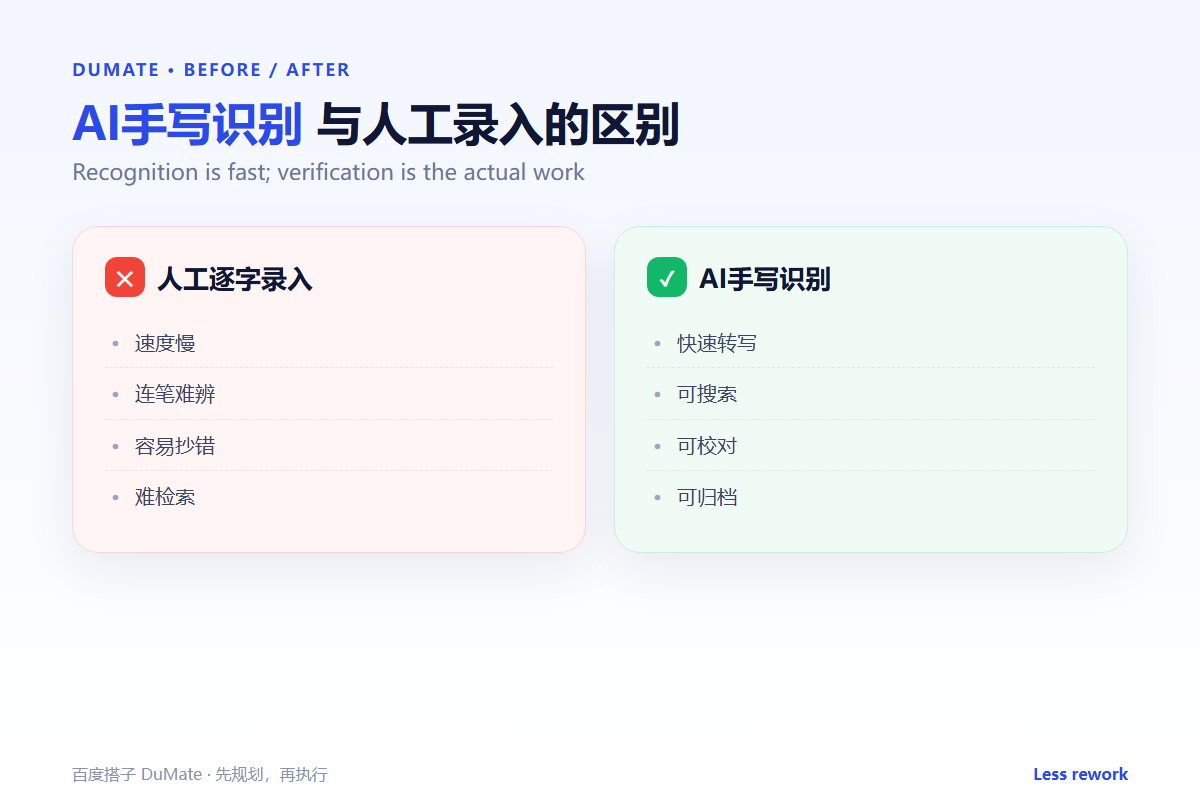
Before and After
Before, a team typed handwritten inspection notes for two days and still found errors in the totals. After, AI手写识别 produced a draft in an hour, and a reviewer checked only the numbers and names against the images.
Recognition changes where the time goes. Verification remains the core of the work.
Used consistently, AI手写识别 becomes part of the normal review routine rather than a separate project.
A final check with AI手写识别 takes a minute and catches the errors that are easiest to miss.
Making It Stick Across a Team
A rollout fails when only one person knows how to use AI手写识别. Write a short guide with three sections: when to use it, what good input looks like, and what to check before sharing the output. Keep the guide to one page.
Train in pairs
Train in pairs. One person runs the task while the other checks the output against the guide, then swap roles. That exercise surfaces unclear steps faster than a presentation.
Keep a shared reference
Keep a shared folder with one strong output, one weak output, and a note explaining the difference. AI手写识别 becomes easier to teach when people can compare real cases.
Review the guide
Review the guide after the first week of use. Remove steps nobody follows and add the questions that keep coming up. A living guide is more useful than a perfect one written in advance.
Assign an owner
Finally, assign an owner. AI手写识别 without an owner drifts, and the guide becomes outdated. The owner does not need to do every task, only keep the standard current. That small responsibility is what keeps AI手写识别 useful after the initial training.
Measure what the team learned
Make the training practical. People learn the workflow by completing a real task, not by listening to a walkthrough. Set aside thirty minutes for practice and review the result together. Measure one thing: how many outputs pass review without correction. That number is a better indicator than attendance.
FAQ
Can it read cursive?
Often, but accuracy drops. Verify more fields when the writing is connected.
Should I crop each line?
No. Full-page recognition preserves context and line order.
What about signatures?
Treat them as images, not text. Do not rely on recognition for identity.
延伸阅读
For printed scans, see AI OCR识别 and AI扫描件修复. Document processing is covered in AI文档处理. Audio notes are covered in AI语音转文字. Keep archives in an AI知识库. External references: NIST AI Risk Management Framework and ISO/IEC 42001.
评论
还没有评论,来说两句吧。