
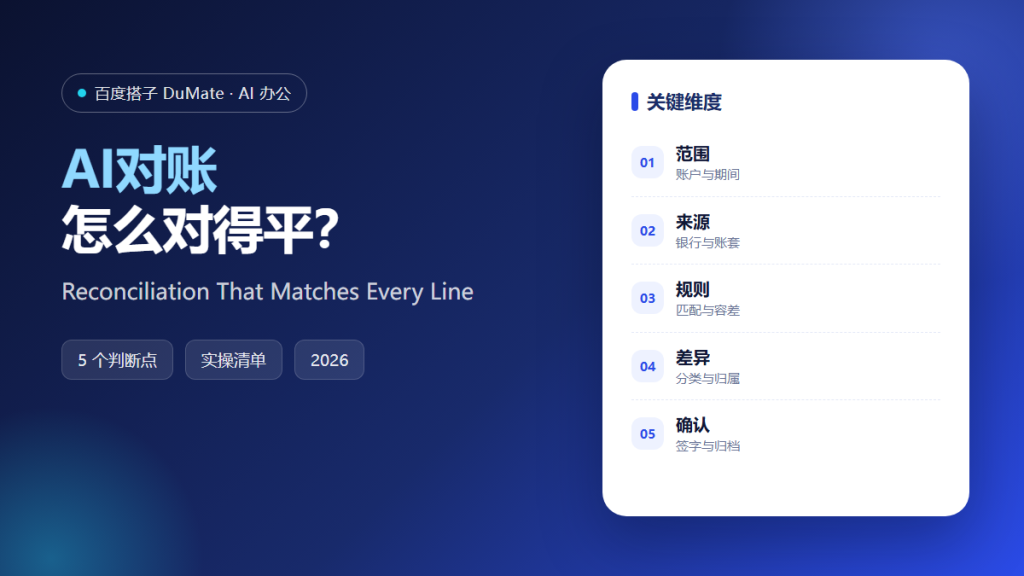
AI对账 is the discipline of proving that two records describe the same reality. The bank statement, the ledger, and the invoice list rarely agree on the first pass, and the gap is where errors, fraud, and timing differences hide. A reconciliation that stops at the total is not a reconciliation; it is a coincidence.
This guide explains a five-step matching process, the break categories that should be separated, and the evidence needed to close a period with confidence.
Key Takeaways
- Reconcile at the line level, not the total.
- Match on reference, amount, and date.
- Separate timing differences from errors.
- Assign every break to an owner.
- Record adjustments with supporting evidence.
Why AI对账 Needs Line-Level Matching
A total can match while the underlying lines are wrong. Two offsetting errors, one duplicate payment and one missing receipt, can leave the summary untouched. AI对账 should compare individual transactions so that each line has a counterpart or a documented reason for being unmatched.
The second reason is timing. A payment sent on the last day of the month may appear in the ledger before it appears in the bank. These differences are normal, but they must be identified rather than treated as errors. AI对账 can group breaks by age and type, which makes the month-end review much faster.
Third, reconciliation is a control, not a clerical task. If the same person can create a payment, record it, and approve the match, the process offers little protection. AI对账 should preserve a clear audit trail and separate the person who prepares the match from the person who reviews it. The reviewer should also confirm that account balances were not adjusted to fit the statement, because a forced balance is a warning sign rather than a successful close of the period under review.
How AI对账 Works in Five Steps
Step 1: Freeze the sources
Export the bank statement, ledger, and subledger for the same period. Record the extraction time and the person who pulled each file. AI对账 cannot resolve differences if the sources keep changing during the review.
Step 2: Normalize the data
Standardize dates, currencies, and reference formats. Remove header rows and duplicate exports. AI对账 can clean inconsistent spacing and identify columns that contain mixed data types before matching begins.
Step 3: Match the lines
Use exact matches on reference and amount first, then fuzzy matches on date and counterparty. Review every fuzzy match manually. AI对账 can propose candidates, but a person should confirm that two similar lines are truly the same transaction.
Step 4: Classify the breaks
Group unmatched items into timing, missing document, duplicate, amount error, and unknown. Assign an owner and a due date to each group. AI对账 can produce the aging report that shows which breaks have survived more than one period.
Step 5: Post and sign off
Record adjustments with a description, a source document, and an approver. Re-run the reconciliation after posting. AI对账 can prepare the summary, but the controller signs the final statement.
‘ alt=’AI对账 checklist: frozen sources, normalized data, matches, breaks and sign-off’ />
A Reconciliation Checklist
- Source files cover the same period.
- Opening balances agree with the prior close.
- Every unmatched line has a category.
- Adjustments have supporting documents.
- The AI对账 review is performed by a second person.
Where AI对账 Fails
AI对账 fails when the tool is allowed to force matches to make the report balance. A forced match hides the very difference the process exists to find. It also fails when breaks are carried forward without explanation.
- Matching only on amount.
- Accepting a fuzzy match without review.
- Leaving old breaks in a suspense account.
- No separation between preparer and reviewer.
Before and After
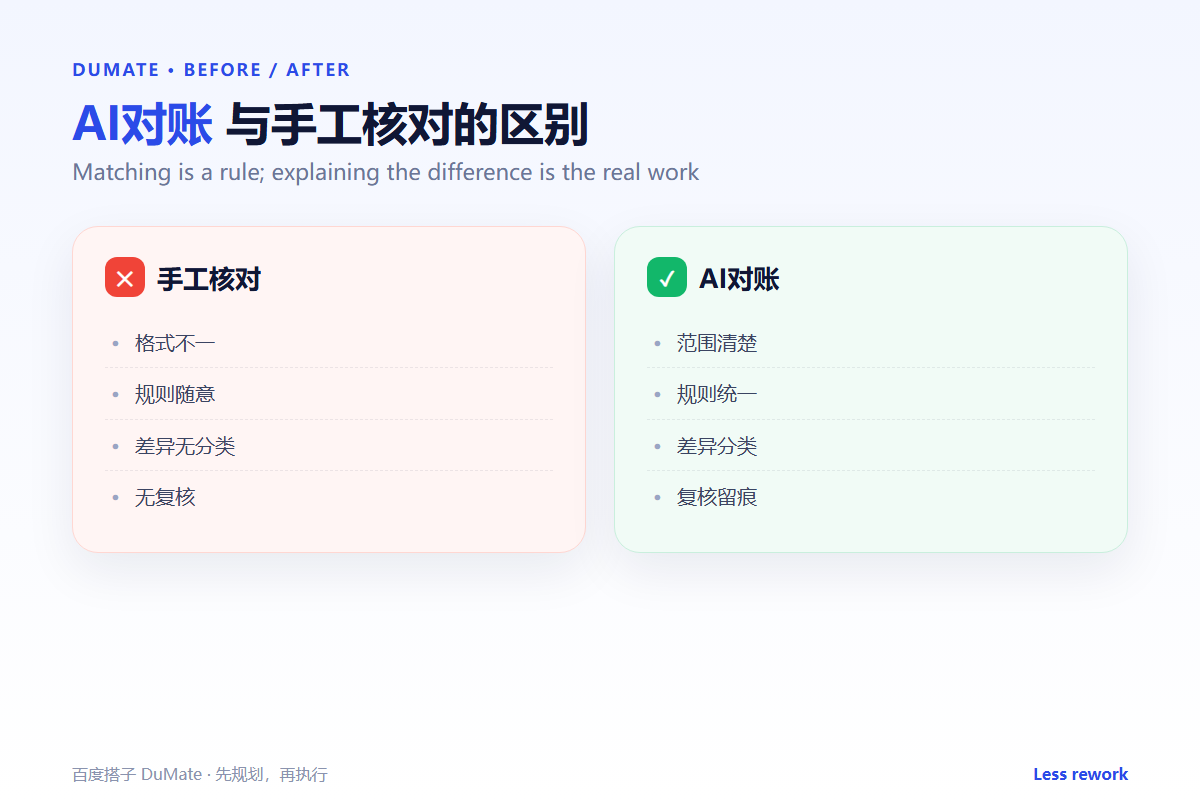
Before, a finance team reconciled at the total level and spent the first week of every month searching for the cause of a small unexplained difference. After, AI对账 matched each line, labeled the breaks, and showed that most of the gap came from three supplier payments recorded in the wrong period.
A clean reconciliation does not prove that every transaction is wise. It proves that every transaction is known, and it is complete only when each remaining difference has a named owner and a documented next step.
Keep the first month simple. One task, one owner, and one weekly review are enough to prove the workflow before it spreads across the team.
Write down what changed after each run. A short note is easier to trust than a memory, and it makes the next improvement obvious.
Review the output before it leaves your desk. A two-minute check catches most of the errors that would otherwise come back as questions.
Keep one example of a good result. New team members learn faster from a concrete reference than from a long explanation.
The first version does not need to be perfect. It needs to be complete enough to review, so the team can see the gaps and fix them in the next round.
Write the review notes in the same place as the work. Notes stored somewhere else are rarely read when the next decision arrives.
FAQ
How often should reconciliation be performed?
Monthly for most accounts, daily for high-volume cash accounts, and whenever a control failure is suspected.
What is an acceptable number of unmatched items?
There is no universal number. What matters is that each item is explained, owned, and resolved within a defined period.
Can AI对账 replace an auditor?
No. It speeds up matching and documentation, but judgment about materiality and control still belongs to finance professionals.
延伸阅读
Close the period with financial statements and budget planning. Investigate anomalies with log analysis and label exceptions with data labeling. Supplier invoices are covered in procurement comparison. External references: NIST AI Risk Management Framework and ISO/IEC 42001.
评论
还没有评论,来说两句吧。