
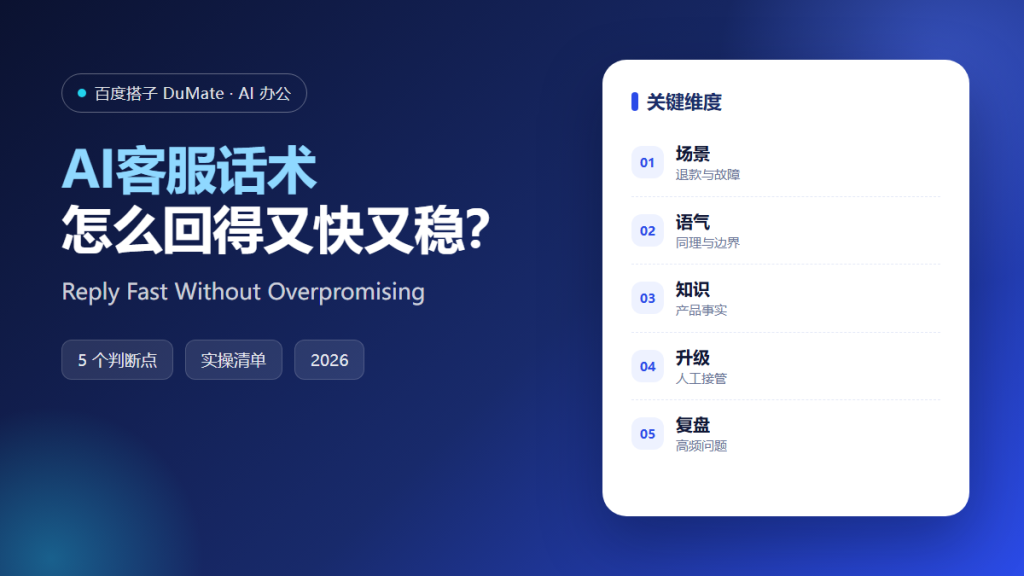
AI客服话术 is often treated as a speed feature. The real goal is consistency. A support team that answers quickly but differently every time creates confusion, duplicate tickets, and customers who learn to ask twice. A reply playbook fixes the wording while leaving room for empathy.
This guide covers the five-step method for building a playbook, the phrases that cause trouble, and the escalation rules that protect the customer relationship.
Key Takeaways
- Organize replies by scenario, not by product.
- Lead with empathy, then with the fix.
- Only promise what the system can deliver.
- Escalate money and complaints to a person.
- Review repeated questions every week.
Why AI客服话术 Needs a Playbook
New agents improvise because they have no examples. Experienced agents improvise because they are in a hurry. Both produce replies that drift in tone and accuracy. A playbook gives everyone a strong starting point, and AI客服话术 makes that starting point fast to retrieve.
A playbook also protects the customer. Clear language about refunds, timelines, and limitations prevents the disappointment that comes from an overpromise. Most escalations are not caused by the original problem; they are caused by a promise that was not kept.
Finally, a playbook is a training asset. When a new agent joins, they can read twenty scenarios and understand the company’s voice in an hour. Without it, they learn by making mistakes in front of customers.
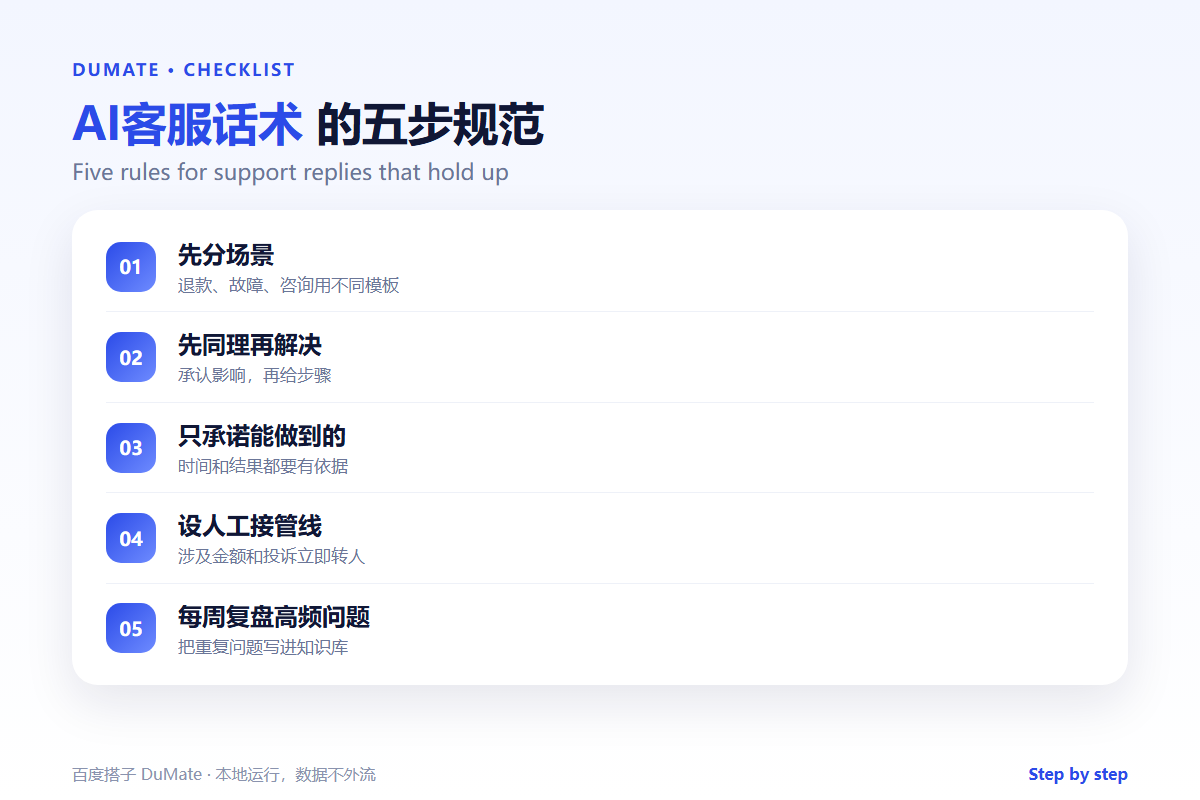
How AI客服话术 Works in Five Steps
Step 1: Group tickets by scenario
Use scenarios such as refund request, login failure, billing question, feature request, and complaint. Ignore product categories for now. Customers experience problems, not product trees.
Step 2: Write the empathy line
Start with a sentence that acknowledges the impact. Keep it specific and short. A generic apology feels automated; a specific acknowledgement feels human. AI客服话术 can draft variants, but an agent should choose the one that fits the case.
Step 3: State the fix and the limit
Explain what will happen, when it will happen, and what is not possible. If a refund takes five business days, say five. If a feature is not available, say so and offer the workaround. Accuracy beats optimism.
Step 4: Define escalation triggers
Send a case to a human when money, legal risk, safety, or a repeated complaint is involved. Write the triggers down so the decision does not depend on how busy the queue is. AI客服话术 should never be the last voice on a serious issue.
Step 5: Review and update weekly
Collect the questions that appeared more than three times. Add a scenario or update an existing one. Remove phrases that caused confusion. A playbook that is not maintained becomes a source of stale answers.
Phrases to Avoid
- We will definitely fix this today.
- That has never happened before.
- You should have read the terms.
- Unfortunately, there is nothing we can do.
- Please wait while we look into it, with no time estimate.
Where AI客服话术 Fails
It fails when the knowledge base is wrong. A perfect template cannot fix an incorrect policy. It also fails when agents paste a reply without reading the ticket, which produces answers that are grammatically correct and contextually absurd. Finally, it fails when tone is uniform across serious and trivial cases.
- Templates that ignore the customer’s history.
- Promises made to close a ticket faster.
- No record of what was promised.
- Escalation rules that change by shift.
Before and After
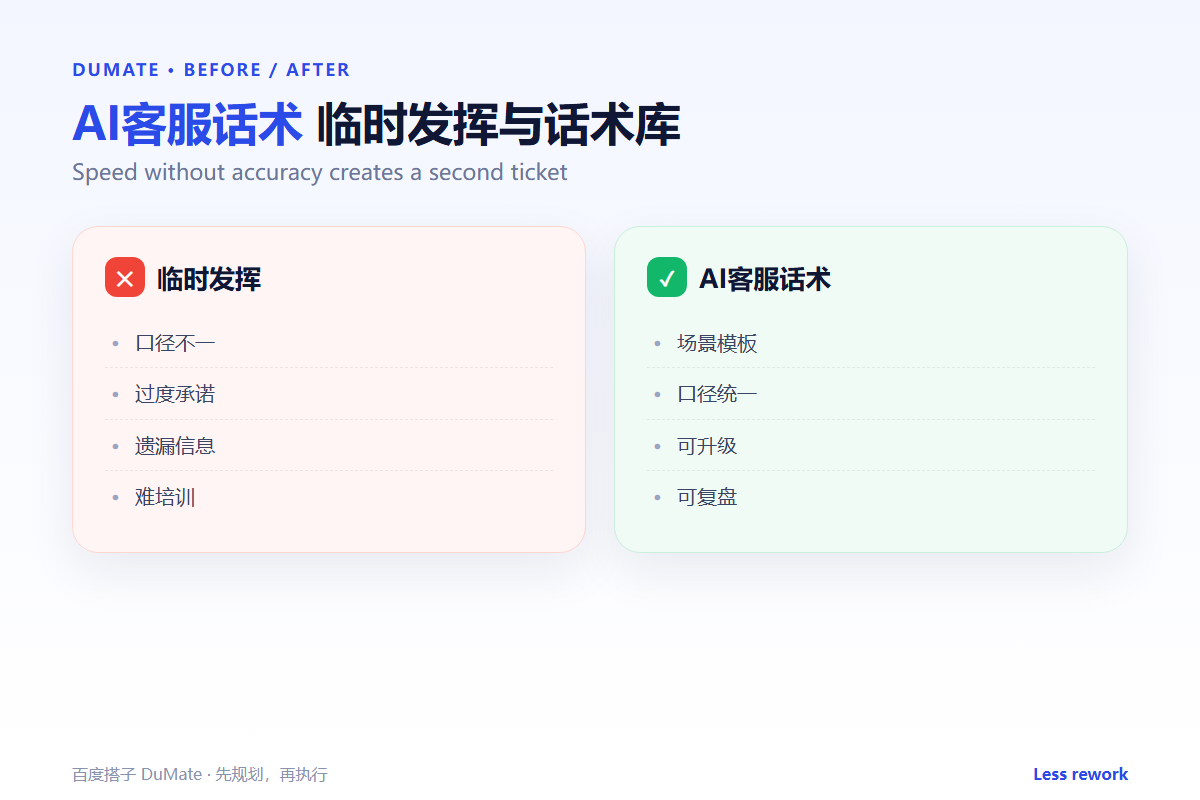
Before, ten agents wrote ten different replies to the same refund question, and customers compared notes on social media. After, the team uses one playbook, AI客服话术 retrieves the right scenario, and the agent edits the empathy line for the specific case. Response time drops, and complaint volume drops with it.
The playbook is not a script for robots. It is a shared standard that frees agents to focus on the part that requires judgment.
Measure the playbook. Track first-response time, resolution time, reopen rate, and satisfaction by scenario. If one scenario has a high reopen rate, the AI客服话术 for that case is probably unclear or overpromising.
Let agents propose edits. The people who read the replies all day notice awkward phrasing before managers do. A monthly session where the team rewrites two templates keeps the AI客服话术 alive.
Keep a short list of phrases that customers respond well to, and another list of phrases that trigger complaints. Update both from real tickets, not from opinion. Over time, the AI客服话术 becomes a record of what actually works.
Finally, protect the handoff. A customer who asks for a person should reach one quickly, without repeating the story. That single rule prevents more frustration than any wording change.
Keep AI客服话术 close to the queue. A playbook stored in a folder nobody opens will not survive a busy Monday. Put the AI客服话术 where agents already work, and link each scenario to the policy page it depends on, so the answer and the rule stay in sync. The best AI客服话术 is the one an agent can find in ten seconds.
FAQ
Will templates make support sound robotic?
Only if agents paste them unchanged. Use the template for structure and write the first sentence yourself.
How many scenarios do we need?
Start with the top twenty ticket types. That usually covers most volume, and the rest can be added over time.
Who owns the playbook?
One support lead should own it, with a monthly review and a clear change log.
延伸阅读
For tone and drafting, see AI写作助手. Keep policies accurate with an AI知识库. Route inbound messages with AI邮件助手. Industry templates are covered in AI专家套件. For multilingual support, read AI翻译工具. External references: NIST AI Risk Management Framework and W3C Web Accessibility Initiative.
评论
还没有评论,来说两句吧。