
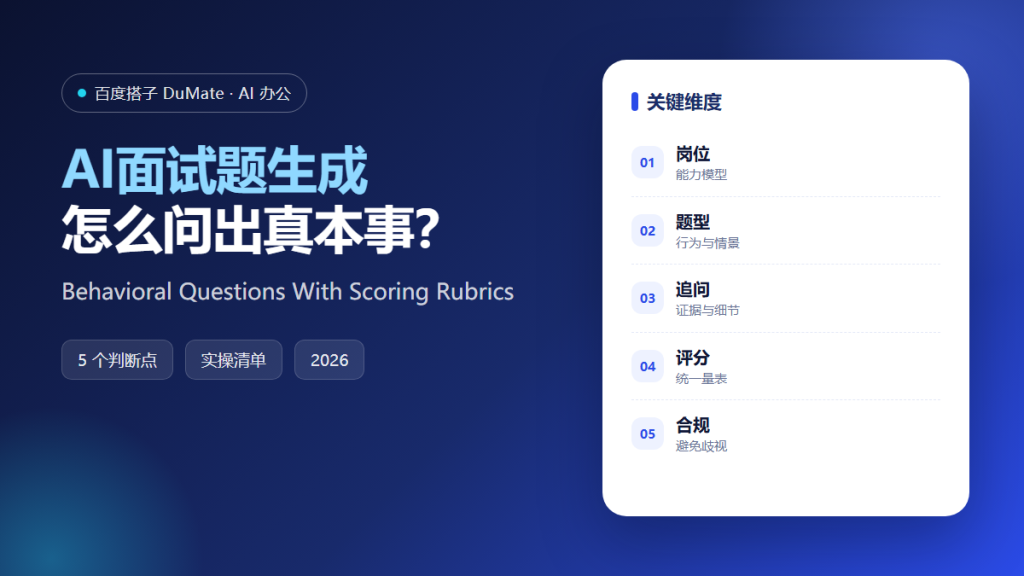
AI面试题生成 solves a problem that most interviewers do not notice: the questions change from candidate to candidate. A friendly conversation feels fair, but it makes comparison impossible. Structured questions plus a shared rubric turn interviews into evidence instead of impressions.
This guide covers the five-step design process, the question types that predict performance, and the compliance checks to run before the first interview.
Key Takeaways
- Start from the role’s core capabilities.
- Ask about real past behavior.
- Plan the follow-up questions in advance.
- Score with a written rubric.
- Avoid questions that touch protected traits.
Why AI面试题生成 Improves Hiring Decisions
Unstructured interviews are pleasant and unreliable. Two interviewers can meet the same candidate and reach opposite conclusions, because each one asked different questions and weighted different answers. AI面试题生成 helps by producing a consistent set of questions tied to the capabilities the role actually needs.
The second benefit is follow-up quality. Most interviewers accept the first answer, which is often a summary. A prepared follow-up asks for the situation, the action, and the result. AI面试题生成 can draft these probes in advance, so the interviewer does not have to improvise under time pressure.
The third benefit is documentation. When every candidate answers the same questions and receives a score on the same scale, the hiring discussion becomes a comparison of evidence. That is better for the candidate and faster for the team.
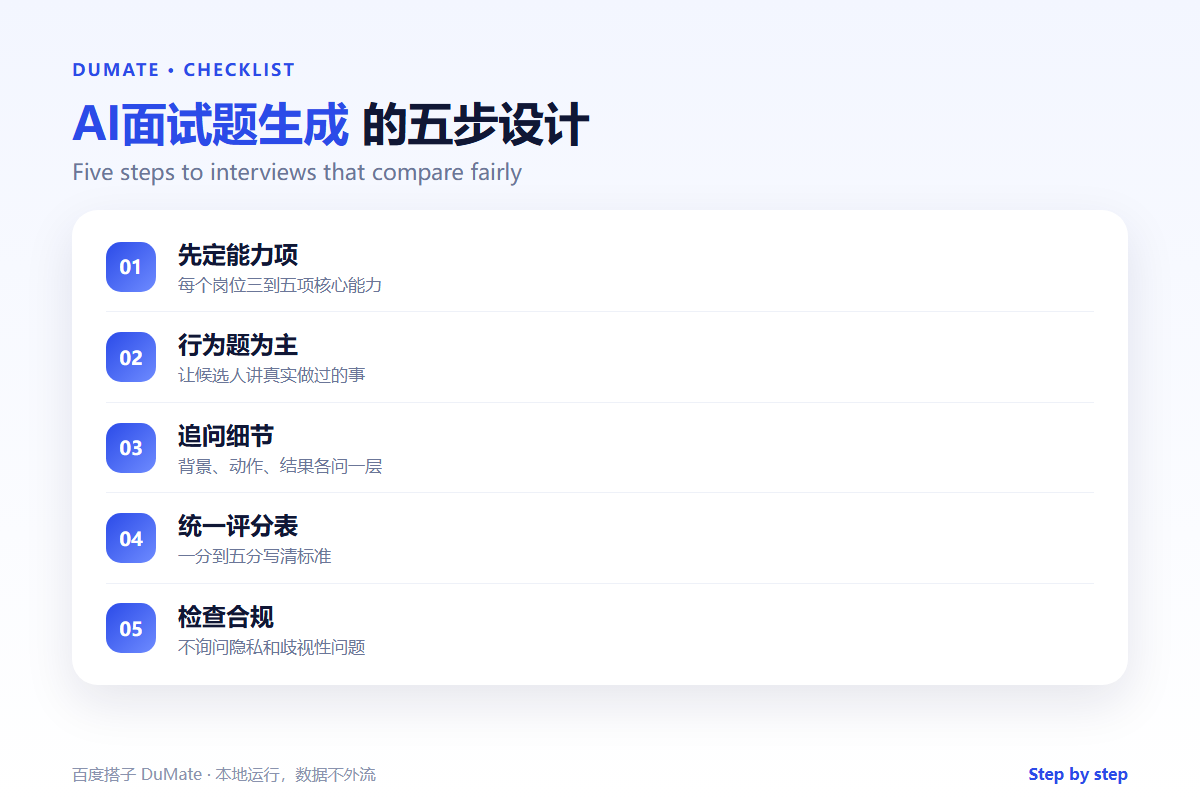
How AI面试题生成 Works in Five Steps
Step 1: Define the capability model
List three to five capabilities the role must demonstrate in the first year. Keep them concrete: managing a launch, handling an escalation, or analyzing a dataset. Vague capabilities produce vague questions.
Step 2: Choose behavioral and situational questions
Behavioral questions ask about the past: tell me about a launch that slipped. Situational questions ask about a hypothetical: how would you handle a conflict between two stakeholders? Use both, and keep the ratio consistent across candidates.
Step 3: Write follow-ups for each question
Plan two probes per question. One asks for specifics, such as what you personally did. The other asks for evidence, such as how you measured the result. AI面试题生成 can draft these, but the interviewer should choose the ones that fit the role.
Step 4: Build a scoring rubric
Define what a one, three, and five look like for each capability. Use behavioral anchors, not adjectives. A five is not excellent; a five is a specific pattern of evidence. This is the part that makes AI面试题生成 genuinely useful.
Step 5: Review for compliance
Remove questions about family plans, health, religion, politics, and other protected traits. If a question is not job-related, cut it. Document the review so the process is defensible.
A Question Set Template
- Capability one: two behavioral questions.
- Capability two: one behavioral, one situational.
- Two planned follow-ups per question.
- Rubric anchors for scores one, three, and five.
- A short note on what would disqualify a candidate.
Where AI面试题生成 Fails
It fails when the capability model is generic. Questions about teamwork and communication produce answers that sound identical. It also fails when interviewers treat the script as a cage and refuse to follow an interesting thread. Structure should support curiosity, not replace it.
- Questions that invite rehearsed answers.
- Rubrics with no behavioral anchors.
- Interviewers scoring from memory days later.
- Inconsistent follow-ups across candidates.
Before and After
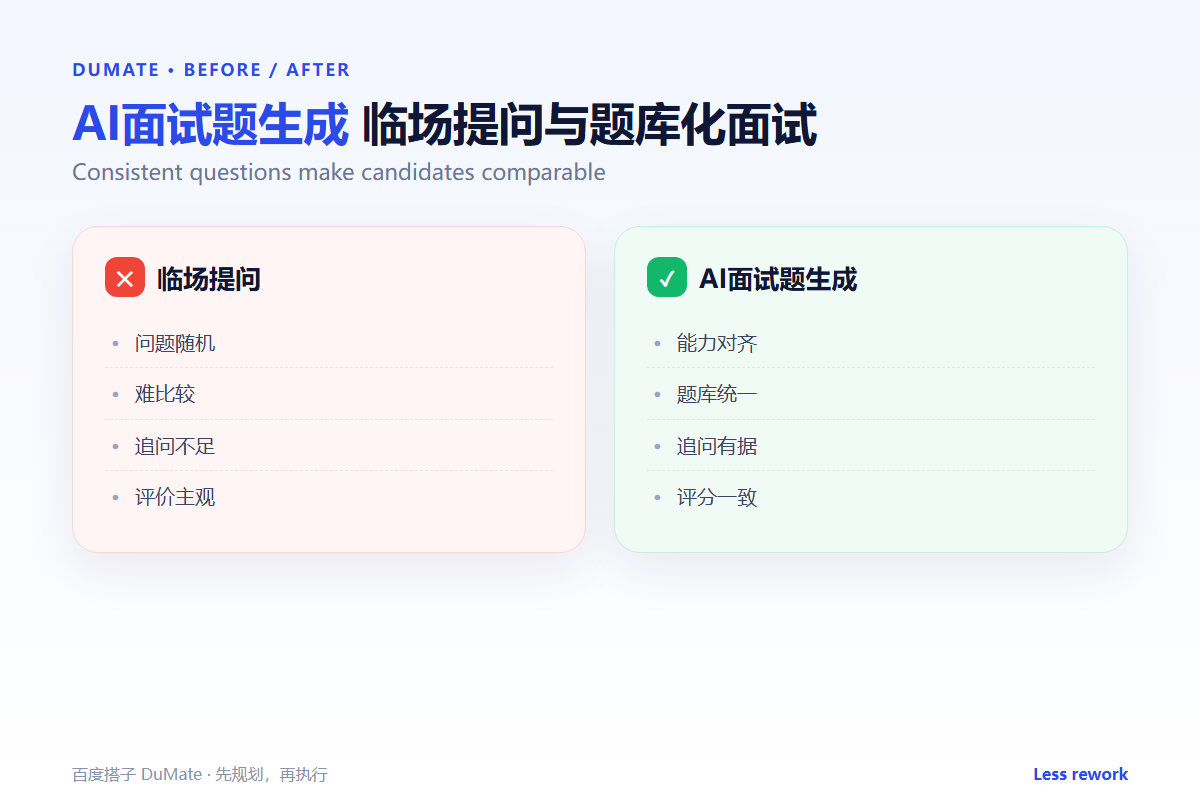
Before, each interviewer prepared questions the night before, and the debrief turned into a contest of impressions. After, the panel uses one question set, takes notes against a rubric, and compares evidence. The debrief is shorter, and the decision is easier to explain to candidates who ask for feedback.
Structure does not make hiring cold. It makes the conversation fairer, because every candidate gets the same chance to show the same capabilities.
Pilot the question set with two interviewers and two practice candidates. Compare notes and fix questions that produce vague answers. A rehearsal makes AI面试题生成 output much stronger than a first draft used live.
Keep a bank of strong answers, anonymized, for calibration. When a new interviewer joins, they can read examples of a score of three and a score of five. That short session improves consistency more than another page of AI面试题生成 instructions.
Review the set every six months. Roles change, and questions that were relevant last year may now test the wrong capability. Update the AI面试题生成 inputs when the role changes, not after a bad hire.
Document what changed after each interview round. If a question consistently fails to produce evidence, rewrite it before the next round. The AI面试题生成 output is a living document, not a one-time script. Teams that revise it after every round get better evidence each time, and the AI面试题生成 becomes a record of what the role actually requires. That record also helps when the role is handed to a new hiring manager, because the questions show what the team learned to look for.
FAQ
How many questions should an interview cover?
Four to six core questions with follow-ups are enough for a forty-five minute session. Depth beats breadth.
Can AI面试题生成 replace interviewer training?
No. It provides the script. Interviewers still need practice in listening and probing.
Should candidates know the rubric?
They should know the capabilities being assessed. Sharing the exact scoring anchors is optional and depends on your process.
延伸阅读
Pair this with AI简历筛选 to keep the pipeline consistent. New hires learn faster with AI培训材料. Capture interview panels with AI会议纪要. Store question sets in an AI知识库. For wording, see AI写作助手. External references: NIST AI Risk Management Framework and ISO/IEC 42001.
评论
还没有评论,来说两句吧。以下为本文的引用通告: