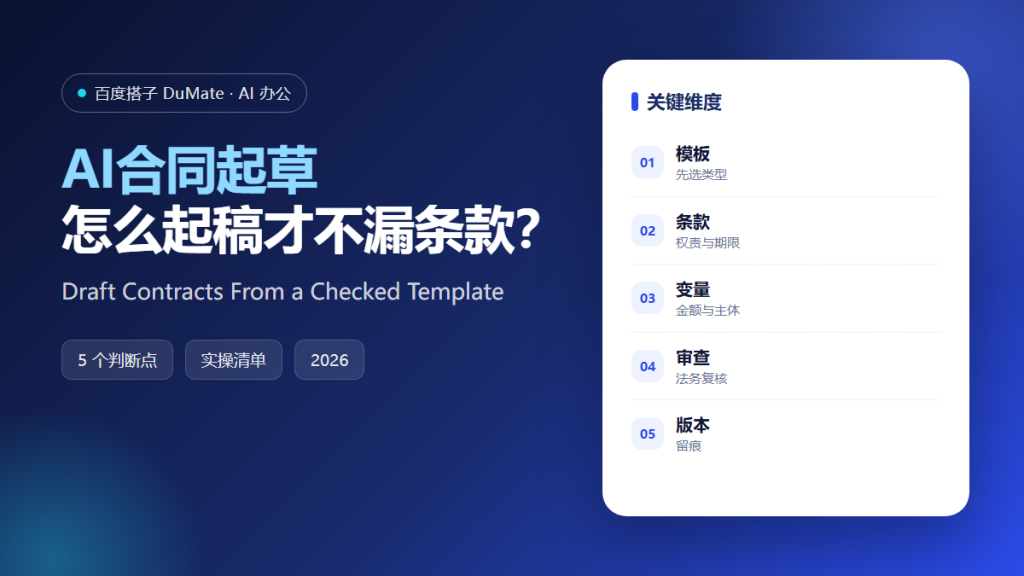
AI合同起草 saves time on the first draft and creates risk on the last mile. Contracts are not prose; they are a set of obligations with money and deadlines attached. A useful drafting process keeps the template stable, marks every variable, and leaves the final judgment to legal review.
This guide covers the five-step method we use for routine agreements, the clauses that are most often incomplete, and the version habits that prevent disputes.
Key Takeaways
- Choose the template by contract type.
- Verify legal names and registration numbers.
- Never guess an amount or a date.
- Mark open items for legal review.
- Keep a version trail for every edit.
Why AI合同起草 Needs a Template First
Starting from a blank page invites omission. Starting from an old contract invites inherited risk. A maintained template sits between the two: it contains the clauses your legal team has approved, with placeholders for the details that change per deal.
AI合同起草 is good at filling placeholders consistently and at flagging missing fields. It is not good at deciding whether a liability cap is appropriate for a specific customer. That decision depends on risk appetite, negotiation history, and jurisdiction, which is why the process routes to a person before signature.
The third reason is speed of review. When every draft follows the same structure, legal reviewers know where to look. They spend their time on the commercial terms instead of reconstructing the document.
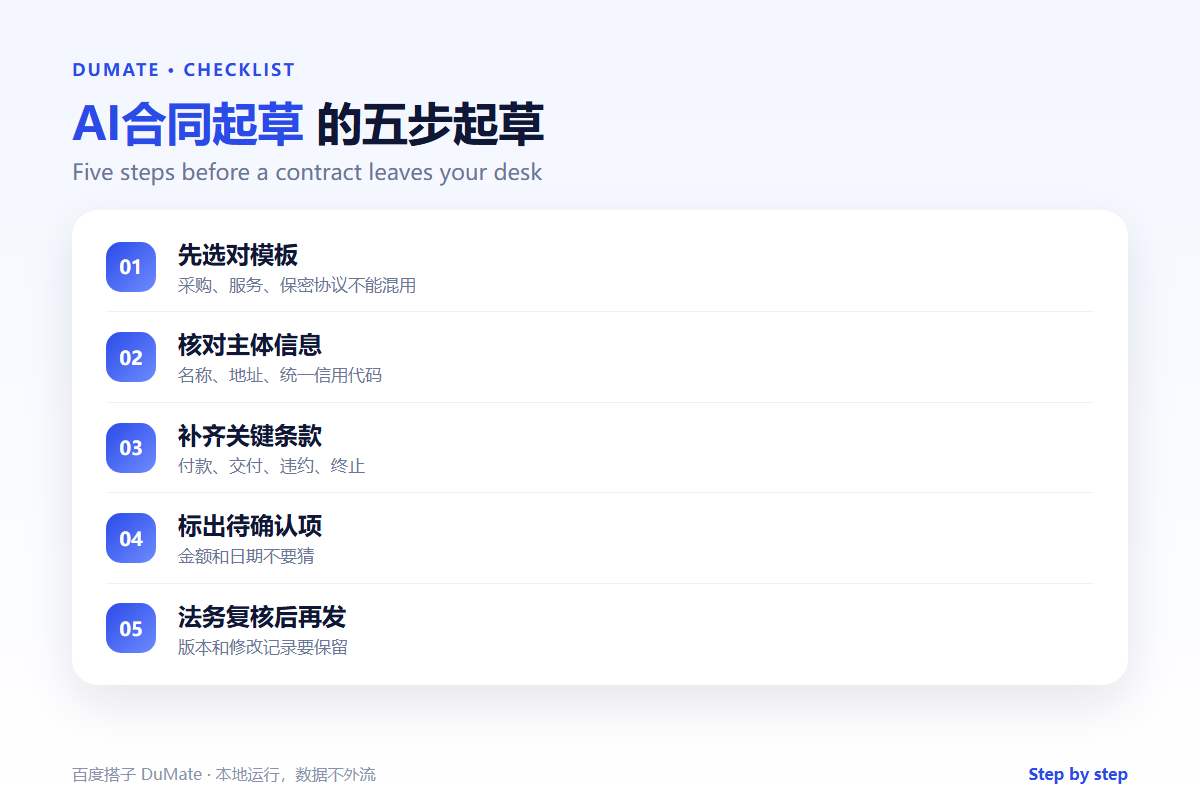
How AI合同起草 Works in Five Steps
Step 1: Select the right template
Procurement, services, confidentiality, and employment agreements are not interchangeable. Choose the template that matches the relationship, then remove sections that do not apply. A mismatch at this step causes problems that no amount of editing can fix.
Step 2: Verify the parties
Check the legal name, address, and registration number against an official source. A typo in a company name can invalidate a notice clause. AI合同起草 can copy the details, but a person should confirm them.
Step 3: Fill the commercial terms
Amount, payment schedule, delivery date, acceptance criteria, and renewal terms. Leave a placeholder if the number is not confirmed. A guessed date is worse than an open item, because it looks finished.
Step 4: Review the risk clauses
Look at liability, indemnity, termination, confidentiality, and data processing. Confirm that the clauses match the deal you agreed in email. This is where AI合同起草 should stop and a legal reviewer should start.
Step 5: Record the version and send
Name the file with the counterparty, date, and version. Keep the redline history. When a dispute starts, the version trail is often more valuable than the contract itself.
Clauses That Are Often Incomplete
- Payment timing and late fees.
- Scope change and approval process.
- Termination notice periods.
- Data ownership and deletion.
- Governing law and dispute venue.
Where AI合同起草 Fails
It fails when the template is outdated. A clause that was standard two years ago may conflict with current data protection rules. It also fails when the assistant invents a plausible clause that nobody approved. Finally, it fails when the draft is sent without a human review, because the cost of a bad clause is measured in years.
- Guessed amounts or dates.
- Party names copied from an old deal.
- Missing annexes and schedules.
- No record of who approved what.
Before and After
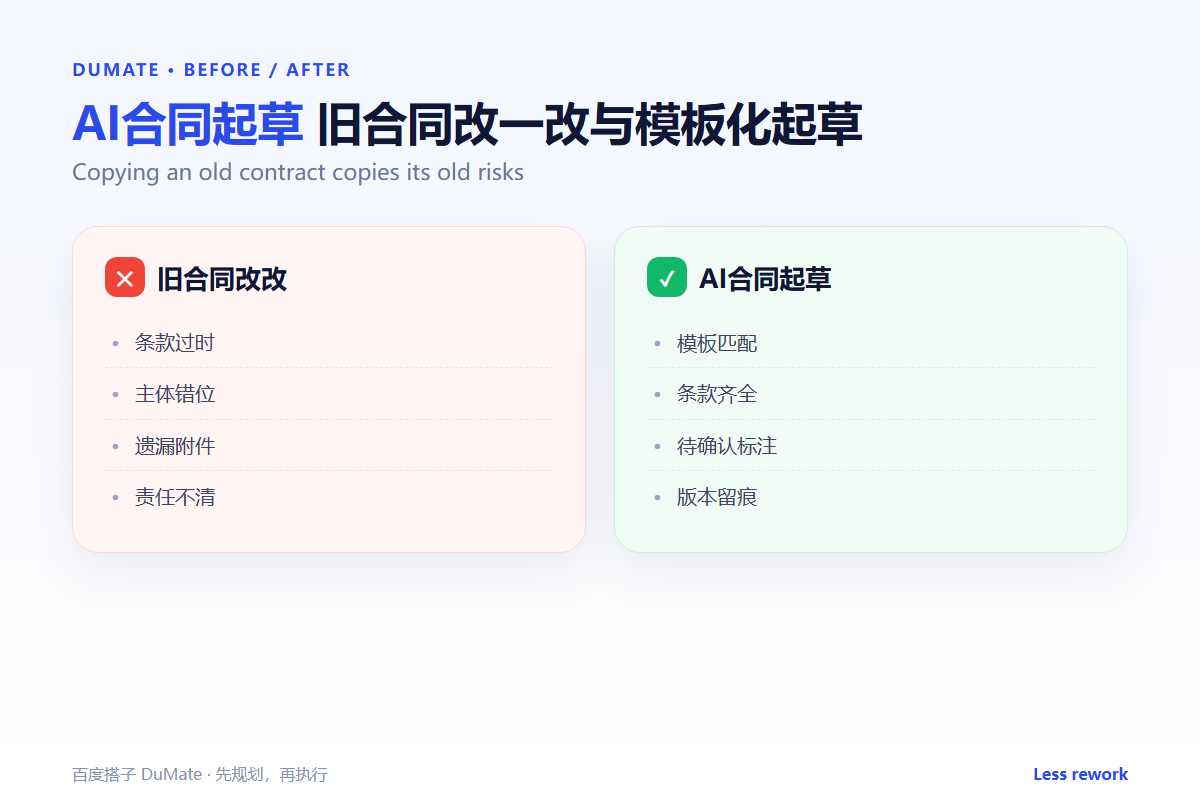
Before, a sales team reused an old contract, changed the customer name, and sent it out. Legal found three outdated clauses and a missing data schedule, and the deal slipped a week. After, AI合同起草 fills a current template, marks two open items, and routes the draft to legal with a summary of changes. The review takes twenty minutes.
The difference is not the writing speed. It is the order of operations: template, facts, open items, review. Skip a step and the saved time comes back as rework.
Keep a small library of approved templates and a short note explaining when each one applies. That library is the real asset behind AI合同起草, because it encodes past legal decisions in a form the whole team can use.
Keep a short open-items list next to every draft. Each item should name the missing fact, the person who owns it, and the clause it affects. AI合同起草 can produce the list, but a person must close each item before the document moves forward.
Train the commercial team on the difference between a template and a negotiation. The template protects standard terms; negotiation changes them. When the two are confused, AI合同起草 produces a document that looks approved but contains unapproved changes.
Finally, review the template library twice a year. Remove clauses that no longer match your legal posture and add the ones that keep appearing in redlines. That review is the maintenance work behind AI合同起草, and it is what keeps the speed from turning into risk.
Keep a short record of lessons from past deals. A clause that caused a delay last quarter should become a note in the AI合同起草 instructions. Over time, the drafting process reflects real negotiations instead of an idealized contract that only exists in a folder.
FAQ
Can AI合同起草 replace a lawyer?
No. It prepares a draft for review. Legal judgment, negotiation, and signature stay with qualified people.
What should we never automate?
Anything involving an unverified amount, a change of legal entity, or a new jurisdiction. Those require a person.
How long should we keep drafts?
Follow your legal retention policy. Keep signed versions and redlines for the full period.
延伸阅读
Before signing, run the draft through AI合同审查. Document handling is covered in AI文档处理. Restrict access with AI权限管理. Store approved templates in an AI知识库. Sensitive terms need AI数据安全. External references: NIST AI Risk Management Framework and ISO/IEC 42001.
评论
还没有评论,来说两句吧。