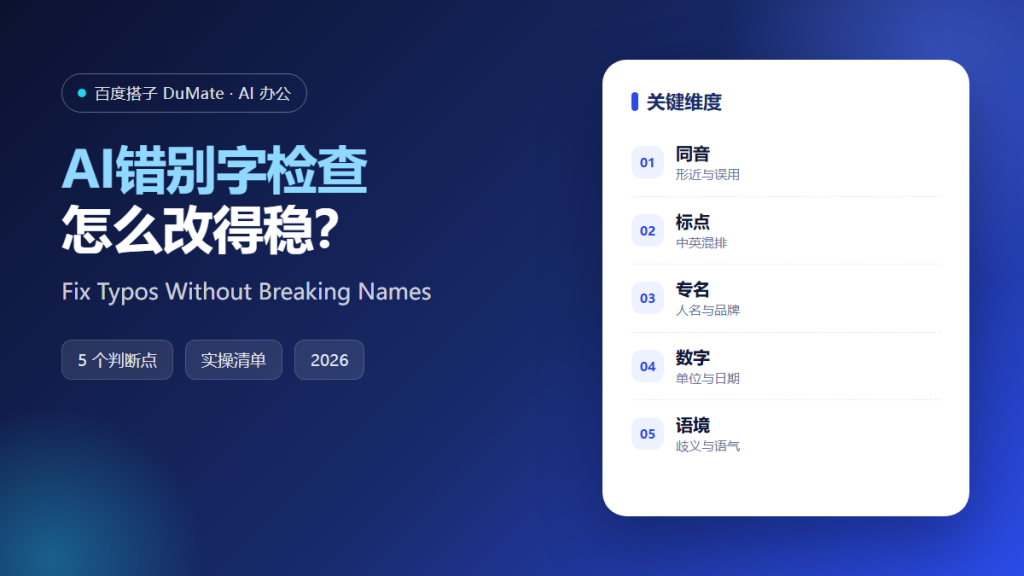
AI错别字检查 looks trivial and causes surprising damage. A blind replacement can rename a company, change a technical term, or turn a correct sentence into a wrong one. The goal is not zero errors at any cost. The goal is a clean text that still says what the author meant.
This guide covers a five-step correction method, the categories that need human confirmation, and the final read that catches what tools miss.
Key Takeaways
- Run the tool, then read the text yourself.
- Confirm every proper name before replacing.
- Unify punctuation and spacing.
- Check numbers and units.
- Keep a version you can roll back to.
Why AI错别字检查 Needs Human Confirmation
Chinese homophones are context-dependent. The same sound can be correct in one sentence and wrong in the next. A tool that replaces by sound alone will introduce errors. AI错别字检查 works best as a first pass, with a person confirming each suggestion.
The second reason is names. Product names, people, and places often look like typos. Replacing them is easy and embarrassing. A protected list prevents most of these mistakes.
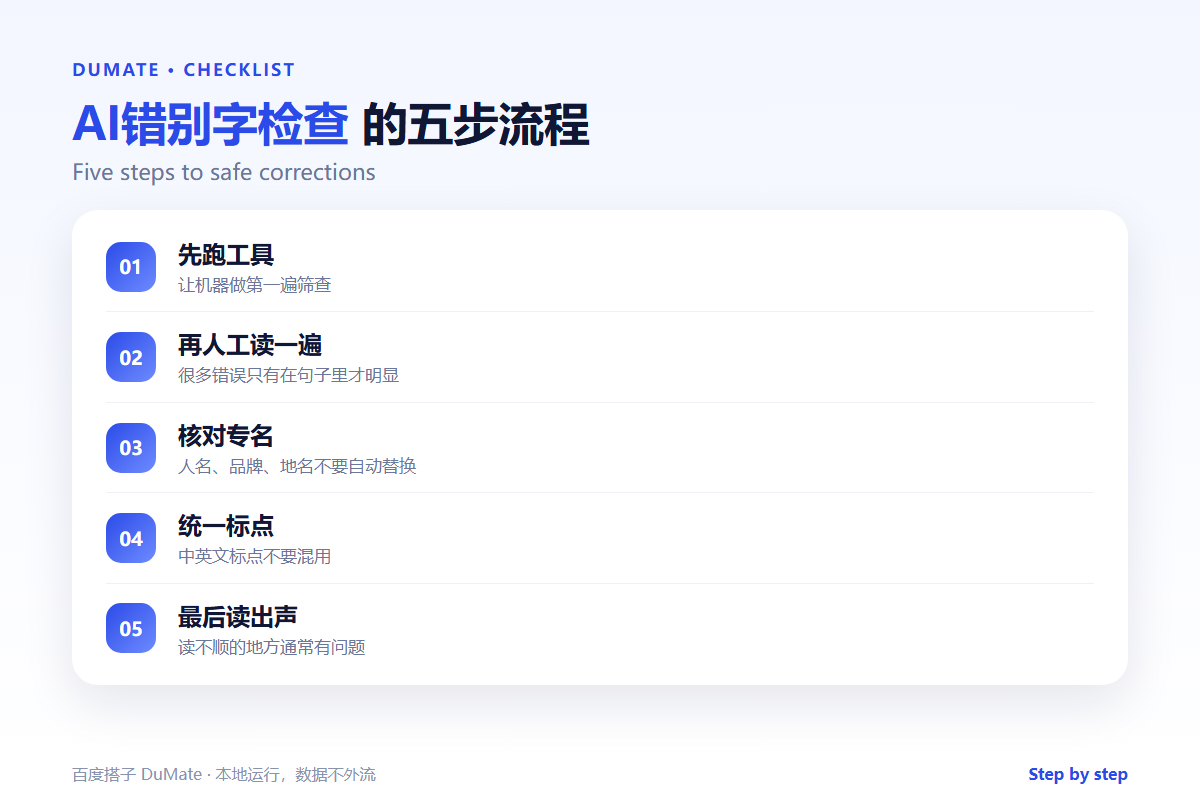
How AI错别字检查 Works in Five Steps
Step 1: Run the first pass
Use the tool to flag suspected errors. Do not accept all changes at once. AI错别字检查 should produce a list, not a silent rewrite.
Step 2: Read the sentence
For each suggestion, read the full sentence. If the replacement changes the meaning, reject it. Context is the final judge.
Step 3: Protect proper names
Check every person, product, and place against an approved list. Add new names to the list. AI错别字检查 should never auto-correct a protected term.
Step 4: Unify punctuation
Choose Chinese or English punctuation and apply it consistently. Check spacing around numbers and units. AI错别字检查 can flag mixed usage.
Step 5: Read aloud
Read the final text aloud. Awkward phrasing often reveals an error that the eye skipped. Keep the previous version until the new one is approved.
A Correction Checklist
- Suggestions were reviewed one by one.
- Proper names are on a protected list.
- Punctuation style is consistent.
- Numbers and units are correct.
- A rollback copy exists.
Where AI错别字检查 Fails
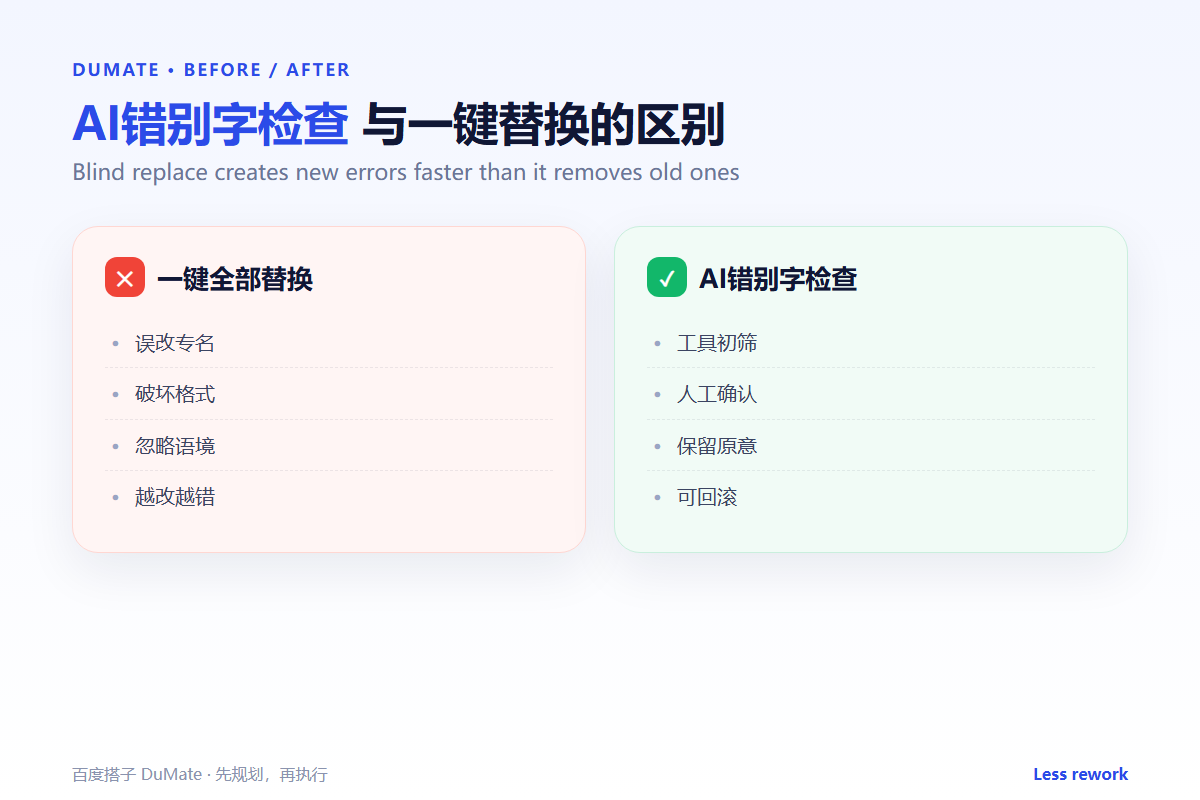
It fails on names and technical terms, as described above. It also fails when the text uses a deliberate style, such as dialect or dialogue, and the tool normalizes it away.
- Blind replace across the document.
- Correcting quoted text.
- Changing technical terms.
- Losing formatting after replacement.
Before and After
Before, a team accepted all suggestions and shipped a document with a renamed product. After, AI错别字检查 produced a list, a reviewer confirmed each item against a name list, and the final text was clean without collateral damage.
The best correction is invisible. The reader notices the message, not the edit.
Used consistently, AI错别字检查 becomes part of the normal review routine rather than a separate project.
A final check with AI错别字检查 takes a minute and catches the errors that are easiest to miss.
The same AI错别字检查 routine works for small tasks and large ones, which is why teams keep using it.
Used consistently, AI错别字检查 becomes part of the normal review routine rather than a separate project.
A final check with AI错别字检查 takes a minute and catches the errors that are easiest to miss.
Making It Stick Across a Team
A rollout fails when only one person knows how to use AI错别字检查. Write a short guide with three sections: when to use it, what good input looks like, and what to check before sharing the output. Keep the guide to one page.
Train in pairs. One person runs the task while the other checks the output against the guide, then swap roles. That exercise surfaces unclear steps faster than a presentation. Keep a shared folder with one strong output, one weak output, and a note explaining the difference. AI错别字检查 becomes easier to teach when people can compare real cases.
Review the guide after the first week of use. Remove steps nobody follows and add the questions that keep coming up. A living guide is more useful than a perfect one written in advance. Finally, assign an owner. AI错别字检查 without an owner drifts, and the guide becomes outdated. The owner does not need to do every task, only keep the standard current. That small responsibility is what keeps AI错别字检查 useful after the initial training.
Make the training practical. People learn the workflow by completing a real task, not by listening to a walkthrough. Set aside thirty minutes for practice and review the result together. Measure one thing: how many outputs pass review without correction. That number is a better indicator than attendance.
Keep the first month simple. One task, one owner, and one weekly review are enough to prove the workflow before it spreads across the team.
Write down what changed after each run. A short note is easier to trust than a memory, and it makes the next improvement obvious.
Review the output before it leaves your desk. A two-minute check catches most of the errors that would otherwise come back as questions.
FAQ
Can I accept all changes?
No. Review each suggestion, especially names, numbers, and technical terms.
How do I handle quoted text?
Do not correct quotations unless the source allows it. Mark an obvious error with a note instead.
What about formatting?
Check bold, links, and tables after replacement. Some tools strip formatting silently.
延伸阅读
For official documents, see AI公文写作 and AI公文校对. For drafting, read AI写作助手. Document processing is covered in AI文档处理. Keep approved names in an AI知识库. External references: NIST AI Risk Management Framework and ISO/IEC 42001.
评论
还没有评论,来说两句吧。以下为本文的引用通告: