
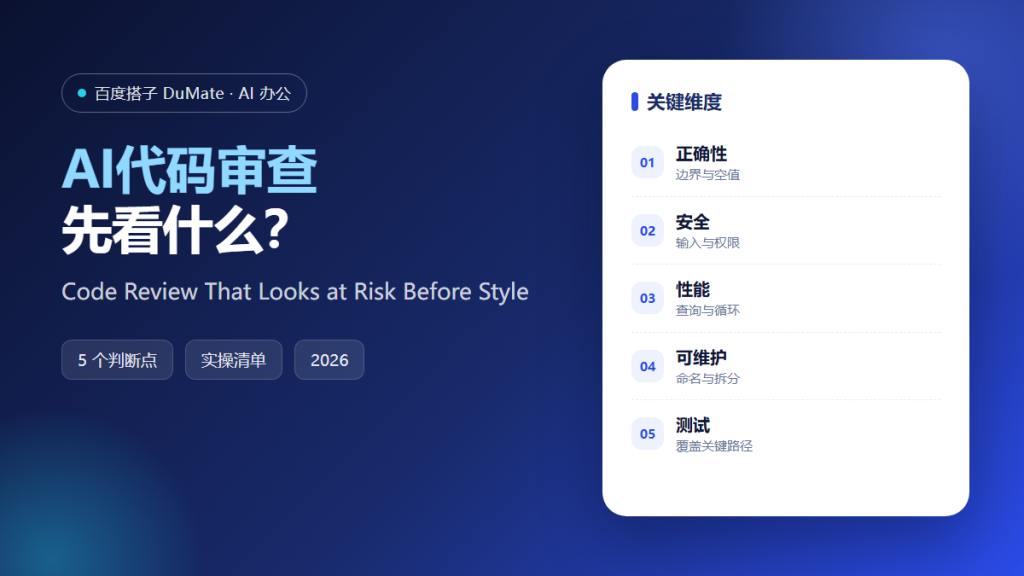
AI代码审查 should spend its attention on risk, because style is the cheapest thing to automate and the easiest thing to argue about. A review that finds a missing permission check is worth more than fifty comments about spacing. The goal is not a perfect diff but a change the team can defend.
This guide describes how AI代码审查 fits a pull request workflow, the five steps from intent to comment, and the habits that turn review into either a gate or a rubber stamp.
Key Takeaways
- Automate formatting before a human reads.
- Understand the intent before the diff.
- Check boundaries, permissions, and data flow.
- Ask for a test on every failure path.
- Write comments that name an action.
Why AI代码审查 Needs a Risk Lens
Every change carries a different kind of risk. A rename is mostly mechanical; a payment handler is not. AI代码审查 is useful when it ranks the diff by consequence and sends attention to the part where a mistake would reach a user or a database. The ranking matters more than the total number of comments.
The second reason is context. A reviewer who sees only the changed lines cannot judge whether a null check belongs upstream. AI代码审查 should summarise the surrounding flow and point to the module that owns the rule, so the discussion happens at the right level of abstraction.
The third reason is tone. A comment that says this is wrong invites a fight; a comment that says this path returns null when the session expires invites a fix. AI代码审查 should produce the second kind, with a location and a scenario, and it should separate a blocking issue from a suggestion. A review is a conversation about consequences, and the comment is only the opening line.
How AI代码审查 Works in Five Steps
Step 1: Read the intent
Start with the description and the linked ticket. State in one sentence what the change is supposed to achieve. If that sentence cannot be written, the review should stop until the author supplies it, because a diff without intent has no correct shape. Write the intent in the pull request description, not only in the review thread.
Step 2: Check the boundaries
Look at input validation, permissions, and error handling first. These are the places where a small diff creates a large incident. AI代码审查 can list every entry point the change touches, including background jobs and queued handlers that never appear in a screenshot.
Step 3: Trace the data
Follow one record from input to storage and back. Check types, nullability, and ownership. AI代码审查 should flag a field that is written in one format and read in another, even when the tests pass, because a passing test may only cover the new path.
Step 4: Walk the failure paths
Ask what happens on timeout, retry, partial success, and duplicate submission. Require a test for each path that matters. AI代码审查 can draft the scenarios, but the author confirms which are realistic and which are already covered by the platform.
Step 5: Write one clear comment per risk
Name the file, the condition, and the consequence, then suggest a direction. Keep style comments out of the thread. AI代码审查 is finished when every blocking comment has an owner and a resolution, and when the suggestions are clearly marked as optional.
‘ alt=’AI代码审查 checklist: intent, boundaries, data and failure paths’ />
A Review Priority Checklist
- Formatting and linting are already clean.
- The change has a stated purpose.
- Permissions and inputs are validated.
- Failure paths have tests.
- Blocking comments are resolved, not liked.
Where AI代码审查 Fails
It fails when the reviewer comments on variable names while a race condition sits in the same file. It also fails when a large diff is approved because nobody had time to read it. Both failures produce the same outcome: a clean review record and a production incident. Neither failure is visible in the review record, which is why a size limit and a risk summary matter more than another checklist item. A review that cannot be measured by defects caught will be optimised for speed.
- Rubber-stamping long pull requests.
- Style debates that block a release.
- Comments without a scenario.
- No review of the tests themselves.
Before and After
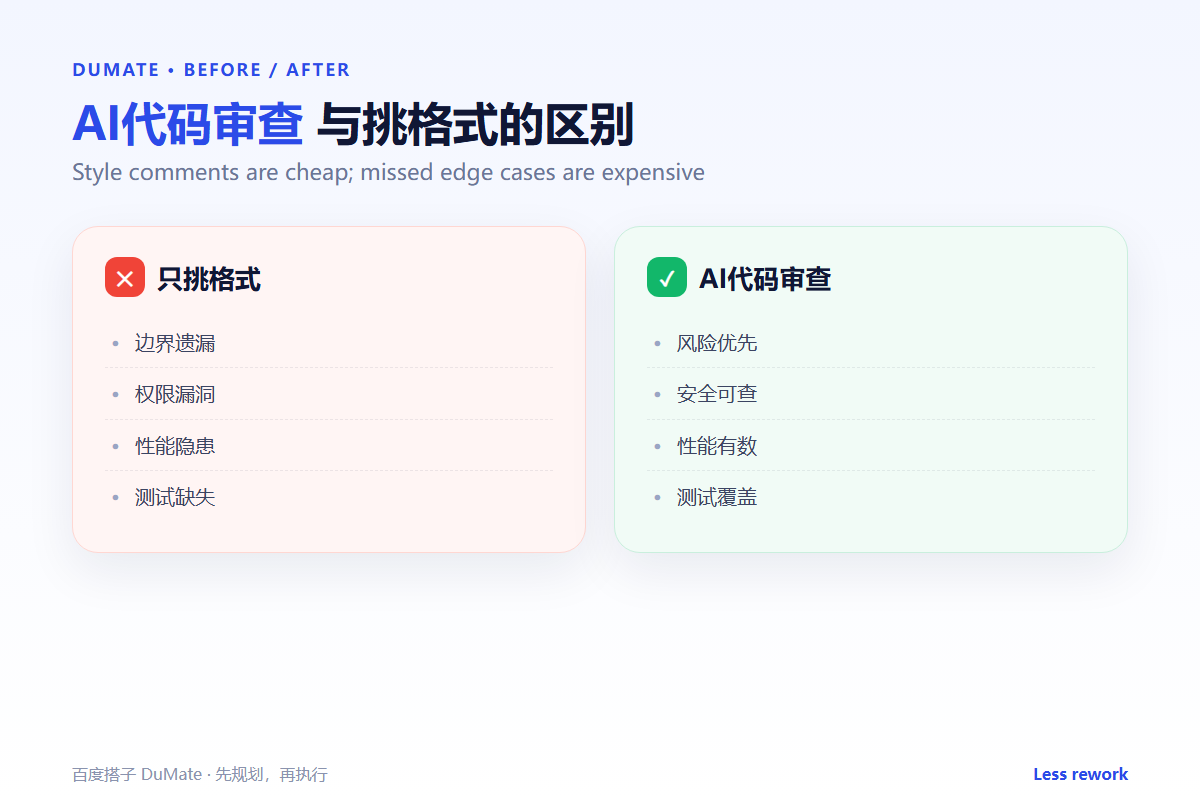
Before, a team reviewed a four-hundred-line change in ten minutes, approved it, and spent the next day debugging a permission error in production. The review had focused on naming, and the missing check was three lines below a comment about spacing. The reviewer had never opened the module that owned the permission, and the diff did not show it.
After, AI代码审查 summarised the flow, flagged two entry points without checks, and asked for one failure test. The pull request took longer to approve and zero time to roll back, which changed how the team measured review quality. The team now asks for a risk summary before reading the diff, and the summary names the paths that need a second reviewer.
FAQ
Can AI代码审查 approve a change?
It can recommend, but accountability stays with a person. Approval is a judgment about risk, context, and timing that a tool cannot own, especially when the release window is tight. AI代码审查 can highlight a risk, but a person decides whether to accept it.
Should it comment on style at all?
Only when a formatter cannot fix it and the team has no rule. Otherwise, automate it and spend the saved time on logic, permissions, and data flow.
How large should a pull request be?
Small enough to read in one sitting. If the description needs chapters, split the change, even when the split feels artificial at first.
延伸阅读
Pair review with test cases and runtime evidence from log analysis. Catch small defects with typo check, clean up prose in document proofreading, and handle reports with PDF editing. External references: NIST AI Risk Management Framework and ISO/IEC 42001.
评论
还没有评论,来说两句吧。