
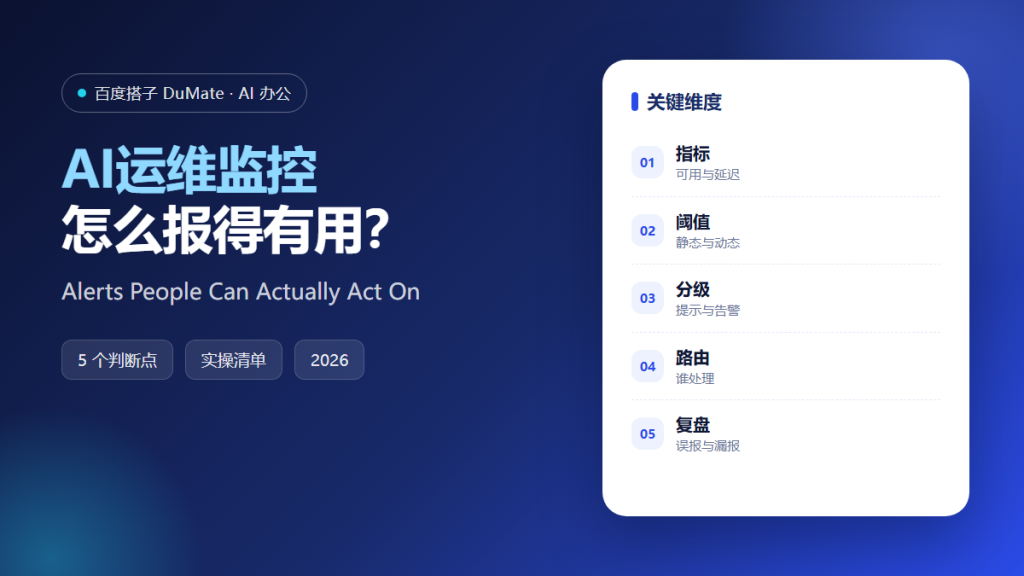
AI运维监控 is judged by the quality of its alerts, not by the number of dashboards it can draw. An alert that wakes someone at three in the morning should come with a reason, an owner, and a first action. Anything less is a notification, not monitoring.
This guide explains how AI运维监控 reduces noise, the five steps from a service level to a routed alert, and the habits that keep an on-call rotation healthy. The measure is attention saved, not metrics collected.
Key Takeaways
- Alert on user impact, not on every metric.
- Give each alert an owner and a runbook.
- Use thresholds that account for seasonality.
- Route by service, not by convenience.
- Review noisy alerts every month.
Why AI运维监控 Needs Actionable Alerts
Alert fatigue is a safety problem. When a channel produces two hundred messages a day, the one that matters is read late or not at all. AI运维监控 is useful when it groups related signals and suppresses the ones that have no action attached, so the channel regains its meaning. A muted channel is worse than no channel, because it looks monitored while nobody is watching.
The second reason is context. A CPU spike means little without the service, the version, and the recent deploy. AI运维监控 should attach a short summary and a link to the dashboard, so the responder starts with evidence instead of a search through five tools and a chat history.
The third reason is ownership. An alert without a team is a notification. AI运维监控 should map each rule to a service owner and a fallback, because an unowned alert becomes everyone’s background noise and nobody’s responsibility. A fallback owner prevents an alert from sitting unread on a holiday.
How AI运维监控 Works in Five Steps
Step 1: Define the service level
Write what users expect in measurable terms: availability, latency, and freshness. AI运维监控 should tie each alert to one of these expectations, otherwise the alert is monitoring a machine rather than a service that someone paid for. Write the expectation in the language a customer would use.
Step 2: Choose the signals
Pick a small set of indicators that move before users complain. Combine a symptom metric with one or two causes. AI运维监控 can rank signals by how often they preceded past incidents, which is more useful than ranking them by how easy they are to collect. Remove the signal that has never changed before an incident.
Step 3: Set thresholds with context
Use a window and a baseline instead of a single number. Account for daily and weekly patterns. AI运维监控 should show how many times a proposed threshold would have fired last month, including the false positives that would have woken someone for nothing.
Step 4: Route with a runbook
Send the alert to the team that can fix it, with a severity, a summary, and three first steps. AI运维监控 can draft the runbook from past tickets, but an engineer should verify every command before it is used at three in the morning. Test the route by sending a real alert to the on-call phone.
Step 5: Review the noise
Once a month, list the alerts that fired and the ones that led to action. Delete or merge the rest. AI运维监控 improves when the review has authority to remove rules, not only to add them, and when the on-call engineer is in the room. Track the ratio of alerts that led to action, month by month.
‘ alt=’AI运维监控 checklist: service level, signals, routing and noise review’ />
A Practical Alert Checklist
- The alert maps to a user expectation.
- A named team owns the response.
- The message includes service and version.
- The runbook has a first action.
- The rule was tested against last month.
Where AI运维监控 Fails
It fails when every metric becomes an alert, and it fails when a static threshold ignores a traffic peak that happens every Monday. The result is a team that mutes the channel and misses the real outage. Noise is not a harmless side effect; it is the failure mode. A dashboard that nobody reads is not a control, and a page that nobody trusts is not an alert.
- Alerts with no owner or runbook.
- Thresholds copied from a default template.
- Duplicate alerts for one root cause.
- No review after an incident.
Before and After
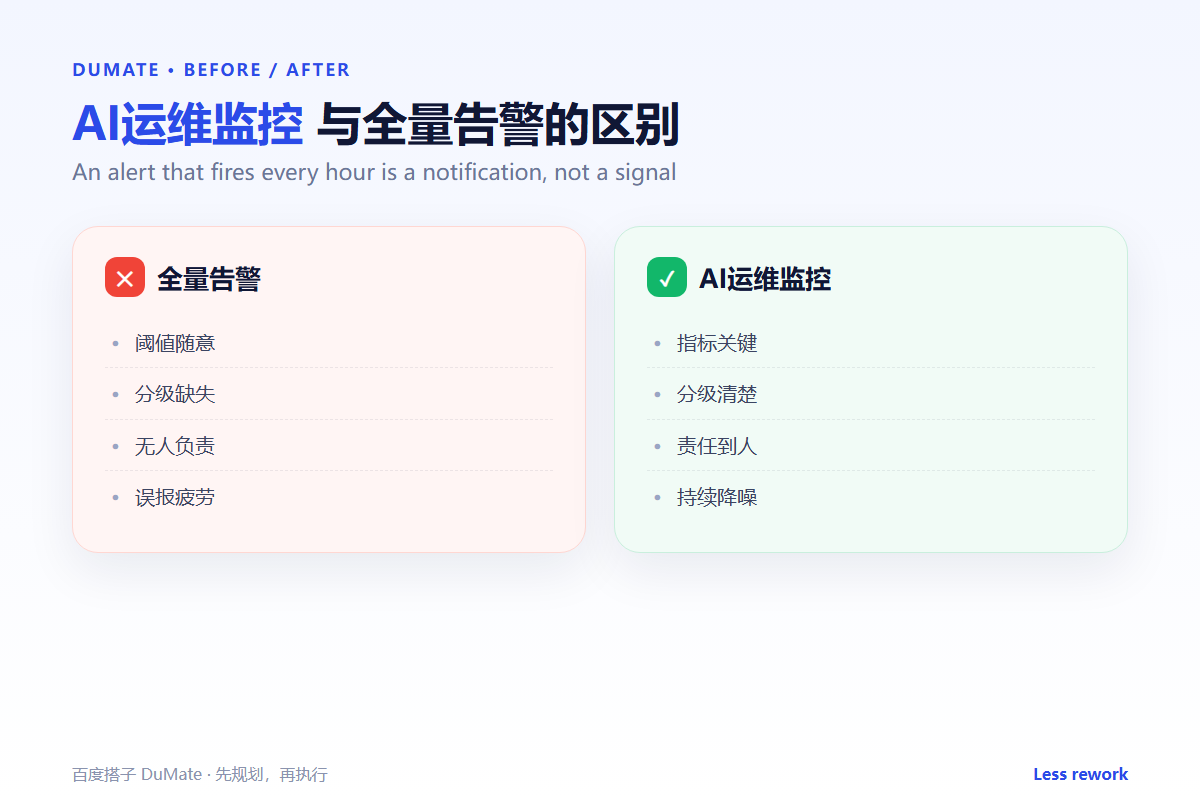
Before, a platform team received four hundred alerts a week. Most were disk warnings that resolved themselves, and the on-call engineer learned to skim the channel. The one real outage arrived between two routine warnings and was found by a customer. The channel had become a diary rather than a warning system.
After, AI运维监控 grouped related signals, removed half the rules, and attached a runbook to the rest. The team received forty alerts a week, and every page led to an action within ten minutes. The on-call rotation became sustainable again, which was the real goal.
FAQ
How many alerts should a team receive?
Few enough that each one is read carefully. If a week passes without a false page, the threshold may be too loose, not too tight, and a monthly review will show which direction to adjust.
Should we alert on symptoms or causes?
Page on symptoms that users feel, and use causes for diagnosis. Alerting on every cause produces noise before an outage exists and trains people to ignore the channel. Every page should point to a symptom a customer can describe.
What belongs in a runbook?
A short description, three diagnostic steps, and one safe action. Long procedures belong in a document, not in a notification, and the first action should be safe to attempt without approval.
延伸阅读
Investigate events with log analysis and predict demand with inventory forecast. Watch customer signals in churn warning and sentiment monitoring, and verify behaviour with test cases. External references: NIST AI Risk Management Framework and ISO/IEC 42001.
评论
还没有评论,来说两句吧。以下为本文的引用通告: