
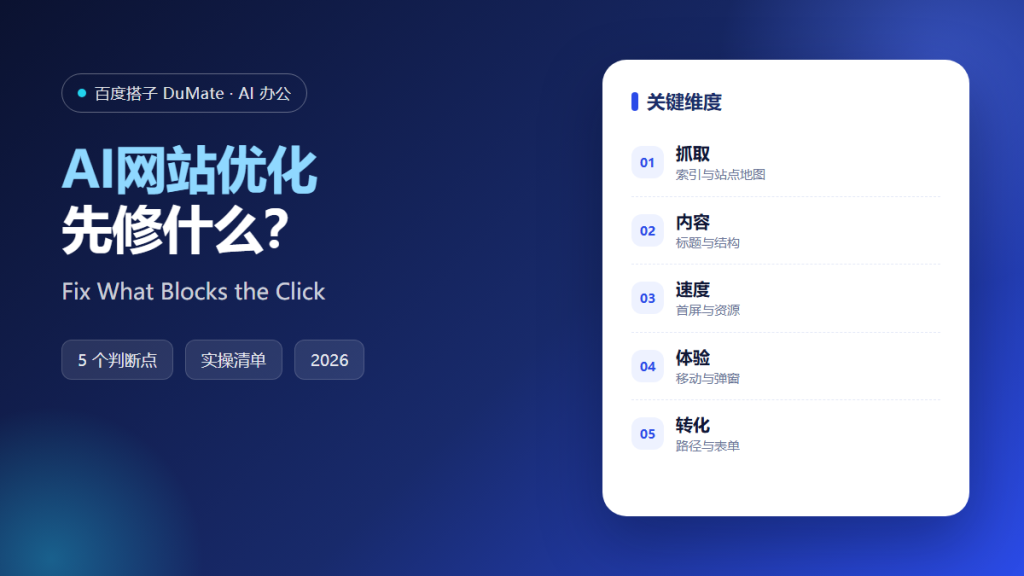
AI网站优化 starts with a question that most audits skip: which element on this page stops a qualified visitor from clicking? A team can chase technical scores for months while the real block sits in a headline that promises the wrong thing, a form with eight fields, or an image that pushes the button below the fold. The audit becomes useful only when it names that block in one sentence a designer can act on.
This guide sets out a five-step diagnostic, a review checklist, and the failure modes that turn optimization into decoration. Every step can be run by one person in a single afternoon, and none of them requires a new tool.
Key Takeaways
- Measure the click, not the ranking.
- Audit on the device your buyers actually use.
- Fix the first blocked step before the second.
- Change one variable per test.
- Keep a dated log of every change.
Why AI网站优化 Needs a Click-Level Diagnosis
A ranking describes visibility, and visibility is not a decision. A page can rank third and still lose the visitor at the title, the price, or the first scroll. AI网站优化 that reports positions and sessions leaves the team guessing about the moment of hesitation, which is exactly the moment worth studying. The fix usually costs less than the report that found it.
Blocks also differ by intent. Someone comparing two models needs a table with the differences in one view; someone ready to buy needs a price, a delivery date, and a return policy. AI网站优化 that sends both visitors to the same long page serves neither. Separating intent before changing layout is what makes the next test measurable instead of hopeful.
Small technical faults compound in the same way. A slow hero image, a layout shift, and a consent banner that covers the button each cost a fraction of a second and a fraction of trust. AI网站优化 should treat them as one chain of friction, measured end to end on a mid-range phone over an ordinary mobile connection, because that is where most clicks are lost.
How AI网站优化 Works in Five Steps
Step 1: Map the path from query to click
Write down the search phrase, the page that answers it, and the action you expect. Do this for the ten queries that carry the most revenue rather than the most traffic. Decisions made on traffic alone tend to favor broad, unqualified phrases, and the map exposes that mismatch while it is still cheap to correct.
Step 2: Record what the page really shows
Open the page on a phone with a fresh browser profile and a throttled connection. Capture the first screen, the time until the main content is usable, and every element that moves after load. For AI网站优化, screenshots from a clean session remove the bias of your own cached, logged-in view, which rarely matches what a first-time visitor sees.
Step 3: Let AI网站优化 name the block
Compare the promise in the title with what the first screen delivers. If the title mentions a price and the screen opens with company history, the block is clarity, not speed. AI网站优化 is easier once the block has a name, because the fix follows from the category: wording, layout, speed, or form.
Step 4: Change one thing and measure
Fix the named block, publish it, and compare the click rate with the previous period at the same traffic source. Resist the urge to redesign three sections at once, because a combined change cannot tell you which part worked, and a win that cannot be explained cannot be repeated.
Step 5: Log the result and the reason
Record the date, the change, the metric, and the segment in a shared log. Six months later that log is the only reliable account of what the team has already tried. AI网站优化 without memory repeats failures with fresh enthusiasm and calls them new ideas.
‘ alt=’AI网站优化 checklist: query, first screen and click path’ />
A Page Review Checklist
- The title matches the intent of the query.
- The first screen states the offer and the price.
- The primary button is visible without scrolling.
- Forms ask only for what the next step needs.
- The page is tested on a mid-range phone.
Where AI网站优化 Fails
AI网站优化 fails when the team optimizes a page that should not exist. A landing page for a query nobody searches, or one that duplicates a stronger product page, will not improve with better copy, and the effort hides a positioning problem.
- Chasing a tool’s score instead of a visitor’s action.
- Testing on a fast desktop and shipping to mobile.
- Changing five elements and crediting one.
- Ignoring the queries that bring unqualified traffic.
Before and After
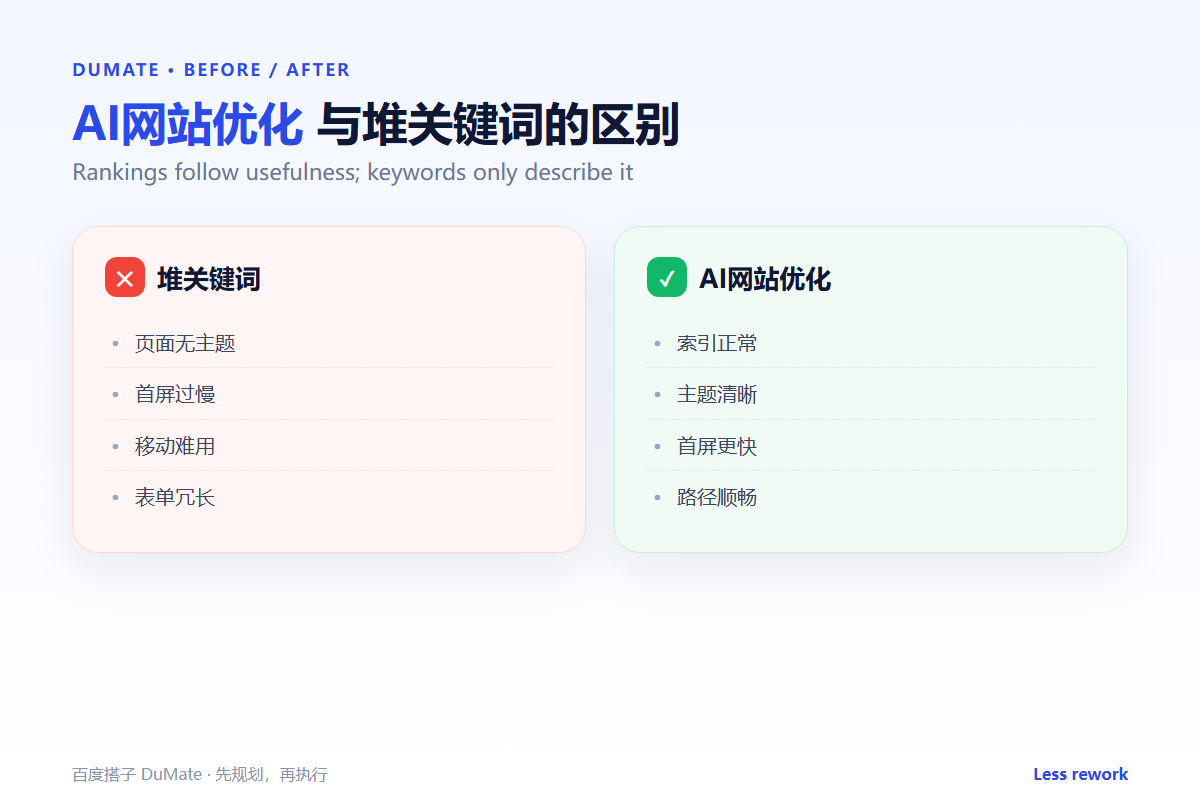
Before, a team rewrote an entire page because the bounce rate was high, and the rate stayed flat. After, AI网站优化 was used to compare the title with the first screen, and a single change to the offer line lifted the click rate within a week.
The difference was not effort. AI网站优化 was the discipline of naming the block before touching the layout, and of measuring the one action the page exists to produce.
FAQ
How long should a test run?
Long enough to cover a full week and at least a few hundred clicks. Short tests on low traffic produce noise that looks like a result.
Do technical scores matter?
They are a proxy. A perfect score on a page that answers the wrong intent still loses the click, so read the score as a hint and the session as evidence.
What if traffic is too low to test?
Use qualitative review and small, reversible changes. AI网站优化 can still rank the blocks by likely impact, even when statistical proof is out of reach.
延伸阅读
For the wording that carries the offer, read product copy. Paid traffic is covered in ad copy, and the errors that damage credibility in typo check. For evidence from sessions, see log analysis, and for regression checks after a release, test cases. External references: NIST AI Risk Management Framework and ISO/IEC 42001.
评论
还没有评论,来说两句吧。