
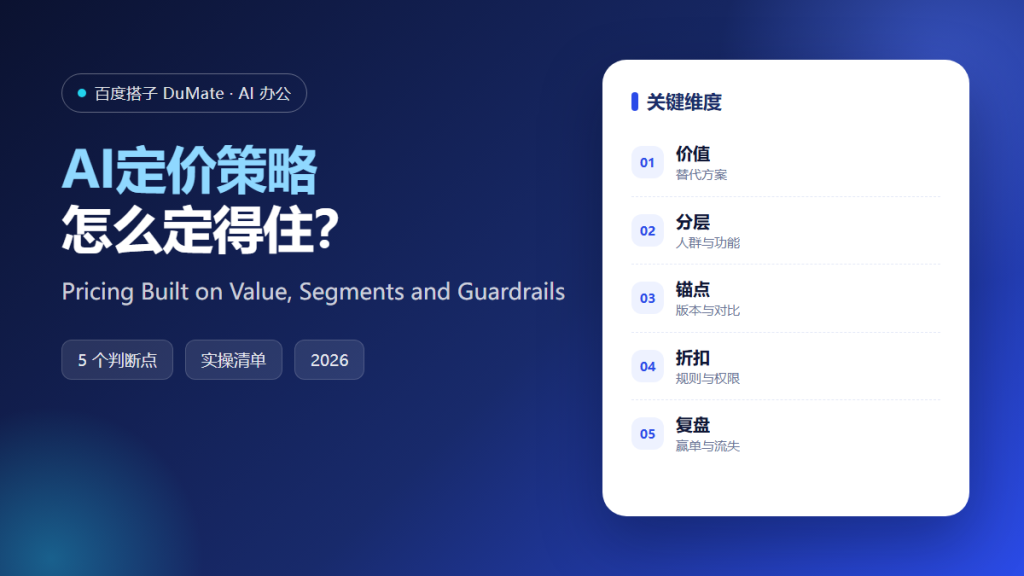
AI定价策略 is a product decision expressed as a number, and the number carries more information than any campaign. It tells the buyer who the product is for, what it replaces, and how confident the seller is. When the price contradicts the page, the buyer believes the price.
This guide covers value anchors, segment separation, and the guardrails that keep a discount from quietly becoming the product. It also assumes someone owns the number, because a price set by committee drifts toward the safest average.
Key Takeaways
- Anchor on the alternative, not on cost.
- Give each segment a reason for its price.
- Write discount rules before the first negotiation.
- Model margin and cash, not revenue alone.
- Review the price with the same rigor as the product.
Why AI定价策略 Needs Value Anchors
Cost tells you the floor, never the price. A buyer compares the offer with what they do today: a spreadsheet, an agency, an internal hire, or nothing at all. AI定价策略 that starts from the alternative can explain the number in the buyer’s own terms, which is also the only explanation a sales team can repeat without improvising. A number with a reason travels further than a number with a discount.
Segments need different anchors because they replace different things. A solo user replaces a template and a few hours; a department replaces a tool and a headcount. AI定价策略 that charges both the same amount either overprices the first or leaves money on the table with the second, and neither group feels understood. The package should make the difference visible without a negotiation.
Guardrails protect the logic after the launch. Without a written rule, every discount is a small decision made under pressure, and the list price becomes a rumor. AI定价策略 should define who can approve what, and which exceptions are worth the margin they cost.
How AI定价策略 Works in Five Steps
Step 1: Name the alternative
Write what the buyer would do if the product did not exist, including the cost of the workaround in hours and errors. A price framed against that alternative sounds reasonable; a price framed against a competitor’s discount does not. Include the hours spent correcting errors, since that is often the largest hidden cost.
Step 2: Separate the segments
Group buyers by the job they need done and the value they receive, not by company size alone. Each group needs its own package, its own proof, and its own sentence explaining the difference. A single plan with a hidden discount menu is not segmentation. AI定价策略 should make the package differences obvious enough to choose between them.
Step 3: Let AI定价策略 set the guardrails
Define the floor, the approval path, and the conditions for an exception. AI定价策略 should model the margin at each level, so a salesperson can see what a ten percent concession does to the year. Then publish the rule, because a rule nobody can read is not a guardrail.
Step 4: Model margin and cash
A price that looks healthy on a spreadsheet can starve the business if payment arrives late or usage costs rise with every account. Check the gross margin at the low end of usage, and check the cash cycle at the high end. The price has to survive both. AI定价策略 should show both figures on one page, because a healthy margin with a slow cash cycle is a trap.
Step 5: Publish, monitor, revise
After launch, track win rate by segment, discount depth, and the reasons given for losses. Review the price on a schedule rather than after a bad month. A pricing change made in a panic is usually a discount with extra steps. Set a review date and a named owner, so the price does not drift by default.
‘ alt=’AI定价策略 checklist: anchor, segment and discount guardrail’ />
A Pricing Review Checklist
- The anchor is the buyer’s current alternative.
- Each segment has a distinct package.
- The floor and the approval path are written.
- Margin is tested at low usage.
- Win and loss reasons are recorded by segment.
Where AI定价策略 Fails
AI定价策略 fails when the discount becomes the strategy. A team that wins every deal with a concession has not found a price; it has found a habit that will be hard to reverse. The list price becomes fiction, and the sales team negotiates against itself.
- Copying a competitor without their cost base.
- Hiding the price to keep optionality.
- Letting sales approve any exception.
- Raising prices without a migration path.
Before and After
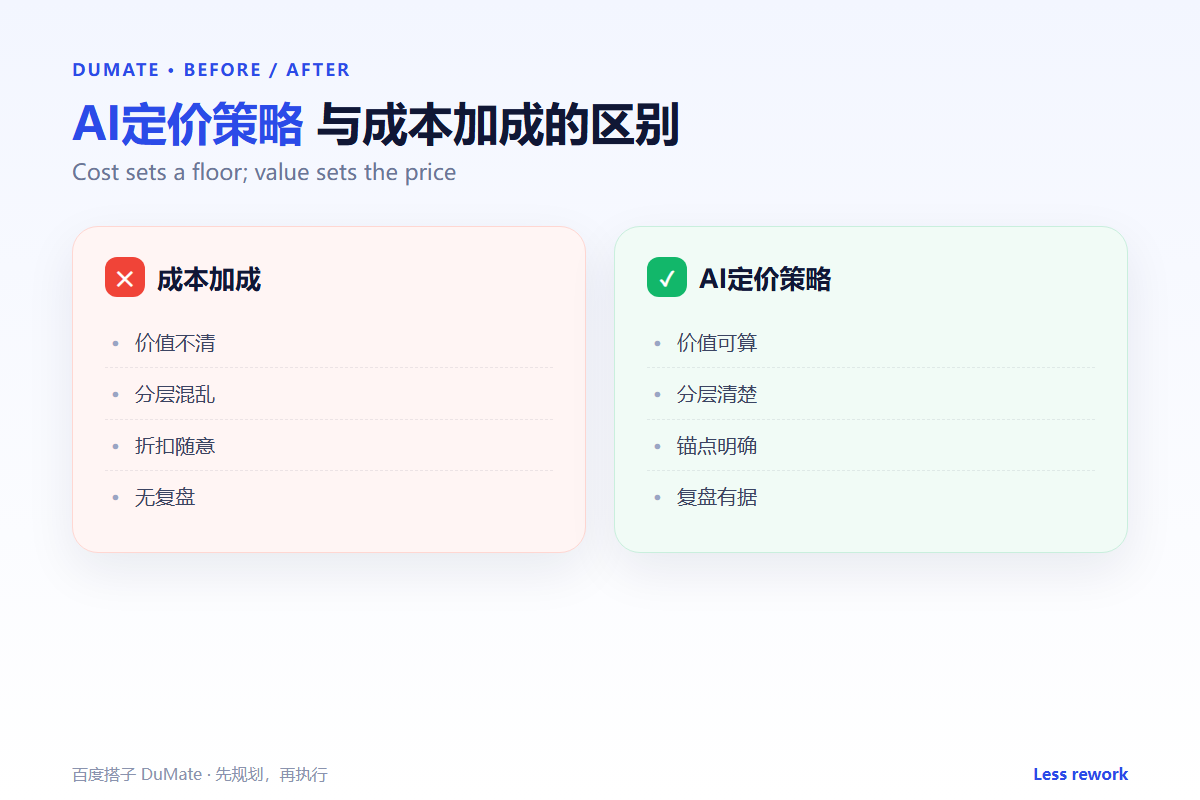
Before, a team priced by adding a margin to cost, then discounted whenever a deal stalled. Revenue grew and margin fell, and nobody could say which segment was profitable. After, AI定价策略 was rebuilt around two anchors, with a written floor and a review of losses by segment.
The average discount dropped by a third. Some deals were lost, and the ones that remained paid for the product the team was actually building. The written rules also shortened negotiations, because every exception had a known price.
FAQ
Should we publish prices?
If the buyer can decide without a call, publish them. A range with clear inclusions is better than a form that promises a quote in two days. If the product needs configuration, a starting price still helps the buyer self-select.
How often should prices change?
When the value or the cost structure changes, and not more than the sales team can explain. Frequent small changes erode confidence in the number.
Is discounting always wrong?
No. AI定价策略 can allow a discount for a reason that creates value, such as a longer term or a reference case, as long as the reason is written and measured.
延伸阅读
For the statements behind the margin, see financial statements, and for planning the year, budget planning. Demand is covered in sales forecast, and buyer logic in customer profile. For supplier costs, read procurement comparison. External references: NIST AI Risk Management Framework and ISO/IEC 42001.
评论
还没有评论,来说两句吧。