

AI旅行规划 tends to produce lists of attractions, not itineraries. A list ignores travel time, opening hours, and the fact that people get tired. A good plan has fewer stops, a clear route, and a backup for the day the weather turns.
This guide covers a five-step planning process, the constraints that matter most, and the booking rules that protect the trip when something changes.
Key Takeaways
- Set the budget and the travel party first.
- Order cities to reduce backtracking.
- Limit each day to three main stops.
- Book refundable options when possible.
- Prepare a rainy-day alternative.
Why AI旅行规划 Needs Realistic Pace
A plan that moves every two hours looks efficient and feels exhausting. Travel time, queues, and meals consume more of the day than the map suggests. AI旅行规划 should include transit time and buffer, not just attractions.
The second reason is the travel party. A trip with children or older parents needs shorter days and more rest. AI旅行规划 should be told who is traveling before it suggests a schedule.
How AI旅行规划 Works in Five Steps
Step 1: Set the frame
Write the dates, budget, travelers, and one priority per person. AI旅行规划 should treat these as constraints, not preferences.
Step 2: Order the route
Group cities by geography and minimize backtracking. Compare train and flight times, including transfers. AI旅行规划 should show the total travel time for each option.
Step 3: Build daily blocks
Limit each day to three main stops and one flexible option. Put the most important stop first. AI旅行规划 should leave gaps for meals and rest.
Step 4: Book with flexibility
Choose refundable hotels and tickets when the price difference is reasonable. Record cancellation deadlines. AI旅行规划 can track the deadlines in a simple list.
Step 5: Prepare backups
List one indoor option and one transport alternative for each day. AI旅行规划 should include the weather pattern for the season.

An Itinerary Checklist
- Travel time is included in each day.
- No more than three main stops.
- Meals and rest are scheduled.
- Bookings have a cancellation window.
- Each day has a backup.
Where AI旅行规划 Fails
It fails when it ignores opening days and local holidays. It also fails when it assumes perfect transport, which is rare during peak season.
- Museums closed on the planned day.
- Connections too tight.
- Hotels far from the center.
- No plan for rain or delays.
Before and After
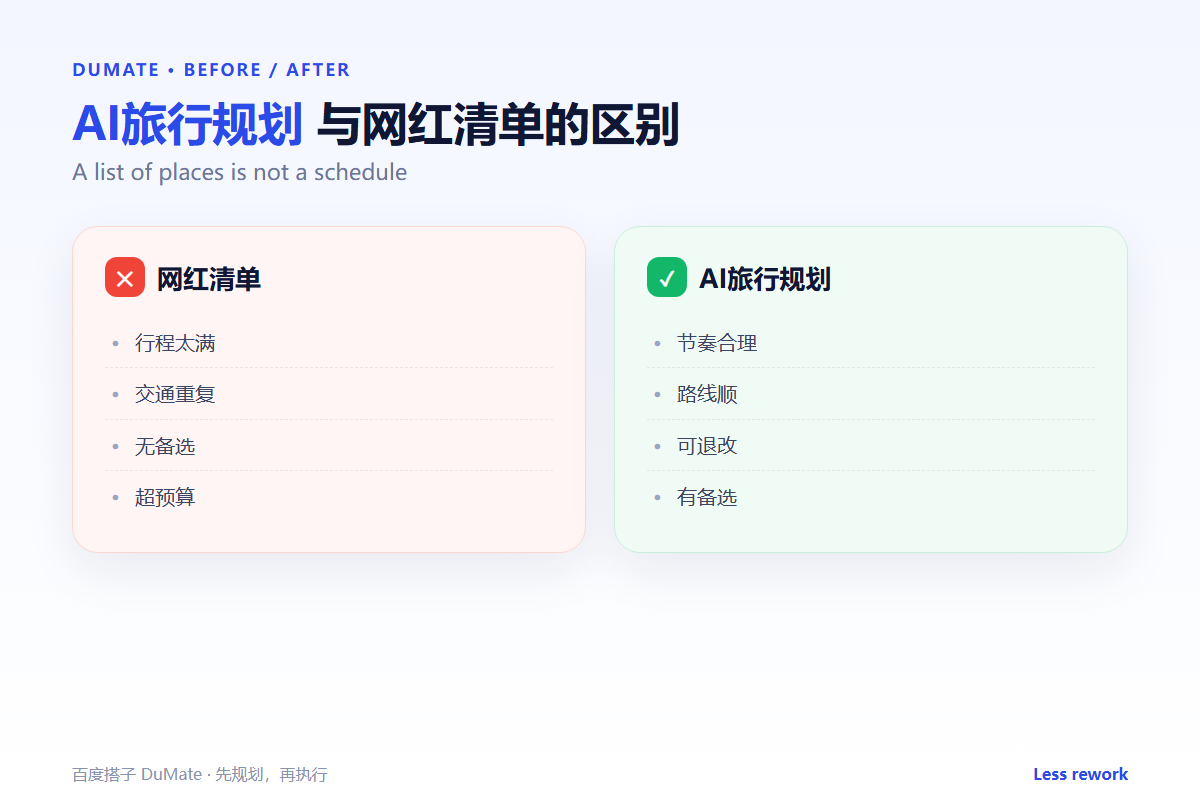
Before, a family planned six stops a day and spent the trip rushing between stations. After, AI旅行规划 reduced the plan to three stops a day, grouped by neighborhood, and added a backup museum for the rainy afternoon.
A good itinerary is not the one with the most places. It is the one people remember without exhaustion.
Used consistently, AI旅行规划 becomes part of the normal review routine rather than a separate project.
A final check with AI旅行规划 takes a minute and catches the errors that are easiest to miss.
Measuring Whether It Works
Measure AI旅行规划 with three numbers: time spent, rework required, and output accepted without changes. Track them for four weeks before drawing a conclusion. Set a baseline from the manual process, because without a baseline any result looks like progress.
Time alone is misleading. A task that finishes faster but needs a full rewrite is not an improvement. Pair time with rework, and pair both with the quality of the final output. AI旅行规划 should be compared with how the work was done before, not with an ideal.
Review the numbers monthly with the people doing the work. They know why a week was slow or why rework increased. AI旅行规划 improves when the review includes the operators, not only the managers. Keep the dashboard small: three numbers and one note are enough.
Also record the exceptions. A week with an unusual campaign or a system outage is not a fair test. Note the context next to the numbers so a later reader does not compare incomparable weeks. When the numbers are stable, expand the scope; when they move the wrong way, fix the input before adding more use cases. The goal is not to prove that AI旅行规划 works, but to know when it works and when it does not.
Keep the first month simple. One task, one owner, and one weekly review are enough to prove the workflow before it spreads across the team.
Write down what changed after each run. A short note is easier to trust than a memory, and it makes the next improvement obvious.
Review the output before it leaves your desk. A two-minute check catches most of the errors that would otherwise come back as questions.
Keep one example of a good result. New team members learn faster from a concrete reference than from a long explanation.
The first version does not need to be perfect. It needs to be complete enough to review, so the team can see the gaps and fix them in the next round.
FAQ
How many cities should a week include?
Two or three. More cities mean more time in transit and less time experiencing them.
Should I book everything in advance?
Book transport and the first nights, then keep some flexibility. Check cancellation terms.
What if the plan changes?
Keep a short list of alternatives and the booking deadlines. Flexibility is cheaper than rebooking.
延伸阅读
For scheduling, see AI日程管理 and AI待办事项. For bookings and confirmations, read AI邮件助手. For drafting, see AI写作助手. Keep documents in an AI知识库. External references: NIST AI Risk Management Framework and ISO/IEC 42001.
评论
还没有评论,来说两句吧。