

AI社媒运营 fails when it produces more posts instead of a position. A calendar filled with greetings, product shots, and reposted articles keeps an account busy and teaches the audience nothing about why they should stay. The feed is not a notice board; it is an argument made in public, one post at a time.
This guide covers the editorial position that gives a calendar its shape, a five-step production routine, and the traps that make a busy account feel empty. It assumes one person owns the calendar, because a schedule shared by five people without an owner becomes a wish list.
Key Takeaways
- Write the position before the calendar.
- Choose three pillars and repeat them.
- Plan in weeks, produce in batches.
- Answer comments with the same care as posts.
- Retire formats that stopped working.
Why AI社媒运营 Needs an Editorial Position
An audience follows an account because it expects a particular kind of value. When the next post is unrelated to the last, that expectation weakens, and the follower has no reason to return. AI社媒运营 without a position produces content that is individually acceptable and collectively forgettable.
A position also solves the daily question of what to post. If the account stands for practical fixes for small workshops, then a customer question, a tool comparison, and a mistake to avoid all belong. AI社媒运营 becomes a matter of selecting from a known set rather than inventing from nothing every morning. The frame survives a slow week, when inspiration is thin and the plan still has something to offer.
It protects the brand when a trend arrives. Most trends can be ignored without cost, and the ones worth joining can be joined in the account’s own voice. AI社媒运营 with a clear position can say no quickly, which is the skill that keeps a feed coherent over a year. That is a decision about scope, not a judgment about creativity.
How AI社媒运营 Works in Five Steps
Step 1: State the position in one sentence
Finish this sentence: we help a specific group do a specific thing better than they can today. If the sentence needs three clauses, it is not ready. The position should be narrow enough that someone could disagree with it. Write it on the first page of the calendar, where it can be argued with.
Step 2: Pick three content pillars
Every pillar needs a reason to exist and a format that suits it. A teaching pillar suits short demonstrations, a trust pillar suits customer stories, and a point-of-view pillar suits commentary. Three is enough for a small team; five is usually a sign of indecision. A pillar without a format is only a theme, and themes drift.
Step 3: Build a weekly rhythm
Assign pillars to days and keep the pattern for a quarter. Rhythm lets the audience know what to expect and lets the team plan production without a scramble. A calendar with gaps is normal; a calendar with fourteen unrelated themes is not. AI社媒运营 should publish from the plan, not from whatever appears in the feed that morning.
Step 4: Let AI社媒运营 draft, not decide
Use it to turn a rough idea into three variations, to summarize a comment thread, or to rewrite a caption for a different platform. AI社媒运营 should not choose the position, the claim, or the tone. Those decisions remain editorial, and they are the reason anyone follows.
Step 5: Review, respond and retire
At the end of each month, look at saves, replies, and profile visits rather than likes alone. Reply to comments that deserve an answer, and retire any format that has produced nothing for two months. A calendar improves by subtraction as much as by addition. A plan that never retires anything slowly becomes a museum of old habits.
‘ alt=’AI社媒运营 checklist: position, pillars and weekly rhythm’ />
A Monthly Calendar Checklist
- The position sentence is visible in the plan.
- Every post belongs to a named pillar.
- At least one post answers a real question.
- Captions are written for the platform they appear on.
- One format is retired or revised.
Where AI社媒运营 Fails
AI社媒运营 fails when output becomes the metric. A team that celebrates thirty posts a month has measured activity, not effect, and the audience can feel the difference within weeks. AI社媒运营 is not a publishing quota.
- Posting daily with nothing to say.
- Copying a competitor’s tone without their constraints.
- Ignoring replies and direct questions.
- Chasing every trend in the same voice.
Before and After
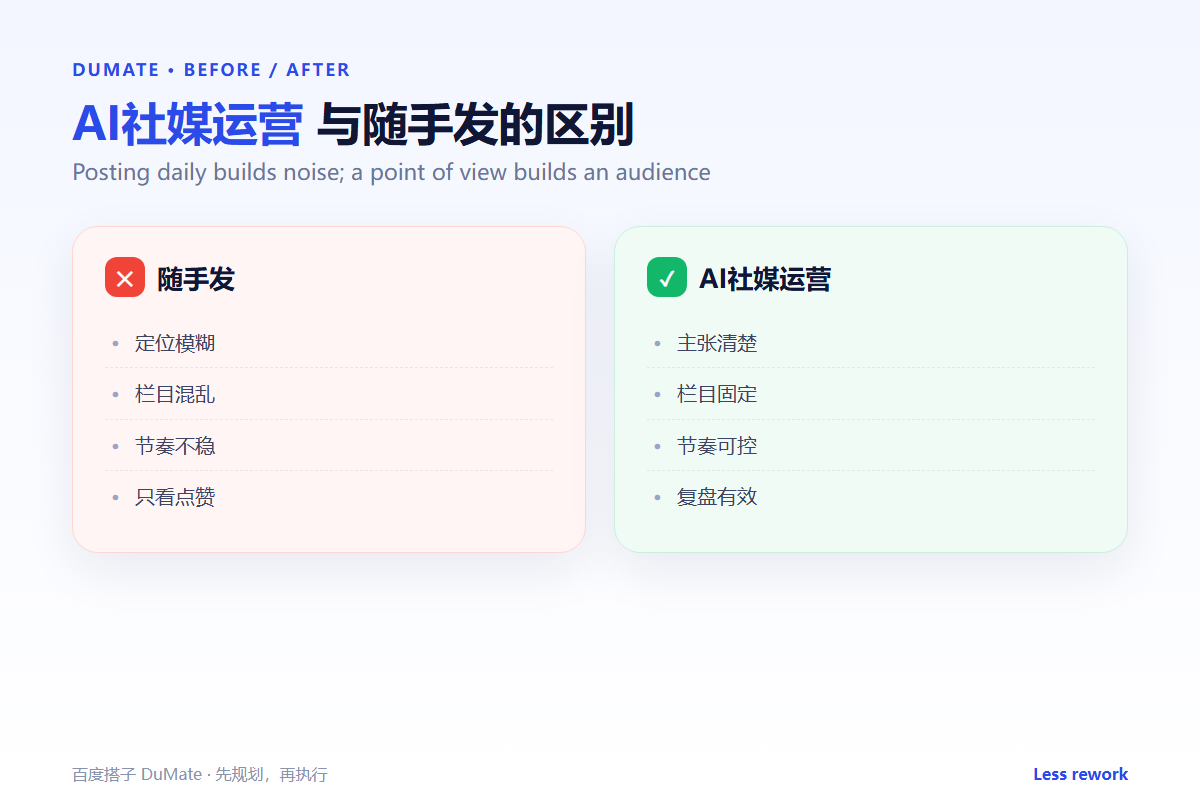
Before, a small brand posted five times a week across four platforms, rewrote captions at midnight, and could not explain which post brought a customer. After, AI社媒运营 was used for drafts and summaries, while a single position sentence decided what was worth publishing at all.
Posting dropped by half. Replies rose, because every post now had a reason to exist and a question worth answering.
FAQ
Which platform should we start with?
The one where your buyers already ask questions. Adding a second platform doubles the calendar, so wait until the first is consistent.
Should we automate replies?
Use automation to route and label, not to answer on your behalf. People can tell, and the trust cost is higher than the time saved.
How do we measure a position?
Look for repetition in comments: the same question, the same objection, the same phrase coming back. AI社媒运营 is working when the audience can describe what you stand for. If they cannot, the position is still a slogan.
延伸阅读
Short video structure is covered in short video script, and live selling in livestream script. For visual hierarchy in a single frame, see poster design. Paid promotion pairs well with ad copy, and audience reaction can be tracked with sentiment monitoring. External references: NIST AI Risk Management Framework and ISO/IEC 42001.
评论
还没有评论,来说两句吧。