
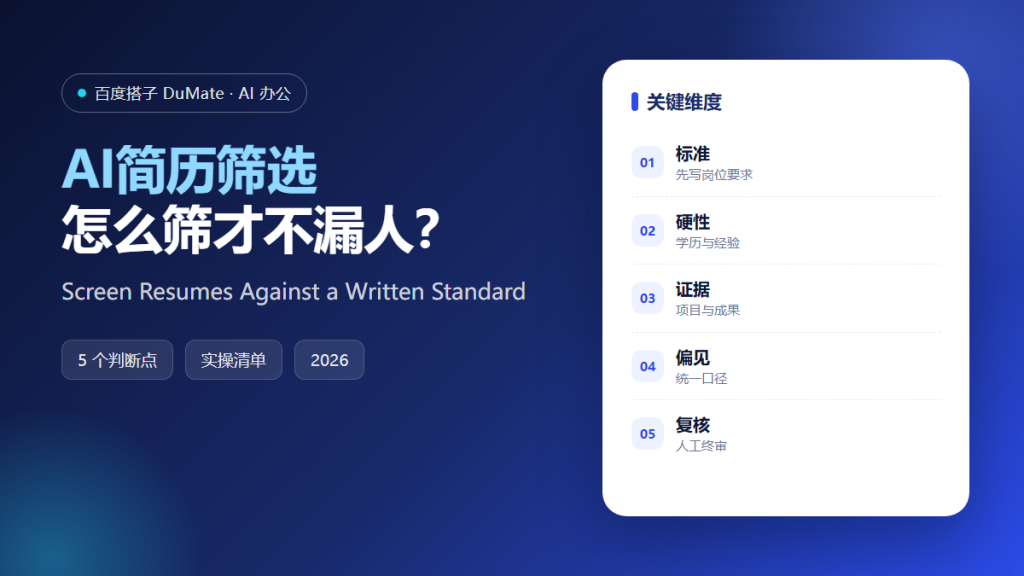
AI简历筛选 is one of the few AI workflows where a mistake has a human cost. Rejecting a strong candidate is not just inefficient; it can be unfair and, in some places, unlawful. The way to use automation here is narrow: apply a written standard consistently, surface evidence, and keep the final judgment with a person.
This guide explains the five-step screening process we recommend, the scoring table that keeps reviewers aligned, and the risks to document before you start.
Key Takeaways
- Write the role requirements before opening resumes.
- Separate must-haves from nice-to-haves.
- Score evidence, not writing style.
- Use one rubric for every candidate.
- Keep a human in the final decision.
Why AI简历筛选 Needs a Written Standard
Hiring teams believe they share a definition of a strong candidate until they compare notes. One reviewer weights a prestigious employer, another weights a specific project, and a third weights years of experience. The disagreement is invisible until the shortlist arrives, and then it becomes a debate about candidates instead of a debate about criteria.
AI简历筛选 makes this problem worse if the criteria are vague, because the tool will infer a pattern from the resumes themselves. That pattern may reflect the language of the last hire rather than the needs of the role. Writing the standard first turns the tool into a filter instead of a mirror.
There is also a documentation benefit. When the criteria and scores are written down, you can explain why a candidate advanced and why another did not. That record protects the candidate, the reviewer, and the company.
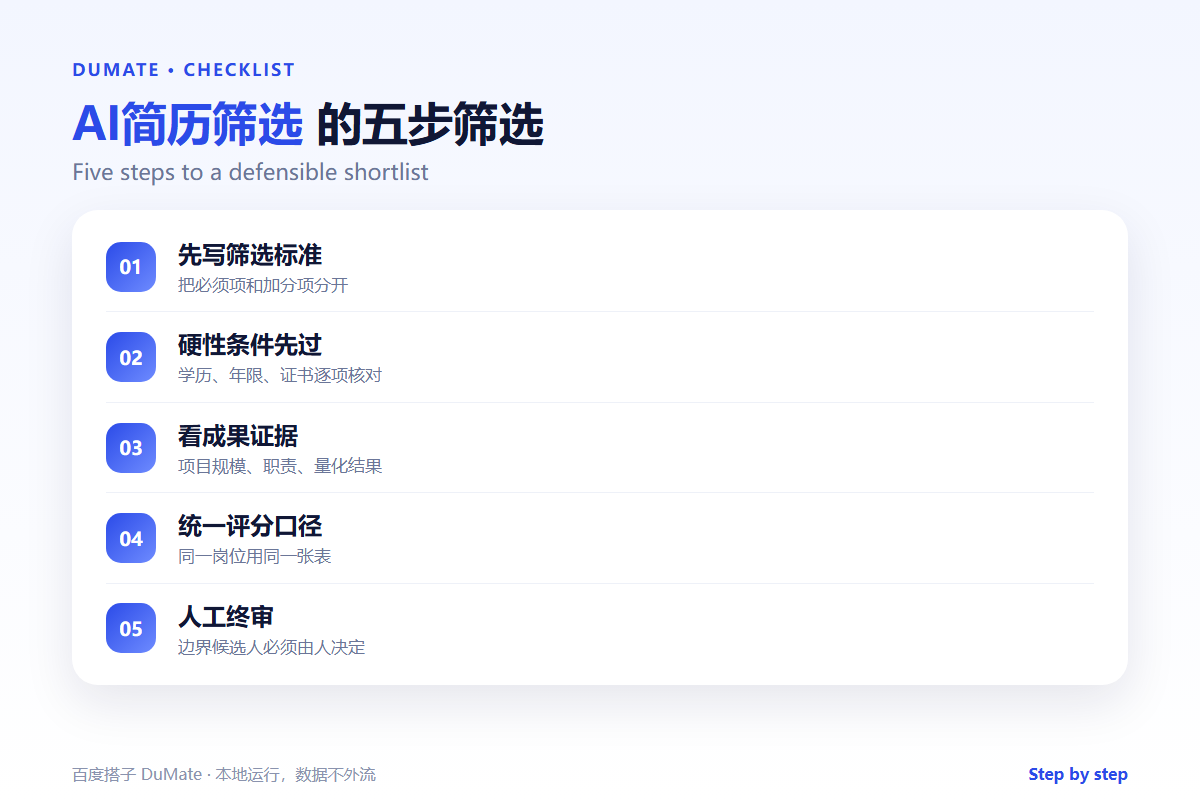
How AI简历筛选 Works in Five Steps
Step 1: Write the role requirements
List the outcomes the role must deliver in the first year. Then translate each outcome into a requirement. If a requirement cannot be traced to an outcome, it probably belongs in a wish list, not in the screening standard.
Step 2: Separate must-haves from nice-to-haves
Mark each requirement as required or preferred. Required items are pass or fail. Preferred items contribute to a score. This distinction prevents a candidate with one missing keyword from being rejected despite strong evidence elsewhere.
Step 3: Score evidence, not presentation
Look for specific projects, scope, and measurable results. A resume that lists responsibilities is weaker than one that describes outcomes. AI简历筛选 can extract these signals, but a reviewer should confirm that the evidence is real rather than a well-written summary.
Step 4: Use one rubric for everyone
Score each candidate on the same dimensions with the same scale. Record a short note for each score so the reasoning is visible. When two reviewers disagree, the notes show whether the difference is about evidence or about interpretation.
Step 5: Keep the final decision human
Automation can rank and summarize. It should not reject. A person reviews the borderline cases, checks for missing context, and makes the call. This is both fairer and more accurate, because context often lives outside the document.
A Simple Scoring Rubric
- Required skills: pass or fail.
- Relevant outcomes: one to five.
- Scope and ownership: one to five.
- Evidence quality: one to five.
- Notes: one line per score.
Where AI简历筛选 Goes Wrong
The biggest risk is proxy discrimination. A model can learn correlations from names, schools, or employment gaps that have nothing to do with performance. The second risk is keyword bias, where a candidate who uses different terminology is screened out despite equivalent experience. The third is automation bias, where reviewers accept a ranking because it looks objective.
- Filters that encode historical preferences.
- No audit trail for rejections.
- Unchecked assumptions about career gaps.
- Judging writing style as competence.
Before and After
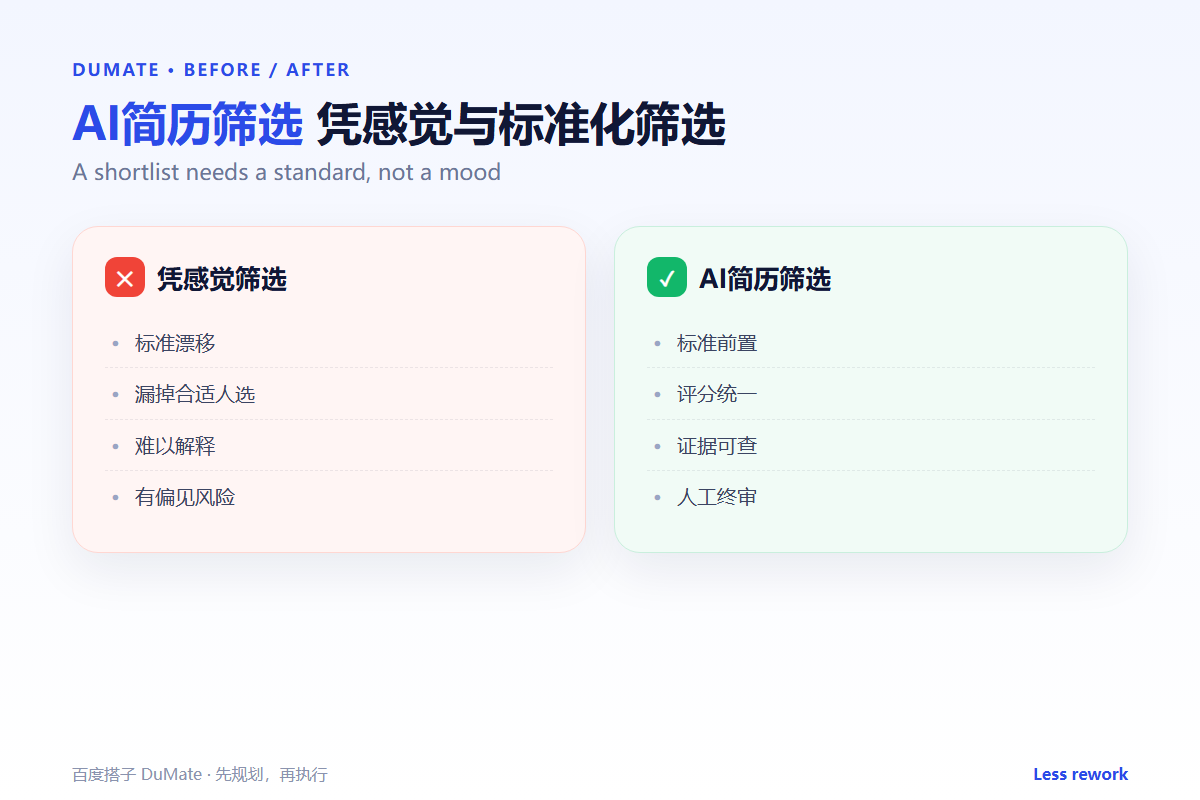
Before, three reviewers read the same resumes and produced three different shortlists. After, the team agrees on a rubric, AI简历筛选 extracts evidence into a consistent format, and reviewers discuss the borderline cases with notes in front of them. The process takes less time and produces a shortlist the team can explain.
The goal is not to remove judgment. The goal is to spend judgment on the cases that deserve it.
Write down the reason for every rejection, even when the reason is obvious. A short note turns AI简历筛选 from a black box into a documented process, and it helps the next reviewer calibrate.
Review the rubric after every ten candidates. If two reviewers consistently disagree on one dimension, the definition is probably unclear. Fix the rubric before adding more AI简历筛选 automation.
Keep candidate data access tight. Screening files contain personal information, so limit who can open them and delete them when the hiring process ends. A fair AI简历筛选 process is also a careful one.
Finally, ask candidates for feedback on the process. Their answers often reveal friction that the hiring team cannot see, and that feedback is free.
Treat AI简历筛选 as a filter that produces questions, not answers. Every shortlisted resume should generate two interview questions, and every rejection should generate a note. That habit keeps AI简历筛选 useful and keeps the final decision human. A written standard is what makes AI简历筛选 defensible when a candidate asks for feedback.
FAQ
Can AI简历筛选 make the final decision?
No. Use it to organize and rank. A person should make every rejection and every offer.
What should we document?
The criteria, the rubric, the scores, and the reason for rejection. Keep the record for as long as your legal team requires.
How do we handle career gaps?
Do not score them unless the role has a genuine recency requirement. If it does, state the requirement in advance.
延伸阅读
Once the shortlist is ready, design the interviews with AI面试题生成. For document handling, see AI文档处理. Keep hiring notes in an AI知识库. Access to candidate data should follow AI权限管理. For the broader office context, read AI办公助手. External references: NIST AI Risk Management Framework and ISO/IEC 42001.
评论
还没有评论,来说两句吧。以下为本文的引用通告: