
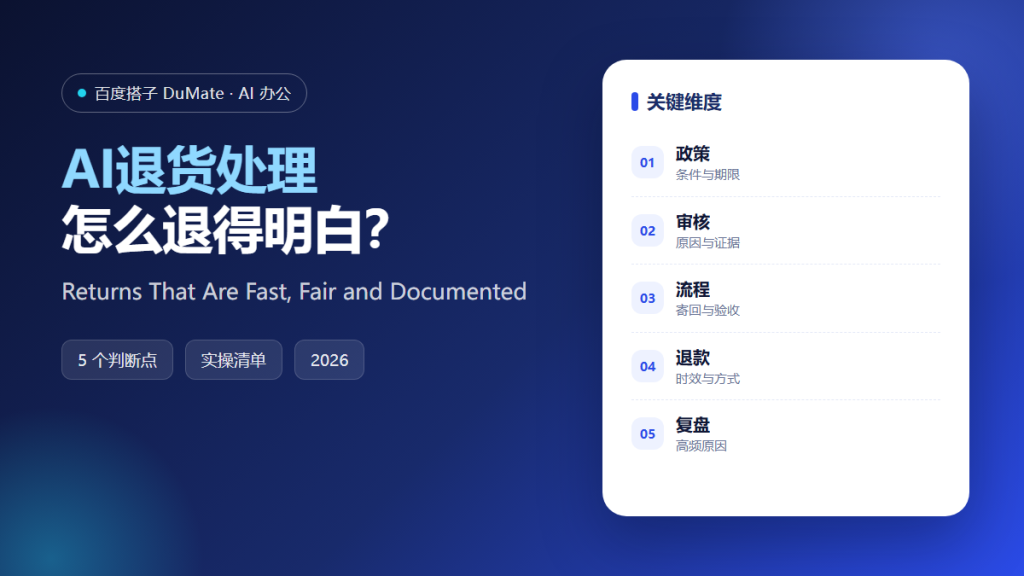
AI退货处理 is judged by two numbers that pull in opposite directions: the hours a customer waits and the money the company writes off. Speed without a rule invites abuse, and caution without speed turns a small fault into a public complaint. AI退货处理 works when the policy is written before the request arrives, not after a manager has been asked to make an exception.
This guide sets out a five-step routine for AI退货处理, the evidence each decision should leave behind, and the failure modes that turn a generous policy into a permanent discount.
Key Takeaways
- Publish the eligibility rule in one sentence.
- Record the reason in the customer’s own words.
- Decide from evidence, not from the tone of the message.
- Send the label in the same reply as the decision.
- Log every exception and review them monthly.
Why AI退货处理 Needs a Written Policy
A returns desk makes the same decision hundreds of times a week, and without a written rule each agent invents a version. AI退货处理 can only apply a policy that exists in text, with conditions and examples, because a system given nothing but the instruction to use judgement will answer differently on Tuesday than it did on Monday.
Fairness is the second reason. A customer who bought through a marketplace and one who bought in a store should receive the same answer for the same fault. AI退货处理 is useful precisely because it applies one rule to both channels and can show the paragraph it used.
The third reason is evidence. A refund without a reason code cannot be recovered from a supplier, audited, or used to fix a product. AI退货处理 should attach the photo, the order line, and the reason to the decision record, which turns a cost into information.
How AI退货处理 Works in Five Steps
Step 1: Publish the rule
Write eligibility as a short table: window, condition, proof, outcome. Publish it where customers can read it, and put the same text behind the support macro. A rule that lives only in a training slide is a rule nobody can appeal, and an unpublished rule invites the argument you were trying to avoid. Keep the table to one screen, because a rule that needs scrolling will be paraphrased by whoever is busiest.
Step 2: Capture the reason
Ask one open question and keep the answer verbatim. A dropdown list helps reporting, but the sentence explains the fault, and the sentence is what a designer or a supplier will read later. AI退货处理 can map the sentence to a category without discarding it, so the record keeps both the code and the story. The question should not suggest an answer, since a leading question produces the reason you expected.
Step 3: Check the evidence
Compare the claim with the order, the delivery date, and any photos. Flag mismatches rather than rejecting them outright, since a mismatch often means a gift order or a replacement shipment. A person reviews flagged cases within the day, and the customer receives a status note instead of silence. The photo should show the fault rather than the whole product, and it should be taken before the item is packed.
Step 4: Choose one of three outcomes
Refund, replace, or repair. Each has a cost and a message template. Deciding the outcome before writing the reply prevents the common habit of promising a refund and then negotiating the amount. The template should name the next step and the date, so the customer stops wondering whether anyone is working on it. Say what happens to the item as well, because a refund without a collection plan leaves a box in the hall.
Step 5: Close the record
Store the reason code, the outcome, the cost, and the date. AI退货处理 can then report which fault drives the most cost, which is the only version of a returns report that product teams read. Group the report by supplier and by product line, and send it monthly to the people who can change a specification. A report nobody opens is a filing exercise, so put the top three lines in the message itself.
‘ alt=’AI退货处理 checklist: written rule, reason code and decision record’ />
A Returns Checklist
- The rule is public and short.
- The reason is recorded in the customer’s words.
- Photos and order data are attached.
- The outcome is one of three, not a negotiation.
- The record is closed with a reason code.
Where AI退货处理 Fails
Failure usually arrives from the edges. A policy written for one market is applied to another, a high-value order bypasses the rule, and the exception becomes the precedent. AI退货处理 keeps working; the policy quietly stops existing.
- No proof requirement, so the same customer repeats the claim.
- Fully automated denials with no appeal route.
- Reason codes so broad that every return looks identical.
- No link between return cost and supplier chargeback.
Before and After
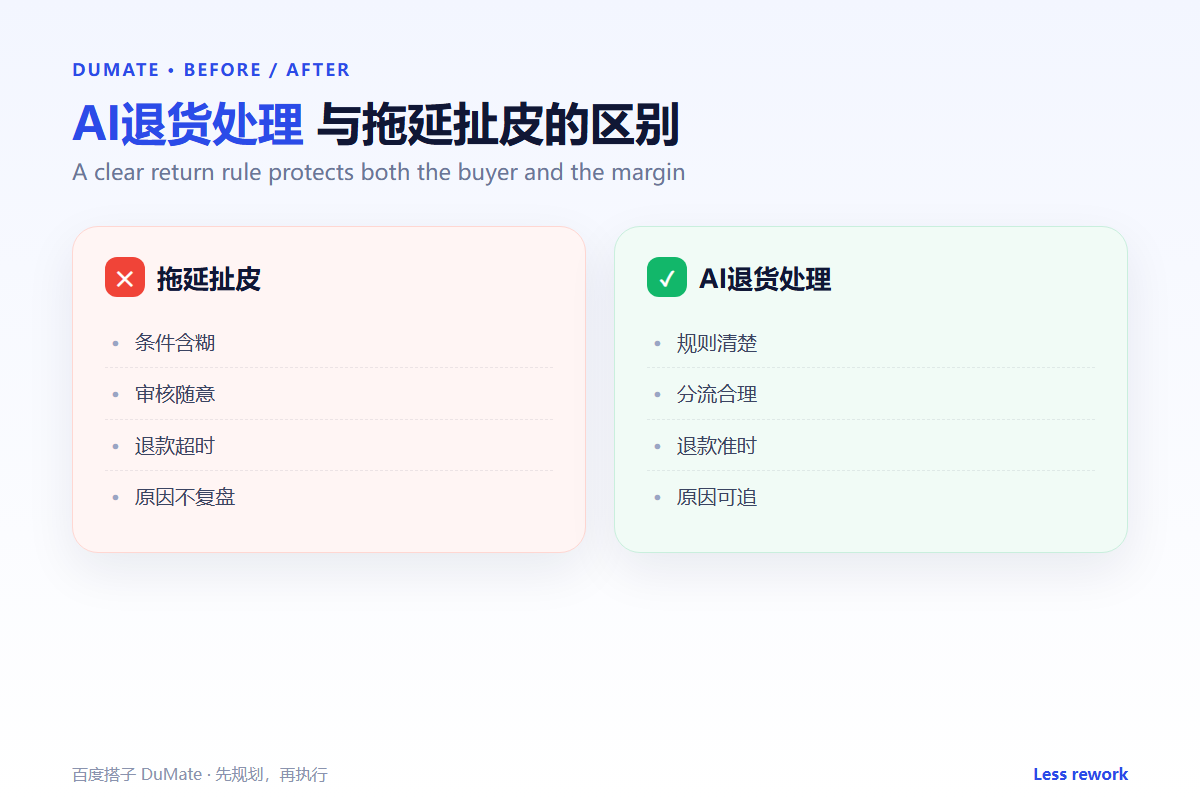
Before, a shoe retailer answered returns by email, and two agents handled the same request differently within an hour. Customers learned to ask twice.
After, AI退货处理 applied one table, asked for a photo once, and sent the label in the first reply. Return cost per order fell, but the larger gain was a defect list that sourcing could use.
FAQ
Does a generous policy increase abuse?
Usually not. Abuse grows where the rule is unclear, because ambiguity invites argument. AI退货处理 with a clear window and a proof requirement is easier to defend than a case-by-case favour.
How fast should a decision arrive?
Within one business day for a complete request. Anything slower invites a second message and a public review.
What should be automated first?
The eligibility check and the label. Keep the final decision with a person until the reason codes are stable.
延伸阅读
For the policy text itself, see policy briefing. Inventory consequences are covered in inventory forecast, and buyer history in customer profile. Retention risk is in churn warning, while the wording of the reply is in product copy. External references: NIST AI Risk Management Framework and ISO/IEC 42001.
评论
还没有评论,来说两句吧。