
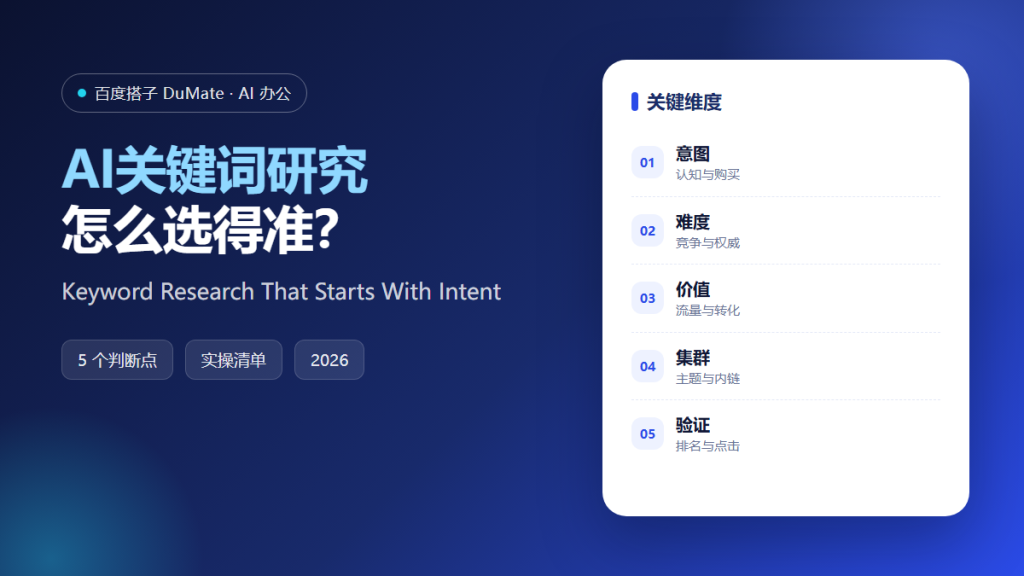
AI关键词研究 usually begins with a volume column, and that is the first mistake. A phrase with forty thousand monthly searches can be worthless if the people typing it want a definition, a free template, or a job. The number describes how many people ask; it says nothing about what they will do next.
This guide explains how to sort phrases by intent before size, the five steps that produce a list a writer can use, and the signals that a keyword is attracting the wrong crowd.
Key Takeaways
- Read the results page before the volume figure.
- Give every intent its own page.
- Mine support tickets and sales calls for phrasing.
- Keep a reject list with reasons.
- Review the list every quarter.
Why AI关键词研究 Needs an Intent Sort
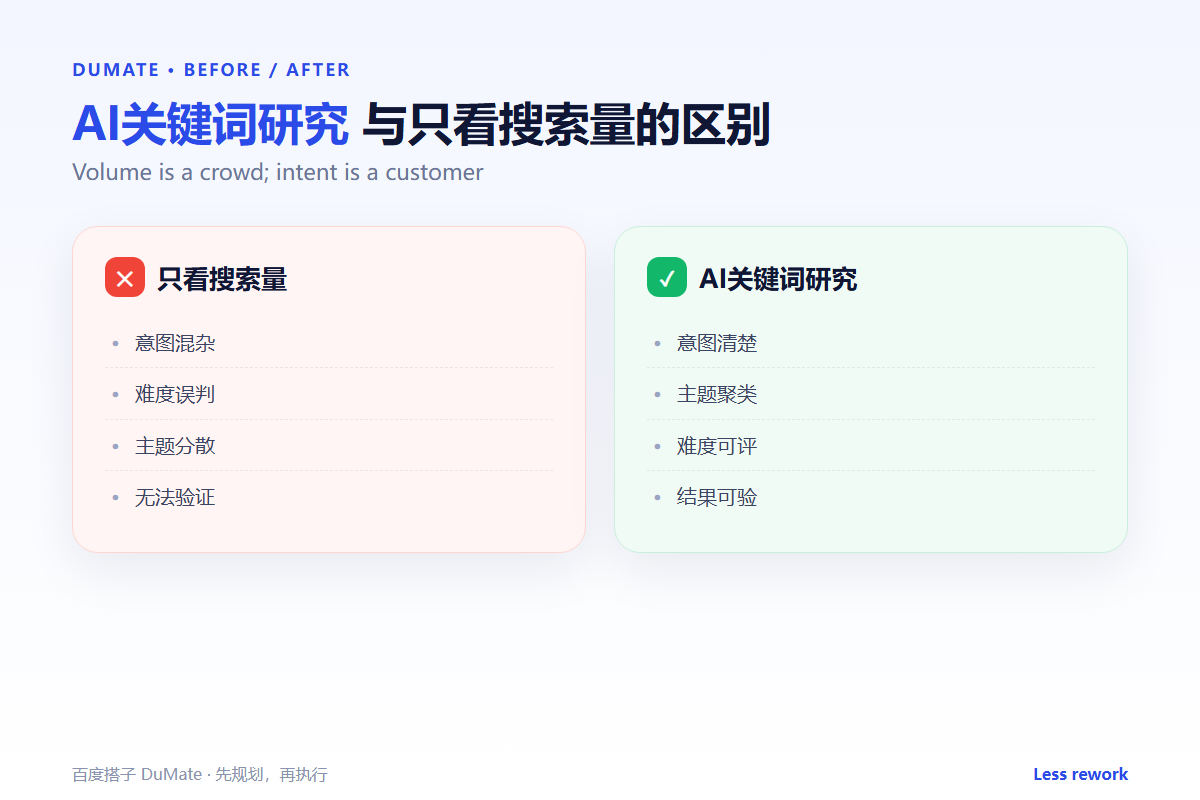
Search volume measures curiosity at a moment, not readiness to act. The same word can serve a student writing an essay and a manager comparing vendors, and a page written for one will frustrate the other. AI关键词研究 that ranks phrases by size alone pushes the team toward crowded head terms and away from the specific questions that convert. AI关键词研究 is a filter, not a catalogue.
Intent sorting also tells you what the page must contain. A comparison query needs a table, a price query needs a number, and a problem query needs a diagnosis before a pitch. When the shape of the answer is clear, AI关键词研究 stops producing topics and starts producing briefs, which is the only output a writer can use without a meeting.
Finally, a documented intent decision protects the team later. When a page underperforms, the first question is whether the phrase ever matched the offer. AI关键词研究 keeps that reasoning next to the phrase, so a review can separate a bad keyword from bad execution instead of blaming both. A list without that reasoning turns every review into a debate about memory.
How AI关键词研究 Works in Five Steps
Step 1: Collect the language customers use
Read support tickets, chat logs, and recorded sales calls for the words people choose when they are not trying to impress anyone. Those phrases are longer and less polished than tool suggestions, and they carry the intent in plain form. AI关键词研究 should start from that raw material, not from a suggestion list. Add them to the list before opening any volume estimate.
Step 2: Label each phrase by job
Sort every candidate into a small set of jobs: learn, compare, price, fix, or buy. If a phrase fits two jobs, split it into two entries, because the page that answers one will not answer the other. AI关键词研究 uses that label to decide the page type, the call to action, and the depth of evidence required.
Step 3: Read the page that already ranks
Look at the top results and ask what format the engine is rewarding: a list, a calculator, a product page, or a forum thread. If every result is a guide, a sales page will struggle no matter how good the copy is. Match the format first, then improve on it.
Step 4: Let AI关键词研究 draft the brief
Turn each intent into a one-page brief: the question, the reader, the evidence needed, and the action at the end. AI关键词研究 is fast at clustering and slow at judgment, so a person should confirm the labels and the priority order before any writing begins.
Step 5: Size last, then prune
Only after the list is sorted should volume decide the order of work. Remove phrases the business cannot serve, phrases that attract free-seekers with no path to revenue, and phrases whose results page is owned by marketplaces. A short list with reasons beats a long export nobody trusts. The order of work should follow what the business can serve, not what the export ranks highest.
‘ alt=’AI关键词研究 checklist: intent label, page format and brief’ />
A Keyword Review Checklist
- Each phrase has one intent label and one owner page.
- The format matches what already ranks.
- The offer can satisfy the question honestly.
- Phrases are grouped by job, not by alphabet.
- Rejected phrases carry a written reason.
Where AI关键词研究 Fails
It fails when a single export becomes the strategy. A list of thousands of phrases, sorted by a number, invites the team to write thin pages for each one, and those pages compete with each other for the same visitor.
- Treating volume as demand.
- Ignoring the results page format.
- Chasing phrases the product cannot serve.
- Never removing pages that lost their intent.
Before and After
Before, a team built a content calendar from a volume export and published thirty posts in a quarter. Traffic rose, trials did not. After, AI关键词研究 was used to label each phrase by job, and the team published eight pages, each one answering a question a buyer had actually asked.
The second quarter produced fewer visits and more revenue, because the list had stopped pretending that curiosity and intent were the same thing.
FAQ
How many keywords should one page target?
One primary intent, with related phrasing used naturally in the body. Pages that chase several jobs usually answer none of them well.
Are paid tools required?
No. Support tickets, search suggestions, and the results page will carry most of the work. Tools help with scale, not with judgment.
How often should the list change?
Review it quarterly, and after any product change that alters what the business can honestly promise. AI关键词研究 is a maintenance habit, not a one-time project.
延伸阅读
To turn a brief into a page that sells, see product copy. Message testing is covered in ad copy. For the buyer behind the query, read customer profile, and for grouping them by need, user segmentation. Listening to how people describe problems is covered in sentiment monitoring. External references: NIST AI Risk Management Framework and ISO/IEC 42001.
评论
还没有评论,来说两句吧。