
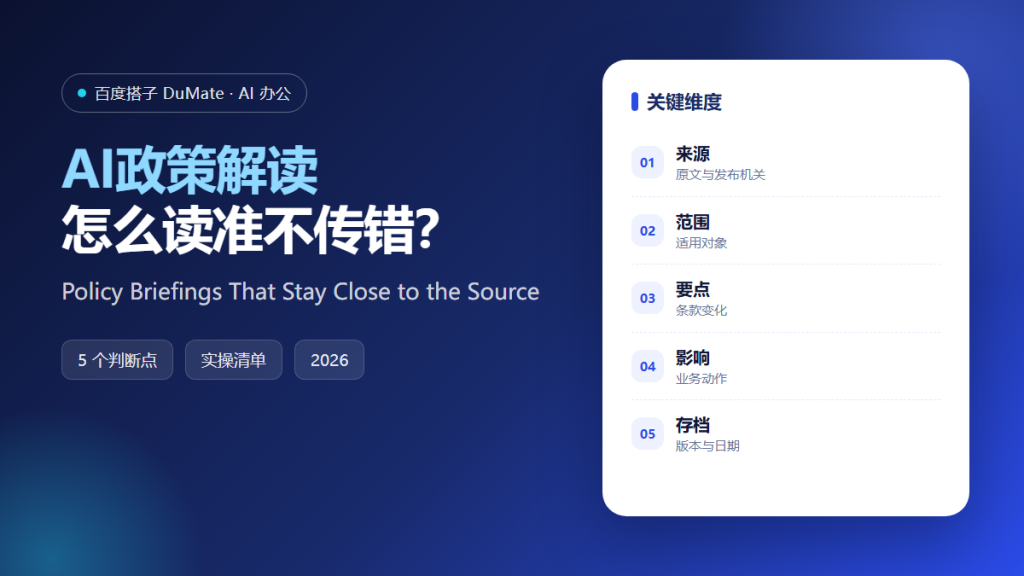
AI政策解读 is risky when it becomes a summary of a summary. Policies are written with precise scope, dates, and exceptions, and a paraphrase can drop the one clause that matters. The safe approach is to start from the original text and end with a short list of business actions.
This guide covers a five-step reading method, the parts of a policy that are most often missed, and the archive habit that keeps old interpretations from circulating.
Key Takeaways
- Read the original document, not a commentary.
- Identify the issuing body and the document number.
- Mark who must comply and who may opt in.
- Compare with the previous version.
- Record the date and keep the source.
Why AI政策解读 Needs the Original Text
Secondary summaries are useful for orientation and unreliable for compliance. They often omit effective dates, transitional rules, and definitions. AI政策解读 should be applied to the source text, with the summary checked against it.
The second reason is change. Most policy work is about what changed, not what the policy says in general. A comparison with the previous version is more useful than a fresh summary.
How AI政策解读 Works in Five Steps
Step 1: Confirm the source
Check the issuing body, the document number, and the publication date. AI政策解读 should cite these in the output so the reader can verify.
Step 2: Identify the scope
Mark who must comply, who may choose, and who is excluded. Pay attention to definitions of covered entities and activities. AI政策解读 should quote the scope clause rather than paraphrase it.
Step 3: Compare versions
List additions, deletions, and modified wording. A changed verb can change an obligation. AI政策解读 can produce a side-by-side table for review.
Step 4: Translate into actions
Write three actions: a process change, an owner, and a deadline. Keep them specific. AI政策解读 should not invent a deadline that the policy does not set.
Step 5: Archive with dates
Save the source, the summary, and the date. Mark the version so outdated interpretations are removed. AI政策解读 should flag when a newer version exists.

A Policy Brief Checklist
- Issuing body and document number are cited.
- The scope clause is quoted.
- Changes are listed separately.
- Actions have owners and dates.
- The archive records the version.
Where AI政策解读 Fails
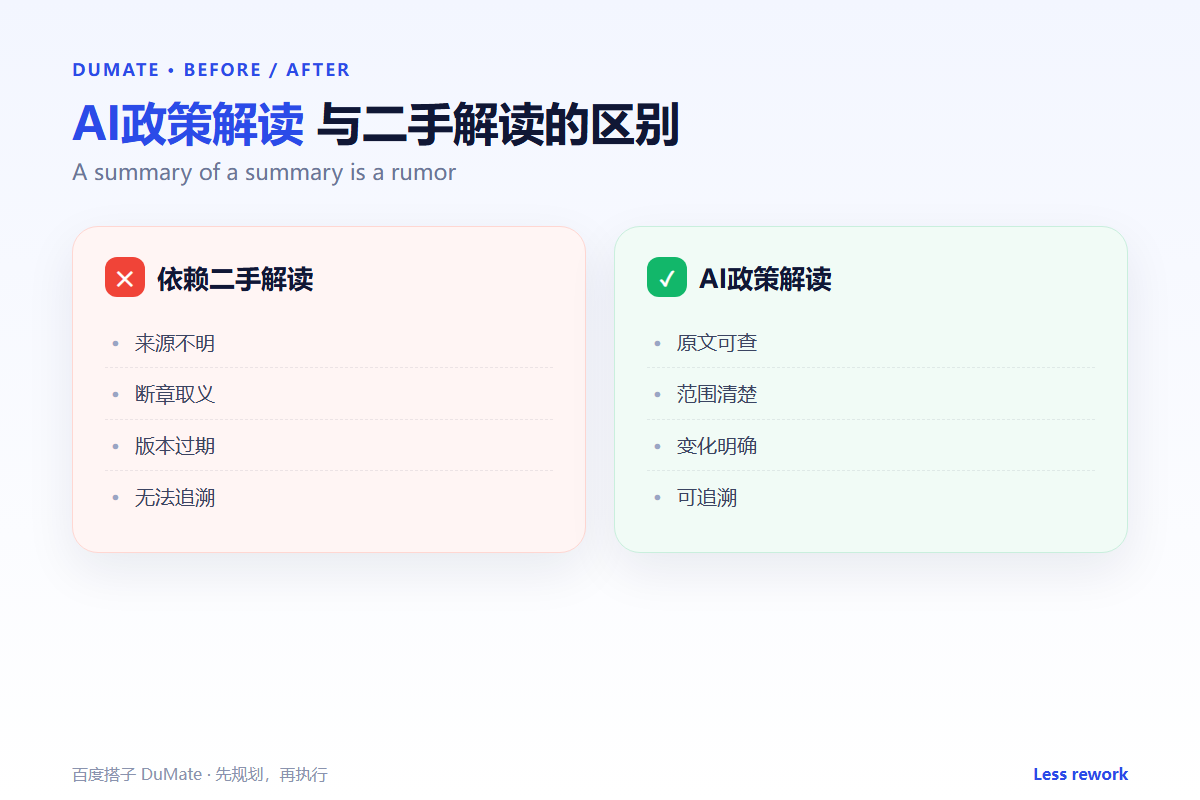
It fails when the model is asked to summarize a policy without the full text. It also fails when the summary merges requirements and recommendations into one list, which makes optional measures look mandatory.
- No source citation.
- Effective dates omitted.
- Recommendations presented as rules.
- Old versions left in circulation.
Before and After
Before, the team relied on a forwarded article and missed a transitional deadline. After, AI政策解读 started from the original text, compared it with the previous version, and produced three actions with owners before the deadline.
The value is not a shorter document. It is a correct one.
Used consistently, AI政策解读 becomes part of the normal review routine rather than a separate project.
A final check with AI政策解读 takes a minute and catches the errors that are easiest to miss.
Making It Stick Across a Team
A rollout fails when only one person knows how to use AI政策解读. Write a short guide with three sections: when to use it, what good input looks like, and what to check before sharing the output. Keep the guide to one page.
Train in pairs. One person runs the task while the other checks the output against the guide, then swap roles. That exercise surfaces unclear steps faster than a presentation. Keep a shared folder with one strong output, one weak output, and a note explaining the difference. AI政策解读 becomes easier to teach when people can compare real cases.
Review the guide after the first week of use. Remove steps nobody follows and add the questions that keep coming up. A living guide is more useful than a perfect one written in advance. Finally, assign an owner. AI政策解读 without an owner drifts, and the guide becomes outdated. The owner does not need to do every task, only keep the standard current. That small responsibility is what keeps AI政策解读 useful after the initial training.
Make the training practical. People learn the workflow by completing a real task, not by listening to a walkthrough. Set aside thirty minutes for practice and review the result together. Measure one thing: how many outputs pass review without correction. That number is a better indicator than attendance.
Keep the first month simple. One task, one owner, and one weekly review are enough to prove the workflow before it spreads across the team.
Write down what changed after each run. A short note is easier to trust than a memory, and it makes the next improvement obvious.
Review the output before it leaves your desk. A two-minute check catches most of the errors that would otherwise come back as questions.
FAQ
Can AI政策解读 replace legal review?
No. It can organize the text and highlight changes. Legal review is still required for obligations and risk.
What if the policy is ambiguous?
Quote the ambiguous clause and ask the issuing body or legal counsel. Do not resolve it with a guess.
How long should a brief be?
One page for the summary, with the source linked. Detail belongs in an appendix.
延伸阅读
For drafting, see AI写作助手. Keep versions in an AI知识库. For distribution, read AI邮件助手. Industry templates are in AI专家套件. For legal boundaries, see AI法律咨询. External references: NIST AI Risk Management Framework and ISO/IEC 42001.
评论
还没有评论,来说两句吧。以下为本文的引用通告: