
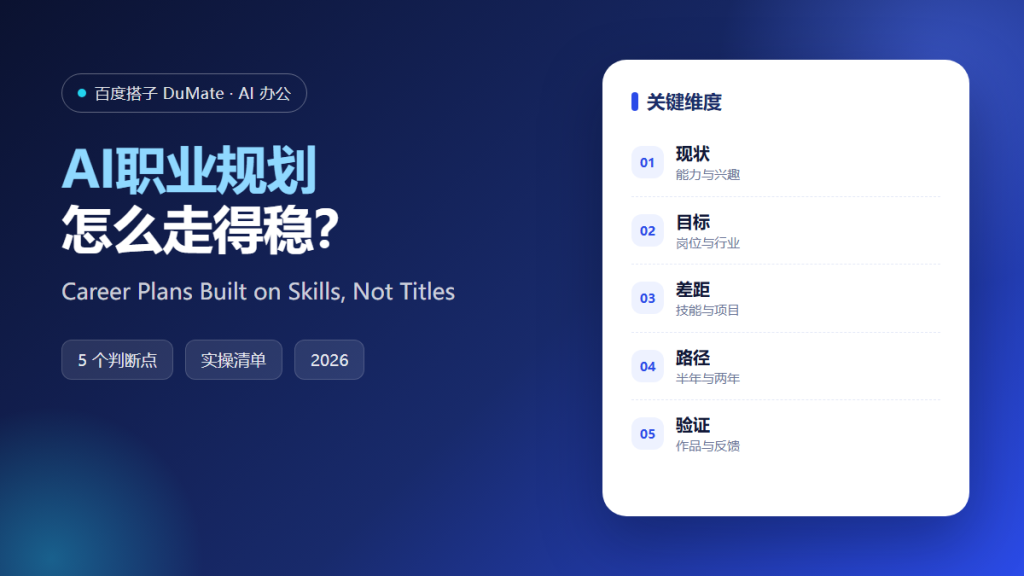
AI职业规划 is more useful when it starts with skills than with job titles. A title is a label attached to a particular organization, and the same label can mean very different work at two companies. Skills, portfolios, and the problems a person can solve travel better than a line on a business card.
This article offers a five-step planning method, a way to test a direction before committing to it, and the traps that turn a career plan into a fantasy document.
Key Takeaways
- List skills you can demonstrate today.
- Choose a direction with real demand.
- Define evidence for each skill.
- Test the direction with a small project.
- Review the plan every quarter.
Why AI职业规划 Needs a Skill Inventory
Most plans begin with a target title and work backward. The problem is that titles hide the actual tasks, and the tasks determine whether a person enjoys the work. AI职业规划 should build an inventory of skills, including the ones the person uses without noticing, before choosing a destination.
A skill inventory also makes gaps visible. Someone who wants to move from support to product management may already have customer insight and troubleshooting experience but lack prioritization and writing practice. AI职业规划 can compare the current inventory with the target role and propose a short list of gaps worth closing.
The third benefit is confidence. A plan based on titles encourages waiting for someone to grant a promotion. A plan based on skills gives the person something to practice this week. AI职业规划 should turn the direction into evidence that can be produced, not a hope that a manager will notice.
How AI职业规划 Works in Five Steps
Step 1: Inventory the present
Write down the tasks you perform well and the tools you know. Add feedback you have received and projects you enjoyed. AI职业规划 can group the list into themes such as analysis, communication, operations, and leadership.
Step 2: Choose a direction
Pick one or two roles that use the strongest themes and have plausible demand. Read real job descriptions and note repeated requirements. AI职业规划 can compare the language across postings and highlight the skills that appear most often.
Step 3: Define the evidence
For each target skill, decide what proof would convince a stranger. A course certificate is weak evidence; a working sample, a published analysis, or a measured improvement is stronger. AI职业规划 can suggest a small artifact for each gap.
Step 4: Run a low-cost test
Spend four to six weeks on a project that resembles the target work. Ask someone in the field for a short review. AI职业规划 can draft the project brief and the questions for the reviewer, but the experience must be real.
Step 5: Review and adjust
At the end of each quarter, compare what you planned with what you produced. Keep the direction if the work was engaging; change it if the test revealed a better fit. AI职业规划 should record the reasons, not just the outcome.
‘ alt=’AI职业规划 checklist: skill inventory, direction, evidence, test and review’ />
A Career Plan Checklist
- Skills are described with examples.
- The target role appears in real postings.
- Each gap has a planned artifact.
- The test fits within six weeks.
- AI职业规划 review dates are on the calendar.
Where AI职业规划 Fails
AI职业规划 fails when the plan is a list of titles with no connection to daily work. It also fails when the person collects courses instead of producing evidence, because another certificate rarely changes how a hiring manager sees the candidate.
- Choosing a direction because it sounds prestigious.
- Ignoring the market and the required experience.
- Planning for a role without talking to anyone in it.
- Reviewing the plan only when a job search begins.
Before and After
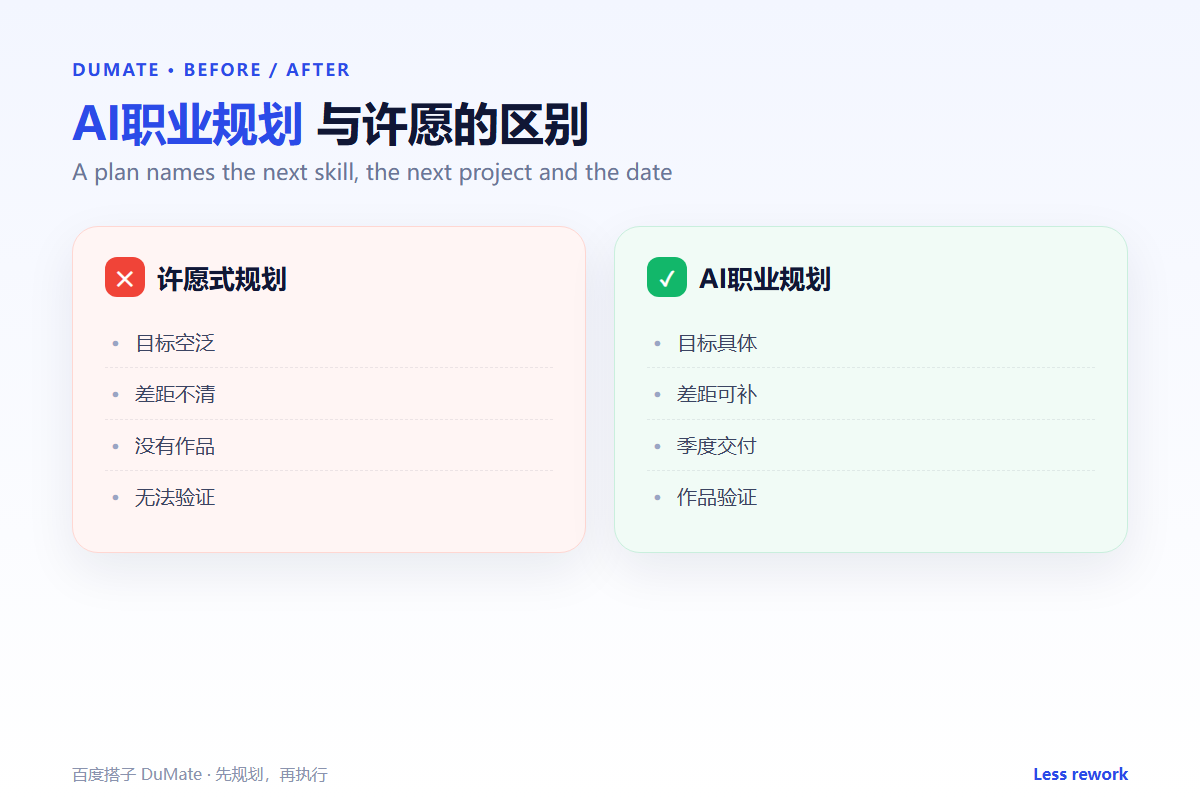
Before, an operations coordinator wanted to become a product manager and spent a year taking introductory courses. The plan listed a title but no proof of product work. After, AI职业规划 helped identify two transferable strengths, customer research and process design, and a six-week project produced a short case study that became the center of every interview.
A career is not a ladder with a fixed set of rungs. It is a series of problems you learn to solve.
Keep the first month simple. One task, one owner, and one weekly review are enough to prove the workflow before it spreads across the team.
Write down what changed after each run. A short note is easier to trust than a memory, and it makes the next improvement obvious.
Review the output before it leaves your desk. A two-minute check catches most of the errors that would otherwise come back as questions.
Keep one example of a good result. New team members learn faster from a concrete reference than from a long explanation.
The first version does not need to be perfect. It needs to be complete enough to review, so the team can see the gaps and fix them in the next round.
Write the review notes in the same place as the work. Notes stored somewhere else are rarely read when the next decision arrives.
FAQ
How often should a career plan change?
Review it every quarter, but change direction only after a real test. Constant rewriting is a form of avoidance.
Do certificates matter?
They help at the entry level and in regulated fields. For most experienced roles, a portfolio and a clear account of results matter more.
What if my manager cannot support the plan?
Use projects, volunteering, and external communities. A plan should not depend entirely on one person’s sponsorship.
延伸阅读
Build a learning rhythm with study plan and explore the field through literature review. Sharpen your written case with official writing and document proofreading. Rehearse the story with speaking practice. External references: NIST AI Risk Management Framework and ISO/IEC 42001.
评论
还没有评论,来说两句吧。