

AI增长实验 is often used to generate ideas, when its real value is to remove them. A hypothesis that cannot fail is a slogan with a number attached, and a test that cannot fail is only a cost. The discipline is to write the belief in a form that Friday could prove wrong.
This guide covers the structure of a killable hypothesis, the five-step routine that keeps a test honest, and the reporting habits that stop a team from explaining away a loss. None of it requires a statistics team, only a decision about what would count as evidence.
Key Takeaways
- Write the belief before the test.
- Attach a metric, a threshold, and a date.
- Choose the smallest test that can fail.
- Decide the stopping rule in advance.
- Record the kill as a result.
Why AI增长实验 Needs Falsifiable Hypotheses
A team that begins with an idea tends to defend it. A team that begins with a statement about behavior can check it. AI增长实验 forces the statement into the open, where the metric, the segment, and the expected size of the change have to be named before anyone builds anything. The naming is most of the work. If the statement is vague, the test will be vague too, and the team will learn a mood rather than a fact.
Falsifiable also means small. If a test needs a quarter and a new billing system, it is not an experiment but a bet, and the result will be impossible to attribute. AI增长实验 should prefer a change that ships in a week and can be read in two.
The third reason is memory. A killed hypothesis is an asset when it is written down with the reason, because it stops the same idea from returning in six months with a new slide. AI增长实验 that records only wins teaches the team nothing about its own market.
How AI增长实验 Works in Five Steps
Step 1: Write the belief as a sentence
Finish the sentence: we believe a specific group will do a specific thing because of a specific change. Keep adjectives out of it. AI增长实验 begins with a claim a colleague could reasonably doubt, and a claim nobody would doubt is not worth testing. A claim about a named group is better than a claim about people in general.
Step 2: Attach the metric and the threshold
Name the number, the current value, the expected value, and the smallest change worth acting on. Without a threshold, every result becomes a discussion. Write the threshold before the test, not after the chart appears and the shape suggests a story. A range is acceptable when the baseline is noisy, but the range has to be chosen before the run.
Step 3: Let AI增长实验 size the test
Ask what sample and duration would show the effect if it exists. AI增长实验 is good at that arithmetic and poor at judging whether the change is worth shipping. Use it for the estimate, then decide with the team that owns the product.
Step 4: Set a stopping rule
Decide in advance what result would end the test early and what would justify one extension. A rule written before the data protects the team from the temptation to keep looking for a better week, which is how noise becomes a strategy. Write the rule in the same document as the hypothesis, where the whole team can see it.
Step 5: Report the kill
When the hypothesis fails, publish the number, the segment, and the reason in the same place the wins are stored. AI增长实验 earns trust when a failed test is reported with the same care as a successful one, and the archive becomes the most useful document the team owns. A short template keeps it readable: belief, change, metric, result, decision.
‘ alt=’AI增长实验 checklist: belief, threshold and stopping rule’ />
An Experiment Review Checklist
- The hypothesis names one behavior.
- The metric existed before the test.
- The threshold is written down.
- The sample matches the segment.
- The result is logged whether it wins or loses.
Where AI增长实验 Fails
AI增长实验 fails when a test is designed to confirm a decision already made. The metric moves, the deck calls it validation, and the underlying doubt survives untouched. The archive fills with stories instead of evidence, and the next quarter repeats the pattern.
- Changing three variables in one test.
- Stopping when the number looks good.
- Testing a change nobody can ship.
- Reporting a lift without the segment size.
Before and After
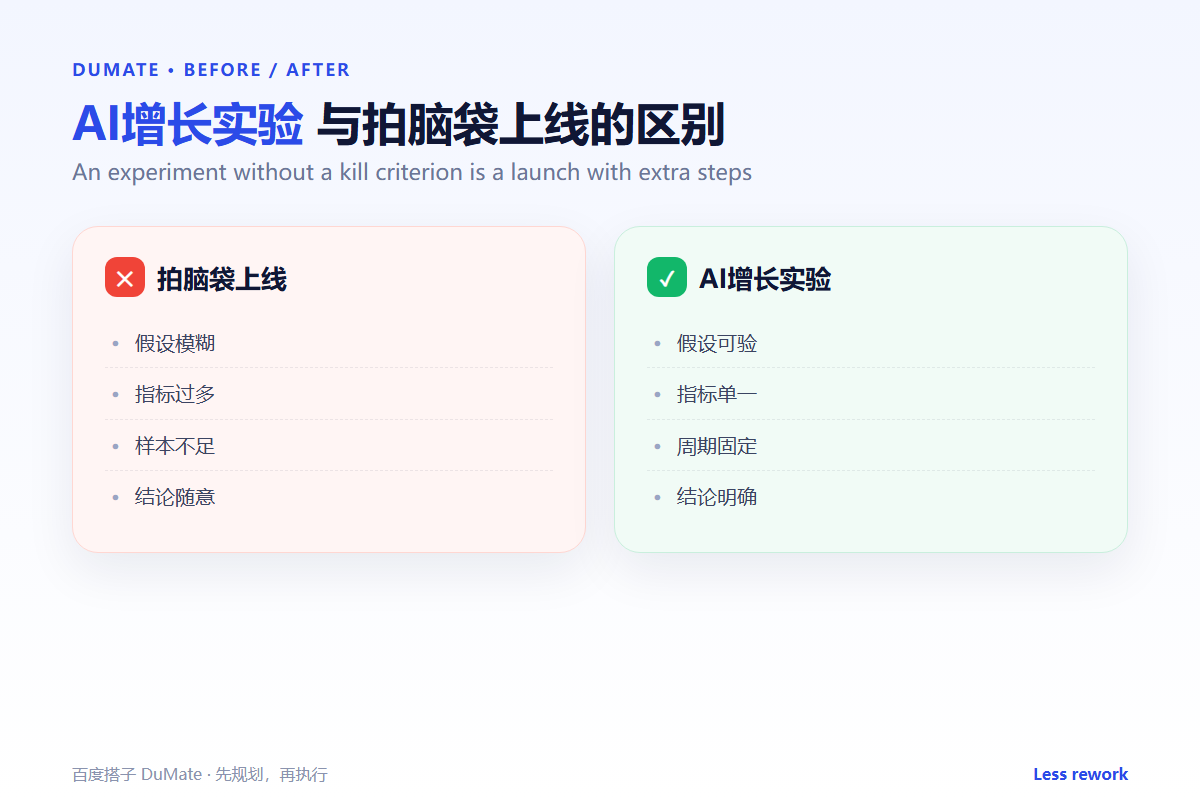
Before, a team spent six weeks rebuilding a checkout flow and called it an experiment, then argued about whether the small rise came from the new layout or the season. After, AI增长实验 was used to test one change to the button label on a single segment, with a threshold agreed in advance.
The second test took four days. It failed, the team killed the idea, and the following test started from a better question. Nobody defended the idea, because the rule had already decided the outcome.
FAQ
How long should an experiment run?
One full business cycle, or until the pre-agreed sample is reached, whichever comes first. Longer is not more rigorous if the traffic is thin.
What if the result is flat?
Flat is a result. Record it, and look at whether the change reached enough of the segment to be visible at all. Look at exposure first, then at the segment, then at the season.
Can qualitative evidence count?
Yes, as a reason to run the test. AI增长实验 needs a number to settle the question, but an interview often supplies the hypothesis worth testing.
延伸阅读
For the checks that keep a release honest, see test cases, and for evidence from real sessions, log analysis. Grouping behavior is covered in data labeling, and demand estimates in sales forecast. For audience definitions, read user segmentation. External references: NIST AI Risk Management Framework and ISO/IEC 42001.
评论
还没有评论,来说两句吧。